


Environmental activists and dozens of Greater Kaohsiung residents yesterday rallied outside the Executive Yuan in Taipei to protest against Premier Jiang Yi-huah’s (江宜樺) remarks on Monday on the government’s plans to address the damage caused by the Greater Kaohsiung gas pipeline explosions and demanding that the premier and Minister of Economic Affairs Chang Chia-juch (張家祝) step down.
Citizen of the Earth executive director Lee Ken-cheng (李根政) told a press conference that the central government’s attitude toward people affected by the blasts shows that it has not reflected upon the mistakes caused by its flawed policies covering the petrochemical industry dating back to more than half a century ago.
Those failed policies were a major contributor to the accident, he said.
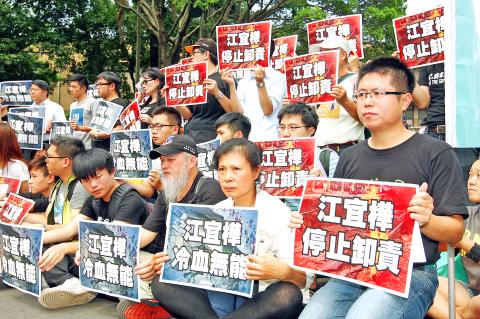
Photo: CNA
“The central government installed the underground pipelines. It has remained their governing authority throughout all these years, but when an accident happens, it shirks all its responsibilities,” he said.
The premier on Monday said there was no need for a special provision bill, financial assistance through a special budget allocation and a dedicated agency to administrate post-disaster relief and reconstruction for Kaohsiung.
On Tuesday he reiterated his opposition in response to requests for special action by Democratic Progressive Party (DPP) lawmakers, and said that the government would establish a 10-member panel of pipeline specialists and establish a national pipeline database instead.
“We are here to tell Jiang Yi-huah and Chang Chia-juch: Since you don’t want any responsibilities, we do not want you to take any, either. We want you to step down,” Lee said.
The group also demanded that the Executive Yuan allocate funds for Kaohsiung relief efforts and provide a credible timetable for its pledge to map the nation’s underground pipeline network.
However, Legislative Speaker Wang Jin-pyng (王金平) told reporters yesterday that he had told DPP caucus whip Ker Chien-ming (柯建銘) and other DPP legislators who had hoped to negotiate with Jiang about post-disaster plans that the central government would allocate funds to cover the city’s compensation and reconstruction costs.
Wang said that Jiang had told him that the impact of the pipeline explosions was as massive as the 921 Earthquake or Typhoon Morakot, so a special budget might not be necessary.
“The premier said the government would draw on its disaster reserve fund, secondary reserve fund for emergency purposes and general budget to fund the relief work,” Wang said.
Executive Yuan spokesperson Sun Lih-chyun (孫立群) said the Executive Yuan declined the DPP legislators’ requests to draft a special provision bill and set up a dedicated agency to monitor relief work because it believes existing laws and regulations are sufficient.
While the Executive Yuan plans to put together a panel of specialists to tackle pipeline-related issues and set up a database for pipeline networks, it would leave the decision of whether to archive and manage the pipelines to the panel, he said.
Meanwhile, Executive Yuan Secretary-General Lee Shu-chuan (李四川) reportedly told yesterday’s Chinese Nationalist Party’s (KMT) Central Standing Committee meeting that the disaster reserve fund allocated to Greater Kaohsiung this year totals about NT$1.94 billion (US$64.6 million), of which NT$190 million has been spent, leaving about NT$1.7 billion.
When reached for comment, Ker confirmed that Kaohsiung has a total of NT$1.7 billion in disaster reserve funds left, which will be used after plans are worked out by the city’s Department of Budget, Accounting and Statistics.
In related developments, National Sun Yat-sen University professor Cheng Ying-yao (鄭英耀) accused the central government of having no compassion.
Greater Kaohsiung is an important city in terms of the nation’s economic development, and the central government is responsible for helping the public, Cheng said.
It should not attempt to evade its responsibility by saying it would not set up special laws, Cheng said.
The university is in Greater Kaohsiung.
Additional reporting by Chen Hui-ping and Jack Chung

Actor Darren Wang (王大陸) was sentenced to six months in prison, commutable to a fine, by the New Taipei District Court today for contravening the Personal Data Protection Act (個人資料保護法) in a case linked to an alleged draft-dodging scheme. Wang allegedly paid NT$3.6 million (US$114,380) to an illegal group to help him evade mandatory military service through falsified medical documents, prosecutors said. He transferred the funds to Chen Chih-ming (陳志明), the alleged mastermind of a draft-evasion ring, although he lost contact with him as he was already in detention on fraud charges, they said. Chen is accused of helping a

SECURITY: Starlink owner Elon Musk has taken pro-Beijing positions, and allowing pro-China companies to control Taiwan’s critical infrastructure is risky, a legislator said Starlink was reluctant to offer services in Taiwan because of the nation’s extremely high penetration rates in 4G and 5G services, the Ministry of Digital Affairs said yesterday. The ministry made the comments at a meeting of the legislature’s Transportation Committee, which reviewed amendments to Article 36 of the Telecommunications Management Act (電信管理法). Article 36 bans foreigners from holding more than 49 percent of shares in public telecommunications networks, while shares foreigners directly and indirectly hold are also capped at 60 percent of the total, unless specified otherwise by law. The amendments, sponsored by Chinese Nationalist Party (KMT) Legislator Ko

UNREASONABLE SURVEILLANCE: A camera targeted on an road by a neighbor captured a man’s habitual unsignaled turn into home, netting him dozens of tickets The Taichung High Administrative Court has canceled all 45 tickets given to a man for failing to use a turn signal while driving, as it considered long-term surveillance of his privacy more problematic than the traffic violations. The man, surnamed Tseng (曾), lives in Changhua County and was reported 45 times within a month for failing to signal while driving when he turned into the alley where his residence is. The reports were filed by his neighbor, who set up security cameras that constantly monitored not only the alley but also the door and yard of Tseng’s house. The surveillance occurred from July

‘SAME OLD TRICK’: Even if Beijing resumes individual travel to Taiwan, it would only benefit Chinese tourism companies, the Economic Democracy Union convener said China’s 10 new “incentives” are “sugar-coated poison,” an official said yesterday, adding that Taiwanese businesses see them clearly for what they are, but that Beijing would inevitably find some local collaborators to try to drums up support. The official, speaking on condition of anonymity, made the remark ahead of a news conference the General Chamber of Commerce is to hold today. The event, titled “Industry Perspectives on China’s Recent Pro-Taiwan Policies,” is expected to include representatives from industry associations — such as those in travel, hotels, food and agriculture — to request the government cooperate with China’s new measures, people familiar with


 RSS
RSS