


The protests against China’s Taiwan Affairs Office Minister Zhang Zhijun (張志軍) in Greater Kaohsiung yesterday turned bloody as a student trying to block his motorcade from leaving the Grand Hi-lai Hotel Kaohsiung was injured in the head, while fierce quarrels broke out between protesters and supporters welcoming his visit.
Despite being flanked by the police wherever he went, protesters were within throwing distance of Zhang when he arrived at Taiwan High Speed Rail Zuoying station at 8:20am to begin his one-day trip in the city and when he got to a resort at Sizihwan (西子灣) to have a chat with Mainland Affairs Council Minister Wang Yu-chi (王郁琦) over tea at night.
Before Zhang arrived at the Zuoying station, the lobby was packed with hundreds of protesters shouting: “Zhang Zhijun, get out of here.”
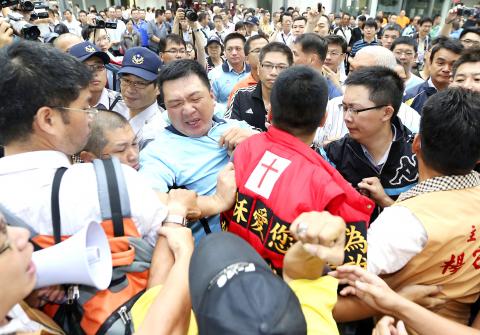
Photo: Reuters
Against them were other groups chanting: “Both sides are one family. Welcome Director Zhang.”
A woman shouted at a man: “Are you not a Chinese? Don’t you have Chinese genes in your blood?”
The man shouted back: “Why am I a Chinese? I am a Taiwanese. If you think you are a Chinese, you might as well go back to China.”
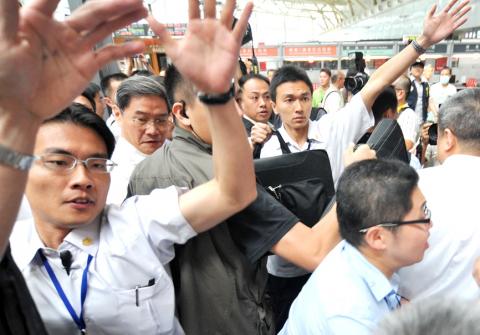
Photo: Huang Chih-yuan, Taipei Times
The police escorted Zhang to leave the station from a side gate, but he was nearly hit by a bottle of water by the other group of demonstrators.
At the Sizihwan Sunset Beach Resort where Zhang was to meet again with Wang, the police were caught unaware when about 100 people organized by the Taiwan Solidarity Union and the Black Island National Youth Front splashed white paint and threw paper money at Zhang’s vehicle.
Zhang was about to alight from the vehicle at that time. He was not hit by the paint, but the vehicle and some of the police and security agents who used umbrellas and bulletproof plates to protect Zhang were splashed with paint.
The protesters held posters that read: “Taiwan, China. One country on each side,” and “The future of Taiwan is to be decided by Taiwanese.”
A protester fainted and was taken away in an ambulance.
Earlier yesterday, National Sun Yat-sen University graduate student Chuang Chen-yang (莊程洋) was sent to a hospital to get 10 more stitches for a 3cm deep wound on his left forehead in a protest outside the Grand Hi-lai where Greater Kaohsiung Mayor Chen Chu (陳菊) sat down with Zhang for a discussion.
At the same time, dozens of people, mostly female Chinese spouses, chanted slogans: “Taiwan, mainland, peaceful unification” at the other side of the square.
Police separated them from the protesters to prevent possible clashes.
When Zhang went to a park in the city for a short visit of 10 minutes, a man waved a national flag of the Republic of China at a distance shouting at him: “Zhang Zhijun, go back to China and bring Ma Ying-jeou (馬英九) back.”
Zhang received a warm welcome when he visited Fo Guang Shan (佛光山), a Buddhist temple, with practitioners in kasaya lining from the entrance and waving flags to welcome him. It was the only venue in which he did not encounter protesters.
Meanwhile, back in Taipei, an unidentified graffiti artist protested by painting the words “NOVOTEL 649” on the wall of Chiang Kai-shek Memorial Hall in Taipei.
It came after Wednesday’s incident in which rights activist lawyer Lai Chung-chiang (賴中強) and members of Democracy Tautin were first asked to leave a room at Taiwan Taoyuan International Airport’s Novotel by hotel staff.
In an unsigned statement sent to the Taipei Times via e-mail, the artist said that what the hotel staff and the police did was something that would only be done by an authoritarian regime, and therefore the protest graffiti was painted on the wall of the building that commemorates a dictator.
Additional reporting by Loa Iok-sin

FUKUOKA SITUATION: Japanese media reported that the pathogen is expected to be identified by the summer, while the CDC downplayed the idea that it was hMPV A “mysterious cold-like illness” reported in Japan’s Fukuoka Prefecture does not seem to be a new disease, but Japanese authorities have been asked about the situation, the Centers for Disease Control (CDC) said yesterday. The Fukuoka Prefectural Medical Association on Wednesday told a news conference that a “mystery cold” that has become a hot topic on social media is “highly likely to be caused by some kind of viral infection,” Japan’s KBC News reported. “Many people are experiencing symptoms starting with a sore throat, followed by a runny nose, phlegm and a severe cough,” KBC News reported, citing association officials. Health authorities are

Nvidia Corp CEO Jensen Huang (黃仁勳) arrived in Taiwan yesterday ahead of upcoming AI and technology events, saying he plans to meet with clients and Taiwan Semiconductor Manufacturing Co Chairman C.C. Wei (魏哲家) during his visit. After landing at Taipei Songshan Airport, Huang posed for photos with fans and handed out Yakult drinks to reporters and supporters waiting at the scene, saying he has “a lot to do” during the trip. Asked about reports that Nvidia’s planned headquarters site in Taipei’s Beitou Shilin Technology Park could break ground on May 27, Huang said that if the company holds an event, he would

The Ministry of Finance this afternoon announced the winning numbers for the March-April uniform invoice lottery. The winning number for the NT$10 million (US$318,060) special prize is 19531471, and the winning number for the NT$2 million grand prize is 85941329. Three numbers were drawn for the NT$200,000 first prize: 07225810, 20231230 and 83518781. Those with receipts matching the last seven digits of any of the first-prize numbers will win the NT$40,000 second prize, while those matching the last six digits will win the NT$10,000 third prize. Those whose receipts match the last five digits of the first-prize numbers can claim the NT$4,000 fourth prize,
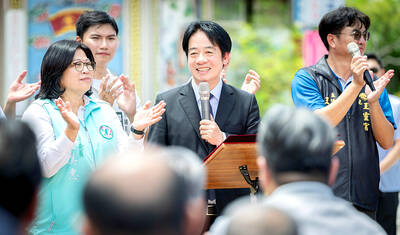
SIX SUBSIDIES: The monthly allowance for older farmers is to increase to NT$10,000, and NT$5,000 is to be given to homemakers under the national pension system, Lai said The government is to implement major welfare policies for disadvantaged groups, including raising the monthly allowance for older farmers to NT$10,000 and providing homemakers with NT$5,000 per month, President William Lai (賴清德) said yesterday. Lai made the remarks during a visit to Wangling Temple in Chiayi County, saying that the planned increases were being introduced amid economic growth and an increase in tax revenue. Touting a policy, in which the government plans to provide a monthly allowance of NT$5,000 for every child under the age of 18 in a bid to address Taiwan’s low birthrate, Lai said that if received for the


 RSS
RSS