


The US is “watching with interest” as China’s Taiwan Affairs Office Minister Zhang Zhijun (張志軍) visits Taiwan for the first time this week, US Assistant Secretary of State for East Asia Daniel Russel said on Wednesday.
Russel unveiled Washington’s seemingly cautious approach to the politically sensitive trip after testifying before the US Senate Committee on Foreign Relations on the future of US-China relations.
In an interview conducted in the corridor outside the committee chamber, Russel said Washington was always interested in developments in cross-strait relations.
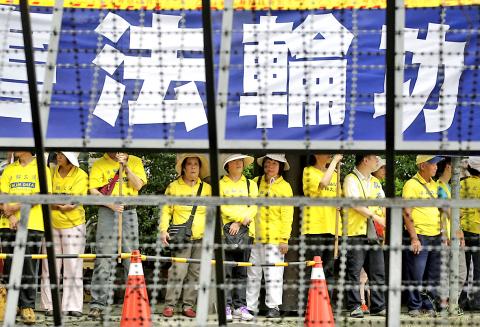
Photo: Reuters
“We will look forward to hearing the outcome of Mr Zhang Zhijun’s visit to Taiwan,” he said.
A US Department of State source later told the Taipei Times that the US expected a full briefing on the visit from President Ma Ying-jeou’s (馬英九) administration.
When members of the Asian press asked Russel if Washington views the visit as a positive development, he said: “We welcome all steps forward on cross-strait relations that are acceptable to the people on both sides of the [Taiwan] Strait.”
He said he had testified before the Senate committee as part of “the runup” to the strategic and economic dialogue that US Secretary of State John Kerry is to hold in Beijing next month.
“What I tried to convey was that the US places great importance on the US-China relationship as being the context of our overall Asia-Pacific rebalance strategy,” Russel said.
The US official said Washington aims to develop practical areas of cooperation as it bids to manage inter-nation differences in a way that reinforces and supports international law in situations such as the territorial disputes between competing claimants in the South and East China seas.
“This is a very important issue for the [US President Barack] Obama administration, for the region and for the US Congress,” he said. “Everyone is of the view here that the claims must be verified, and the differences must be resolved peacefully, and the behavior of all parties in the region must be governed by a sense of restraint and responsibility and care.”
During his testimony, Russel said Beijing’s neighbors are “understandably alarmed” by China’s increasingly coercive efforts to assert its claims in the contested waters.
“A pattern of unilateral Chinese actions in sensitive and disputed areas is raising tensions and damaging China’s international standing,” he said.
Russel said that some of China’s actions were directed at US allies and that Washington has key interests at stake in the region, including freedom of navigation and over-flight, unimpeded lawful commerce, respect for international law and the peaceful management of disputes.
As a rising power, China should hold itself to a high standard regarding its behavior, Russel said.
“To wilfully disregard diplomatic and other peaceful ways of dealing with disagreement and disputes in favor of economic or physical coercion is destabilizing and dangerous,” he said.
Disputes should be decided on the merits of China’s and other claimants’ legal claims, along with adherence to international law and norms, not the strength of the competing countries’ military and law enforcement, nor the size of their economies, he added.
Rusel also criticized China’s human rights record and its “harsh crackdown” on commemorations of the 25th anniversary of Tiananmen Square Massacre.

NATIONAL SECURITY: Authorities are working to confirm the identities of the military personnel involved and investigating possible illegal conduct and regulatory violations Authorities are probing possible national security implications after Kinmen police and immigration officers on Sunday found a Chinese woman allegedly posing as a tourist while engaging in prostitution involving more than 10 military personnel. The woman, surnamed Chen (陳), has since been deported, authorities said, adding that investigators are still working to confirm the identities of those implicated, as the records only listed code names and aliases. The case stemmed from a report received by the Kinmen District Prosecutors’ Office on Friday last week from the Jinhu Precinct of the Kinmen County Police Bureau. On Sunday, police, along with the National Immigration

GLOBALGIVING: ‘ Caving to external pressure is not acceptable for an organization that has cultivated justice reform and human rights for 30 years,’ one NGO said A slew of non-government organizations (NGOs) have withdrawn from the GlobalGiving fundraising platform after it announced it would use “Chinese Taipei” instead of “Taiwan” from next month. The Taiwan Good Rice Association wrote on Facebook on Friday that it was informed on April 28 via a teleconference call of the change, which was made because the platform wanted to operate in China. Taiwan Good Rice is to terminate all cooperative relationships with GlobalGiving in response to the platform’s “unilateral and non-negotiable” decision to remove references to Taiwan, the NGO said. “Taiwan is in the official name of Taiwan Good Rice Association and the
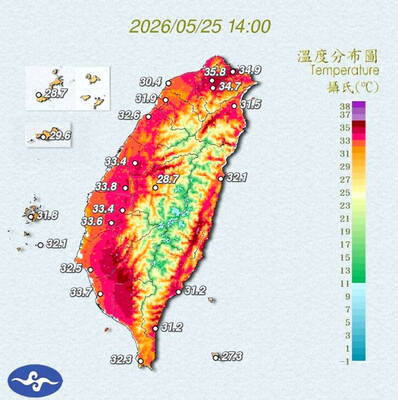
STAY COOL: The HPA recommended that people stay hydrated, use air-conditioning or fans while indoors, wear loose-fitting clothes and walk in the shade while outdoors Employers must implement measures such as installing cooling equipment, and providing drinking water and rest breaks for outdoor workers starting from Monday next week, the Taipei Department of Labor said on Sunday. Employers who fail to comply could face fines of NT$30,000 to NT$300,000 under the Occupational Safety and Health Act (職業安全衛生法), the department said. Businesses in Taipei employing fewer than 100 workers, as well as registered self-employed workers with labor insurance coverage, could receive on-site assessments and guidance from occupational safety consultants to help them apply for central government subsidies to implement or improve heat-protection measures, it said. Under the Ministry of

Chinese Nationalist Party (KMT) Chairwoman Cheng Li-wun (鄭麗文) yesterday briefed her party’s Central Standing Committee regarding her scheduled visit to the US between Monday next week and June 16, saying that her purpose would be to persuade the US that the Republic of China (ROC) Constitution was a “one China” constitution that would foster stable and peaceful cross-strait relations. The ROC Constitution is the most important defense for all Taiwanese citizens, as it upholds our democracy and has contributed to our robust economy, which aligns with international and US interests, she said. “We would not be troublemakers and drag the US under,”


 RSS
RSS