


Taipei Rapid Transit Corp (TRTC) is seeking compensation of NT$20.61 million (US$728,000) for the loss of passengers and revenue from the suspect in the killing rampage on the Taipei Mass Rapid Transit (MRT) system last month, the company said yesterday.
Ling Chi-yao (凌啟堯), director of TRTC’s public relations division, said the company filed a petition in the district court in New Taipei City for an order of payment from 21-year-old Cheng Chieh (鄭捷), who is accused of killing four passengers and injuring 24 others in a knife-stabbing spree on the metro rail system’s Bannan Line on May 21.
According to Ling, passenger volumes on the MRT system declined by more than 945,000 within just 10 days after the stabbing incident, with the loss of revenue topping NT$20.61 million.
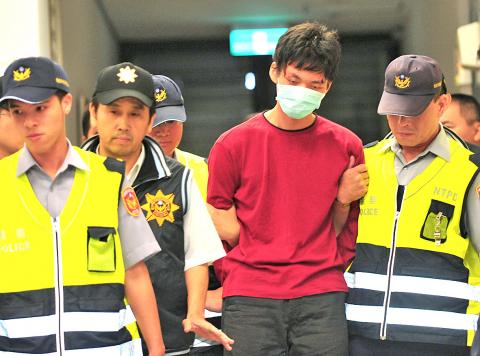
Photo: Liu Hsin-de, Taipei Times
Meanwhile, Taipei Mayor Hau Lung-bin (郝龍斌) said that the restitution will mainly be used to compensate the deceased’s families and passengers who sustained injuries in the incident.
Hau also confirmed that the city government is raising charity funds of NT$8 million from agencies in the central government as well as the private sector for the four passengers killed in the incident. He said that the fund would help increase compensation for the four passengers’ families from NT$5.6 million to NT$7.6 million each.
“I think the Taipei City Government and the TRTC cannot shun their responsibility in helping and comforting the passengers,” Hau said, when asked if it was appropriate for the city government to launch a charity drive.
TRTC on Wednesday night unveiled surveillance footage showing how the company handled the emergency situation on May 21, after an alleged radio conversation between the train driver and the operation control center on the day of the accident was posted online. The alleged conversation showed that the person answering at the operation control center failed to grasp the severity of the situation and ordered the train to move on.
The surveillance footage showed that the operation control center was informed by the driver about an unruly passenger stabbing passengers at 4:26:25pm on May 21.
The center notified the Rapid Transit Division of the Taipei City Police Department 22 seconds later about a passenger wielding a knife and killing passengers.
The footage also showed that the control center twice tried to reach the fire department in New Taipei City at 4:27:27pm. Because the line was busy, the control center personnel then called the Taipei City Fire Department and asked it to relay the message to the fire department in New Taipei City.
Two policemen in New Taipei City entered the Jiangzicui (江子翠) Station, at which the train stopped during the attack, at 4:30:45pm.
The TRTC said that all the evidence is to be verified and examined by prosecutors.
Meanwhile, the killing spree has made some passengers overly vigilant when using the MRT system. Three passengers sustained injuries on Wednesday night during a stampede following a false report about a person being killed on the train. The panic was in fact caused by a 30-year-old passenger suffering an epileptic fit.
A video posted online showed passengers running out of the train as soon as it arrived at the Longshan Temple station.
“Somebody in the back was shouting that someone had been killed,” an injured passenger said. “Then we were told to keep running, but I did not even know what was going on. People fell down while running away and I was hurt too.”

FUKUOKA SITUATION: Japanese media reported that the pathogen is expected to be identified by the summer, while the CDC downplayed the idea that it was hMPV A “mysterious cold-like illness” reported in Japan’s Fukuoka Prefecture does not seem to be a new disease, but Japanese authorities have been asked about the situation, the Centers for Disease Control (CDC) said yesterday. The Fukuoka Prefectural Medical Association on Wednesday told a news conference that a “mystery cold” that has become a hot topic on social media is “highly likely to be caused by some kind of viral infection,” Japan’s KBC News reported. “Many people are experiencing symptoms starting with a sore throat, followed by a runny nose, phlegm and a severe cough,” KBC News reported, citing association officials. Health authorities are

Nvidia Corp CEO Jensen Huang (黃仁勳) arrived in Taiwan yesterday ahead of upcoming AI and technology events, saying he plans to meet with clients and Taiwan Semiconductor Manufacturing Co Chairman C.C. Wei (魏哲家) during his visit. After landing at Taipei Songshan Airport, Huang posed for photos with fans and handed out Yakult drinks to reporters and supporters waiting at the scene, saying he has “a lot to do” during the trip. Asked about reports that Nvidia’s planned headquarters site in Taipei’s Beitou Shilin Technology Park could break ground on May 27, Huang said that if the company holds an event, he would

The Ministry of Finance this afternoon announced the winning numbers for the March-April uniform invoice lottery. The winning number for the NT$10 million (US$318,060) special prize is 19531471, and the winning number for the NT$2 million grand prize is 85941329. Three numbers were drawn for the NT$200,000 first prize: 07225810, 20231230 and 83518781. Those with receipts matching the last seven digits of any of the first-prize numbers will win the NT$40,000 second prize, while those matching the last six digits will win the NT$10,000 third prize. Those whose receipts match the last five digits of the first-prize numbers can claim the NT$4,000 fourth prize,

Taiwan Travelogue (臺灣漫遊錄), which earlier this week became the first Taiwanese novel to win the International Booker Prize, is to be adapted into a television series through a Taiwan-Japan coproduction, producer Chang Chen-yu (張辰漁) said yesterday. Chang, a producer at World Softest Production Film Co, wrote on Facebook that the company had been searching for projects with international appeal that retain a strong Taiwanese identity after colleagues and Japanese partners strongly recommended the novel. After reading the book, Chang said he immediately decided to pursue the screen rights. “A great story has the power to transcend time and borders, and connect countless people,”


 RSS
RSS