


The student-led Sunflower movement should be treated as “a wake-up call” not only for Taiwan, but also for the US and other countries as they ponder Taiwan’s future in the face of China’s expansionism.
William Stanton, Director of Center for Asia Policy at National Tsing Hua University and a former director of the American Institute in Taiwan (AIT), described China’s positioning as a bid to return to its days as an “empire.”
Taiwan is a success story marked by its transitions from dictatorship to democracy and from poverty to prosperity, with US help in the form of aid and defense weapons, said Stanton.
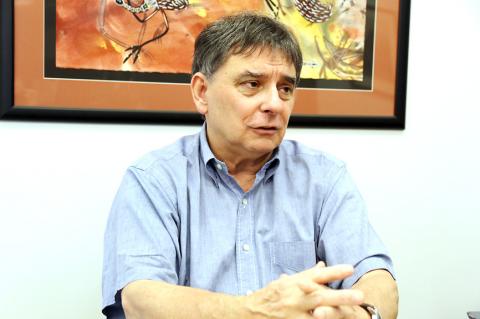
Photo: Shih Hsiu-chuan, Taipei Times
“I think now, as much as ever, the US should be much more for ward-leaning in trying to ink its free-trade agreement [FTA] with Taiwan and be much more active and positive in encouraging Taiwan’s entry into the TPP [Trans-Pacific Partnership],” Stanton said in an interview with the Taipei Times on Friday.
During the interview, Stanton said that he did not represent anyone’s views except his own because he has retired from the US Foreign Service.
The underlying anxiety among young people as revealed in the Sunflower movement, which was prompted by the cross-strait service trade agreement, came from their “real-world concerns” about their economic future and showed “a widespread discontent with the direction things [cross-strait relations] are going,” he said.
Stanton, who can speak fluent Mandarin, said he understands why people are concerned about the trade deal because everywhere he goes, he talks to people about what it means for them: when he takes a taxi, eats at a cafeteria or gets his hair cut.
Stanton has acquired a good sense of the students’ thinking through the many students he meets and mentors at the university.
The changes brought about in Hong Kong after it underwent a process of economic integration with China — the attacks on journalists, media self-censorship, advertising money controlling the media, rising property prices, hospital staff and resource deficiencies, shortages in supplies such as baby milk powder — have been “discouraging,” Stanton said. “People look at the Hong Kong model, and they see there is dissatisfaction among Hong Kong people.”
There needs to be an objective economic analysis of the details of the agreement to tell people how it will affect their livelihoods for better or worse through debates and fact-checking processes, such as how the US is handling controversies surrounding Obamacare, Stanton said.
Saying that he is “a supporter of free trade” and has worked on the US-Australia FTA and the US-South Korea FTA, Stanton added that economic merit is not the only aspect that needs to be examined.
“There is no subject called economics. It is political economy. Everybody knows there is a political dimension to economic decisions. I don’t think it can be divorced,” Stanton said.
Taiwanese are also concerned about the political consequences the trade agreement will bring, and that also needs to be addressed by political leadership, Stanton said.
“I think there has to be a frank discussion about what it means for Taiwan politically,” he said.
The US has 20 FTAs and many of them were motivated by politics, including the ones signed with Israel, Jordan, Morocco, Australia and South Korea, he said.
“The thing you have to do is to have a wider picture and a broader perspective” to look at the cross-strait service trade agreement, Stanton said, alluding to the positive reviews about the agreement recently made by some US academics in Washington.
On the trade agreement with China, there are questions to be examined other than its economic merits, for example, the impacts that opening Taiwan’s printing, publishing and translation sectors to Chinese investors will have on press freedom in Taiwan, he said.
Citing as examples China censors taking scissors to Pirates of the Caribbean because it shows scenes of a Chinese pirate and SET TV eliminating one of its talk shows so that it can sell its dramas to China, Stanton said “Taiwanese should worry about that.”
“The political leadership needs to address that. People in Washington making comments on this agreement need to be sensitive to that as well,” he said.
In Stanton’s view, the strategic implications of Taiwan should not be left out of consideration.
Since World War II, US alliances with Taiwan, Japan, South Korea and Philippines have contributed to peace and stability, under which even China has prospered, he said.
“If Taiwan is lost and becomes a part of China, if the South China Sea is lost, China will return to its days as an empire, and everybody around the world will become tributary states because China will be able to rule the sea and to control the flow of crude oil. Look at what happens. They [China] just lost the WTO case on rare earth,” he said.
China now is very intent on changing the “status quo” and it wants to drive the US out of Asia, Stanton said, adding there are “implications beyond Taiwan for what happens on Taiwan” if Taiwan loses its independent status while China recreates its Qing Empire days.
John Mearsheimer, a professor of politics at the University of Chicago, recently predicted that in the face of China’s continued rise, Taiwan would have to give up even its present de facto independent status and seek a Hong Kong-style accommodation with Beijing.
“I don’t know if it will happen, but I don’t think it is by any means inevitable,” Stanton said, adding the student protest is a “wake-up call” for a lot of people to do things differently.
The US and other countries should be trying to create trade agreements on their own with Taiwan, Stanton said.
“Everybody needs to have a relationship with China. That’s clear, including Taiwan, but Taiwan is already so heavily invested [in China],” he said.
More than 40 percent of Taiwan’s exports are bound for China, 80 percent of Taiwan’s overseas investment goes to China, and Taiwan now faces intense competition from Chinese manufacturers which used to be its customers, Stanton said.
It is in the interests of the US to help Taiwan diversify its external economic relations, he said.
Stanton said it is not going to be easy for the US to sign an FTA with Taiwan because there is too much protectionism in Taiwan “sometimes irrational protectionism and sometimes politically motivated protectionism.”
“Taiwan has been isolated for so long. [Protectionism] is kind of understandable, but I think we should do more to push to Taiwan into our arms, rather than just saying: ‘Well, Taiwan has to take steps. It has to do this [and that.]’ That’s true for everybody,” Stanton said.
The US should also bring Taiwan into TPP talks in the same way it allowed Japan to join for another reason, when Japan expressed its interest, he added.
Stanton said he “never bought the arguments” that the US cannot move forward with its trade relations with Taiwan unless Taiwan signs an agreement with China or that pressure from China would force the US to block Taiwan’s bid to join the TPP talks.
“That’s inconceivable to me,” Stanton said.
Stanton said he does not see any direct or even indirect connection between what Taiwan does in trade with China and what the US would do to facilitate its trade relations with Taiwan or to support the nation’s joining TPP talks.
Taiwan ought to be in the TPP negotiations because it is an important trading partner and friend of the US, Stanton said, adding that the US “should be more encouraging.”
If Taiwan has expanded trade relations with other countries, there might be less anxiety about this cross-strait service trade agreement, “because no one wants to feel that they just have one trading partner,” Stanton said.
The Sunflower movement’s call for the legislature to establish an oversight mechanism on cross-strait negotiations before it reviews the service trade agreement with China has raised concern among officials, who say that it would create uncertainty for other trading partners if a signed trade agreement fails to be ratified by the legislature.
Stanton dismissed the concern, saying that “legislative objection and legislative issues are normal.”
“Every county has a legislative procedural. Legislative approval for most countries is an issue. It’s not unique to Taiwan. It’s not like in every country, [the government] sings an agreement and it gets the rubber stamp [from its legislature],” Stanton said.
China has rejected the possibility that the service trade agreement be renegotiated on grounds that there is no precedent for reopening negotiations on a signed agreement.
To that argument, Stanton said this is because in China, there is no legislature that would block anything, “but that’s not how Taiwan necessarily was supposed to operate. It certainly doesn’t work that way in the US.”
Stanton, who participated in student protests against the Vietnam War when he was a graduate student, said the demonstrations in the US were partly responsible for helping the US speed up withdrawal from Vietnam, adding that civil disobedience was also an important part of bringing equal rights to African Americans.
Some people have said that the students’ occupation of the legislative was “undemocratic,” but “it’s long been a tradition in the US and many countries, that people stage civil disobedience protests and civil resistance trying to speak out when they feel they are not being heard,” Stanton said, adding that the protests in Taiwan were “peaceful and rational.”
“I think it’s a good thing when you see the students actually being passionate about a wider and broader issue, and they criticize,” Stanton said.

FUKUOKA SITUATION: Japanese media reported that the pathogen is expected to be identified by the summer, while the CDC downplayed the idea that it was hMPV A “mysterious cold-like illness” reported in Japan’s Fukuoka Prefecture does not seem to be a new disease, but Japanese authorities have been asked about the situation, the Centers for Disease Control (CDC) said yesterday. The Fukuoka Prefectural Medical Association on Wednesday told a news conference that a “mystery cold” that has become a hot topic on social media is “highly likely to be caused by some kind of viral infection,” Japan’s KBC News reported. “Many people are experiencing symptoms starting with a sore throat, followed by a runny nose, phlegm and a severe cough,” KBC News reported, citing association officials. Health authorities are

Nvidia Corp CEO Jensen Huang (黃仁勳) arrived in Taiwan yesterday ahead of upcoming AI and technology events, saying he plans to meet with clients and Taiwan Semiconductor Manufacturing Co Chairman C.C. Wei (魏哲家) during his visit. After landing at Taipei Songshan Airport, Huang posed for photos with fans and handed out Yakult drinks to reporters and supporters waiting at the scene, saying he has “a lot to do” during the trip. Asked about reports that Nvidia’s planned headquarters site in Taipei’s Beitou Shilin Technology Park could break ground on May 27, Huang said that if the company holds an event, he would

The Ministry of Finance this afternoon announced the winning numbers for the March-April uniform invoice lottery. The winning number for the NT$10 million (US$318,060) special prize is 19531471, and the winning number for the NT$2 million grand prize is 85941329. Three numbers were drawn for the NT$200,000 first prize: 07225810, 20231230 and 83518781. Those with receipts matching the last seven digits of any of the first-prize numbers will win the NT$40,000 second prize, while those matching the last six digits will win the NT$10,000 third prize. Those whose receipts match the last five digits of the first-prize numbers can claim the NT$4,000 fourth prize,
Taiwan Travelogue (臺灣漫遊錄), which earlier this week became the first Taiwanese novel to win the International Booker Prize, is to be adapted into a television series through a Taiwan-Japan coproduction, producer Chang Chen-yu (張辰漁) said yesterday. Chang, a producer at World Softest Production Film Co, wrote on Facebook that the company had been searching for projects with international appeal that retain a strong Taiwanese identity after colleagues and Japanese partners strongly recommended the novel. After reading the book, Chang said he immediately decided to pursue the screen rights. “A great story has the power to transcend time and borders, and connect countless people,”


 RSS
RSS