


A member of the US Congress has called on Washington to “support the desire of the Taiwanese to be a free and separate state.”
Democratic Representative Alan Grayson told the House of Representatives Foreign Affairs Committee on Tuesday that Taiwan should not be absorbed by China.
“The Taiwanese have a separate culture and in many cases a separate language, and a separate history, from China,” he said.
Grayson was speaking as the full committee voted unanimously to reaffirm US commitment to the Taiwan Relations Act (TRA), which was signed into law 35 years ago.
He said that Taiwanese were “fundamentally different” from Chinese and recognized themselves as fundamentally different.
“We can and should support their desire for self-determination,” he said.
“It is possible for Taiwan to be free and independent,” he added.
Among the policies specifically mentioned by the new resolution was a commitment to Taiwan’s security, “including the sale of sophisticated weapons of a defensive character to Taiwan, such as F-16C/Ds and diesel-electric submarines.”
Despite strong bipartisan support for such sales, US President Barack Obama’s administration has refused to authorize them.
Although six members of the committee made short speeches in favor of the resolution, none of them mentioned the student protesters who have dominated the news in Taipei for more than a week.
Committee Chairman Ed Royce, a Republican, said there were few other pieces of foreign policy legislation as consequential as the TRA.
Royce said the steadfast support of the US Congress had helped Taiwan become a thriving democratic society and a world leader in high-tech innovation.
“Today’s bipartisan legislation, which currently has over 60 cosponsors, reinforces our nation’s unwavering support for Taiwan and its 23 million people,” he said.
Democratic Representative Eliot Engle, the committee’s minority leader, said Taiwan was a flourishing multi-party democracy with a vibrant free-market economy.
He said the US relationship with Taiwan was not only one of shared interests, but also one of shared values.
Republican Representative Ileana Ros-Lehtinen said that with the significant increase in China’s defense budget and continued threats from North Korea, there was no better time to strengthen relations with Taiwan.
“It is in our national security interests to support Taiwan — we must stand up for all people being suppressed by authoritarian regimes,” she said.
Democratic Representative Ami Bera said it was incredibly important to “emphasize and strengthen” the US relationship with Taiwan.
“Taiwan has a deep cultural connection to the US,” he said. “We have a flourishing Taiwanese-American community, with almost half of them living in California.”
“The majority of Taiwanese Americans have college degrees and are making important contributions to our country,” he said.

The Ministry of Finance this afternoon announced the winning numbers for the March-April uniform invoice lottery. The winning number for the NT$10 million (US$318,060) special prize is 19531471, and the winning number for the NT$2 million grand prize is 85941329. Three numbers were drawn for the NT$200,000 first prize: 07225810, 20231230 and 83518781. Those with receipts matching the last seven digits of any of the first-prize numbers will win the NT$40,000 second prize, while those matching the last six digits will win the NT$10,000 third prize. Those whose receipts match the last five digits of the first-prize numbers can claim the NT$4,000 fourth prize,

SIX SUBSIDIES: The monthly allowance for older farmers is to increase to NT$10,000, and NT$5,000 is to be given to homemakers under the national pension system, Lai said The government is to implement major welfare policies for disadvantaged groups, including raising the monthly allowance for older farmers to NT$10,000 and providing homemakers with NT$5,000 per month, President William Lai (賴清德) said yesterday. Lai made the remarks during a visit to Wangling Temple in Chiayi County, saying that the planned increases were being introduced amid economic growth and an increase in tax revenue. Touting a policy, in which the government plans to provide a monthly allowance of NT$5,000 for every child under the age of 18 in a bid to address Taiwan’s low birthrate, Lai said that if received for the
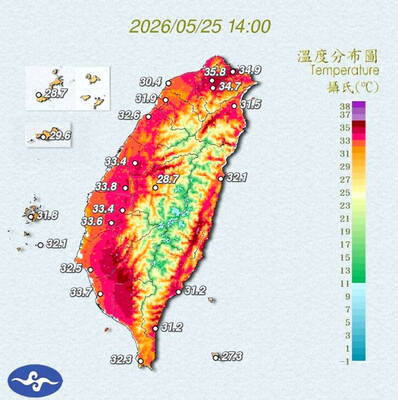
STAY COOL: The HPA recommended that people stay hydrated, use air-conditioning or fans while indoors, wear loose-fitting clothes and walk in the shade while outdoors Employers must implement measures such as installing cooling equipment, and providing drinking water and rest breaks for outdoor workers starting from Monday next week, the Taipei Department of Labor said on Sunday. Employers who fail to comply could face fines of NT$30,000 to NT$300,000 under the Occupational Safety and Health Act (職業安全衛生法), the department said. Businesses in Taipei employing fewer than 100 workers, as well as registered self-employed workers with labor insurance coverage, could receive on-site assessments and guidance from occupational safety consultants to help them apply for central government subsidies to implement or improve heat-protection measures, it said. Under the Ministry of

NATIONAL SECURITY: Authorities are working to confirm the identities of the military personnel involved and investigating possible illegal conduct and regulatory violations Authorities are probing possible national security implications after Kinmen police and immigration officers on Sunday found a Chinese woman allegedly posing as a tourist while engaging in prostitution involving more than 10 military personnel. The woman, surnamed Chen (陳), has since been deported, authorities said, adding that investigators are still working to confirm the identities of those implicated, as the records only listed code names and aliases. The case stemmed from a report received by the Kinmen District Prosecutors’ Office on Friday last week from the Jinhu Precinct of the Kinmen County Police Bureau. On Sunday, police, along with the National Immigration


 RSS
RSS