


Controversial remarks made by the Chinese Nationalist Party (KMT) administration and pro-unification academics about the 228 Massacre reverberated after the nation observed the 67th anniversary of the tragedy on Friday, drawing strong criticism from a broad spectrum of society.
In addition to remarks by President Ma Ying-jeou (馬英九) and Shih Hsin University professor Wang Hsiao-po (王曉波), the public was also angered by a comment from Premier Jiang Yi-huah (江宜樺).
On Friday, when accompanying Ma at a state ceremony in Hualien County to mark the event, Jiang urged the public to “be tolerant about the differences between ethnic groups and to learn to forgive an unintentional mistake.”
By “unintentional mistake,” Jiang appeared to be referring to the bloody crackdown, carried out by Nationalist Army troops after an anti-government uprising broke out on Feb. 28, 1947, that wiped out almost an entire generation of Taiwanese elite, killing tens of thousands of people.
Jiang, a political scientist known for his belief in liberalism prior to his political career, has been “blinded by what could be his loyalty to the KMT administration” to give a senseless comment like that, Democratic Progressive Party (DPP) Legislator Kuan Bi-ling (管碧玲) said.
Netizens and several academics, including National Taiwan University history professor Chen Tsui-lien (陳翠蓮), responded by saying that if Jiang believed what he said, the Nanjing Massacre committed by the Japanese Imperial Army during World War II could be interpreted as Japan’s unintentional mistake.
Chen and Chen Yi-shen (陳儀深), an associate research fellow at Academia Sinica, both accused Jiang of trying to avoid the KMT’s responsibility for the massacre and for ignoring that the massacre was state violence.
Former premier Frank Hsieh (謝長廷) of the DPP challenged Ma over the longstanding dispute over the nature of payment made to the 228 victims and their families on Ma’s Facebook page.
Ma wrote in the message that it has been more than 20 years since the government apologized and began compensating the victims and uncovering the truth, adding that the effort would continue.
Hsieh challenged Ma over his use of the word “compensation,” which has been one of the central disputes regarding the transitional justice effort for the tragedy, as the DPP and most victims have insisted on the wording of “indemnity.”
“Compensation means that the government does not commit any mistake — for example, the government compensates those whose land is expropriated — while indemnity means that the government acknowledges its mistakes,” Hsieh said.
While the current law on the indemnity is still called the February 28 Incident Disposition and Compensation Act in English, the Chinese-language title of the act is “indemnity (賠償)” rather than “compensation (補償),” he said.
“With Ma’s opposition to using ‘indemnity’ both at the time the act was proposed and at present, it was clear that his mentality toward the massacre remains unchanged after 20 years,” Hsieh said.
The KMT said in a press release that Ma opposed using “indemnity” because the Civic Code requires victims to submit evidence of damage before receiving indemnity from the government, while less of a legal threshold is required to receive compensation.
Separately, the Taiwan Association of University Professors also lambasted Wang’s comment that the killing of 20,000 people by Chiang Kai-shek’s (蔣介石) Nationalist Army in the 228 Massacre was “a small case” compared with the 400,000 killed during Chiang’s campaigns against the Chinese Communist Party in China.
The 20,000 deaths in the 228 Massacre, when Taiwan’s population was about 6 million, means that, on average, 33 of 10,000 — or 0.33 percent — of Taiwanese were killed, while the 400,000 killed represented less than 0.1 percent of the total Chinese population of 500 million at the time.
“So why was the 228 Massacre a small case?” the association asked.

FUKUOKA SITUATION: Japanese media reported that the pathogen is expected to be identified by the summer, while the CDC downplayed the idea that it was hMPV A “mysterious cold-like illness” reported in Japan’s Fukuoka Prefecture does not seem to be a new disease, but Japanese authorities have been asked about the situation, the Centers for Disease Control (CDC) said yesterday. The Fukuoka Prefectural Medical Association on Wednesday told a news conference that a “mystery cold” that has become a hot topic on social media is “highly likely to be caused by some kind of viral infection,” Japan’s KBC News reported. “Many people are experiencing symptoms starting with a sore throat, followed by a runny nose, phlegm and a severe cough,” KBC News reported, citing association officials. Health authorities are

Nvidia Corp CEO Jensen Huang (黃仁勳) arrived in Taiwan yesterday ahead of upcoming AI and technology events, saying he plans to meet with clients and Taiwan Semiconductor Manufacturing Co Chairman C.C. Wei (魏哲家) during his visit. After landing at Taipei Songshan Airport, Huang posed for photos with fans and handed out Yakult drinks to reporters and supporters waiting at the scene, saying he has “a lot to do” during the trip. Asked about reports that Nvidia’s planned headquarters site in Taipei’s Beitou Shilin Technology Park could break ground on May 27, Huang said that if the company holds an event, he would

The Ministry of Finance this afternoon announced the winning numbers for the March-April uniform invoice lottery. The winning number for the NT$10 million (US$318,060) special prize is 19531471, and the winning number for the NT$2 million grand prize is 85941329. Three numbers were drawn for the NT$200,000 first prize: 07225810, 20231230 and 83518781. Those with receipts matching the last seven digits of any of the first-prize numbers will win the NT$40,000 second prize, while those matching the last six digits will win the NT$10,000 third prize. Those whose receipts match the last five digits of the first-prize numbers can claim the NT$4,000 fourth prize,
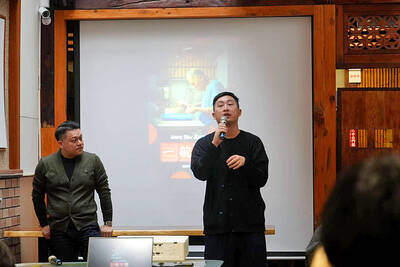
Taiwan Travelogue (臺灣漫遊錄), which earlier this week became the first Taiwanese novel to win the International Booker Prize, is to be adapted into a television series through a Taiwan-Japan coproduction, producer Chang Chen-yu (張辰漁) said yesterday. Chang, a producer at World Softest Production Film Co, wrote on Facebook that the company had been searching for projects with international appeal that retain a strong Taiwanese identity after colleagues and Japanese partners strongly recommended the novel. After reading the book, Chang said he immediately decided to pursue the screen rights. “A great story has the power to transcend time and borders, and connect countless people,”


 RSS
RSS