

Mainland Affairs Council (MAC) Minister Wang Yu-chi (王郁琦) yesterday met with China’s Association for Relations Across the Taiwan Straits (ARATS) Chairman Chen Deming (陳德銘) in Taipei, and said he looked forward to working closely with him.
It was the first time the two men had met, with both addressing each other with their official titles; Chen referring to Wang as “Minister Wang.”
Chen and his delegation arrived in Taiwan on Wednesday for the 10th round of cross-strait negotiations. He and Straits Exchange Foundation (SEF) Chairman Lin Join-sane (林中森) yesterday signed agreements on meteorological and seismic data sharing.
“The signings will make a great contribution to improving people’s safety across the Taiwan Strait, and we expect to continue promoting cross-strait relations under the 1992 consensus,” Wang said during the meeting.
Citing his earlier meeting with China’s Taiwan Affairs Office (TAO) Minister Zhang Zhijun (張志軍), in the Chinese city of Nanjing, Wang said that the communication channel between the MAC and TAO will not affect that of the SEF and the ARATS. The extra channel is complementary, rather than adversarial he added.
Chen agreed that the consensuses reached during the Wang-Zhang meeting would have a positive influence on development across the Taiwan Strait.
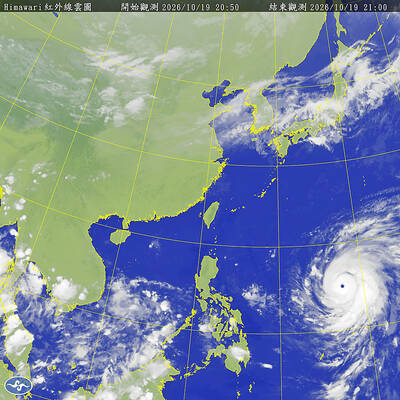
Typhoon Champi is forecast to turn northward earlier than previously expected, sparing Taiwan a direct hit but still bringing heavy rain to the north of the country on Friday and Saturday, the Central Weather Administration (CWA) said yesterday. Typhoon Champi had strengthened and increased in size over the past 12 hours, and as of yesterday afternoon, was packing sustained winds of 198kph near its center, CWA forecaster Cheng Chieh-jen (鄭傑仁) said. However, due to the weakening of a Pacific high-pressure system the storm is now expected to turn northward earlier than initially forecast, likely around Japan’s Ishigaki Island, Cheng said. As Champi brushes
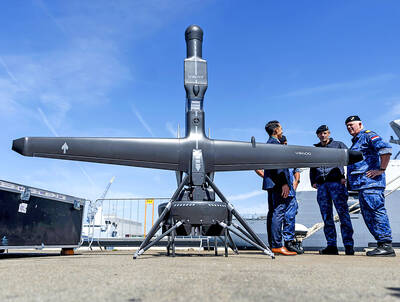
DEFENSE PROCUREMENT: Taiwan could become the largest operator of V-BAT drones outside the US once they are delivered, the Ministry of National Defense said The navy and the coast guard are acquiring 292 units of MQ-35A V-BAT vertical takeoff and landing (VTOL) surveillance drones manufactured by US-based defense technology company Shield AI, making Taiwan one of the largest buyers of the drone. The Coast Guard Administration budgeted NT$1.2 billion (US$37.1 million) to buy 12 drones, which have been delivered, Shield AI said in a report on Oct 13. The navy is planning to spend NT$36 billion under a four-year program code-named Project Yuan Xiao (遠鴞) to acquire 280 V-BAT drones, the Ministry of National Defense’s fiscal 2027 report showed. The combined procurement is expected

MAYORAL RACE: Su Chiao-hui made gains by persuading undecided voters and winning over voters in KMT-leaning districts, a pollster said Legislator Su Chiao-hui (蘇巧慧), the Democratic Progressive Party’s (DPP) candidate for New Taipei City mayor, has a 13.1 percentage point lead over her Chinese Nationalist Party (KMT) rival Lee Shu-chuan (李四川), a poll released yesterday showed. The poll, commissioned by the Taipei Trust in Democracy Association, showed that 43.1 percent of respondents said they would vote for Su, up 7.9 percentage points from a poll conducted in late August, while support for Lee was at 30 percent, down 4.7 percentage points. It showed that 48.6 percent of respondents thought Su would make a suitable mayor, compared with 35.9 percent for Lee. Independent candidate
A Chinese People's Liberation Army (PLA) Navy aircraft carrier group was being monitored after entering the western Pacific, the Ministry of National Defense said today, after Beijing yesterday criticized Taiwan for using a water cannon against a Chinese fishing boat near the Pratas Islands (Dongsha Islands, 東沙群島). A Chinese naval task group led by the aircraft carrier Liaoning (遼寧) yesterday sailed to the western Pacific for training, Chinese state-run Xinhua news agency quoted the PLA Navy as saying. “The drill is part of the annual routine training plan aimed at testing and improving the troops’ combat readiness and enhancing their ability to


 RSS
RSS