


The Democratic Progressive Party (DPP) yesterday unveiled a new education policy focused on tackling the challenges of the nation’s low birthrate, the imbalanced development of secondary education, and the supervision and management of private universities.
Education is one of the most important policy areas with regard to Taiwan’s competitiveness, especially since the nation has one of the lowest birthrates in the world, DPP Chairman Su Tseng-chang (蘇貞昌) told a press conference.
The press conference was the first of a series of events during which the party is to unveil its policies on foreign affairs, national defense, energy and other areas that are to form the backbone of its “Green New Deal” initiative ahead of the seven-in-one election in November.
Su has described the initiative, which includes promoting sustainable development, good governance, social justice and alliances with other democracies, as the DPP’s pledge for the country’s future
According to the DPP’s think tank, a decreasing number of students due to the low birthrate has impacted primary schools since 2004, junior-high schools since 2010 and high schools since last year.
Based on the age-specific fertility rates of women in their child-bearing years, Taiwan’s total fertility rate (TFR) — how many children a woman has in her lifetime — is calculated to be less than 1.3, which is much lower than the replacement TFR of approximately 2.1 births needed to maintain a stable population.
The 1.3 figure means that just 200,000 babies are born in Taiwan every year.
The declining number of pupils presents an even more serious challenge for higher education, the think tank said in a report.
In 2012, the vacancy rate for the 162 universities nationwide was 16.85 percent. Based on the current birthrate, about 30 percent of universities — 46 — would not be able to recruit any students by 2022 and would face closure, said National Taiwan University professor Chen Tung-sheng (陳東升), one of the co-authors of the think tank’s education policy report.
To tackle this problem, the party recommended the integration of early childhood education and care to lessen parents’ burden and urged avoiding closing public primary schools unless they are no longer sustainable due to insufficient enrolment.
The current ratio of high schools to vocational high schools, which was 52 to 48 in 2012, was not healthy and should be reversed to a level of about 40 to 60, the party said.
This ratio is more optimal because secondary education should be employment-oriented to ensure that graduates meet the demands of the job market, Chen added.
With regards to higher education, the closure of private universities is inevitable and the think tank recommended that public schools increase their enrolment volume and make sure that underprivileged pupils are able to enroll by providing financial assistance, the professor said
The party’s policy holds the Ministry of Education responsible for strictly monitoring the financial and enrollment status of private universities and would make it take the initiative in transferring students from closed private institutions.
At the same time, the ministry should protect the rights of teachers at private universities that close and make the best possible use of the resulting vacant buildings and properties, the DPP said.
The party is set to unveil its foreign policy today, with its assessment of China’s military threat to Taiwan and its energy policy scheduled to be announced next week.
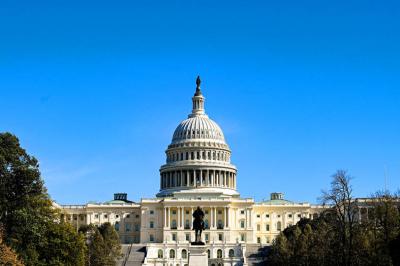
The US House of Representatives yesterday passed the PROTECT Taiwan Act, which stipulates that Washington would exclude China from participating in major global financial organizations if its actions directly threaten Taiwan’s security. The bill, proposed by Republican US Representative Frank Lucas, passed with 395 votes in favor and two against. It stipulates that if China’s actions pose any threat to Taiwan’s security, economic or social systems, the US would, “to the maximum extent practicable,” exclude China from international financial institutions, including the G20, the Bank for International Settlements and the Financial Stability Board. The bill makes it clear that China
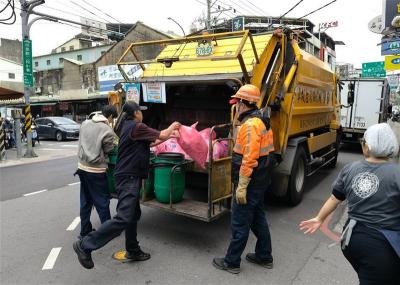
Garbage and recycling schedules are to vary from Saturday through Sunday next week over the Lunar New Year holiday period. The following collection information is from the governments of the six special municipalities. Taipei Regular service: Sunday to Monday next week. No service: Tuesday to Thursday next week. Extra service: Friday next week. Regular service resumes: Saturday next week. New Taipei City Extra service: Sunday. Adjusted collection time: Monday next week — garbage collection is to begin in the morning and end at 6pm. No service: Tuesday to Thursday next week. Regular service resumes: Friday next week. Note: Garbage can be dropped off at 70

A KFC branch in Kaohsiung may be fined between NT$60,000 and NT$200 million (US$1,907 and US$6.37 million), after a customer yesterday found an entire AAA battery inside an egg tart, the Kaohsiung Department of Health said today. The customer was about to microwave a box of egg tarts they had bought at the fast-food restaurant’s Nanzih (楠梓) branch when they checked the bottom and saw a dark shadow inside one of them, they said in a Threads post. The customer filmed themself taking the egg tart apart to reveal an entire AAA battery inside, which apparently showed signs of damage. Surveillance footage showed
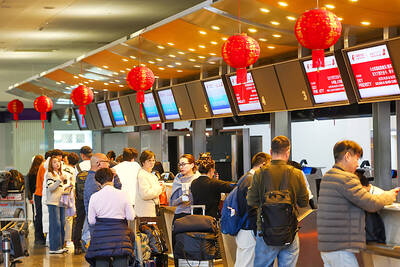
GROUP EFFORT: The number of inbound travelers rose 11 to 12 percent last month, with a significant increase in tourists from Europe and North America, an official said The government aims to attract 9.4 million visitors this year, the Tourism Administration said yesterday, citing last year’s success in diversifying tourist markets. Taiwan last year drew about 8.57 million international arrivals, 72.3 percent of pre-COVID-19 levels. By contrast, the nation had about 18.94 million outbound tourists last year, surpassing the pre-COVID-19 level of 17.1 million. The estimated tourism revenue deficit was about NT$700.9 billion (US$22.22 billion). Taoyuan International Airport Corp expects more than 160,000 passengers to pass through the nation’s largest airport daily during the Lunar New Year holiday, which begins on Saturday. As of Jan. 30, the nation’s average hotel occupancy rate


 RSS
RSS