


Former premier Frank Hsieh (謝長廷) of the Democratic Progressive Party (DPP) yesterday said that the party has failed to make substantial progress in its relationship with Beijing and must make changes to its China policy as soon as possible.
In an interview with the Chinese-language China Times published yesterday, Hsieh spoke about what he called the DPP’s failed cross-strait policy that appears to have depreciated DPP Chairman Su Tseng-chang’s (蘇貞昌) efforts to see the party progress.
The DPP cannot afford to sit and do nothing about its China policy, Hseih said, citing an unreleased survey conducted by the party following its loss in the 2012 presidential election in which 65 percent of respondents found the DPP’s ability to manage cross-strait economic exchanges questionable.
“If the DPP wants to return to power, it must change its China policy as soon as possible,” Hsieh was quoted as saying.
The former premier said he was displeased with the DPP’s review of and recommendations for its China policy last week, in which it pledged to “seek the public’s consensus” on cross-strait issues.
Hseih said that vow was “a beautiful shot that failed to score.”
No one in the party tabled any initiative to complement or challenge his proposal for “two sides, two constitutions,” Hsieh was quoted as saying, arguing that his initiative was the only such DPP proposal accepted by the Taiwanese public, Beijing and Washington.
When asked about critics who had said his initiative was “pro-Chinese Nationalist Party [KMT],” Hsieh said that if the DPP intended to seek the maximum consensus among Taiwanese, “it is impossible not to include the KMT’s view.”
The DPP’s approach of “alienating anything related to China” and its efforts to oppose everything from the KMT had produced no positive results, he added.
DPP whip Ker Chien-Ming’s proposal to freeze the DPP’s Taiwan independence clause should be discussed and included as a policy option, Hsieh said.
In related news, the Taiwan Affairs Office yesterday said that the DPP would be “walking toward a dead end if it insisted on independence, regardless of which mask it puts on the policy.”
Responding to the remarks, DPP Department of China Affairs Director Honigmann Hong (洪財隆) said that the party’s China policy reflected the core values of the mainstream Taiwanese public, responded to societal views across the Taiwan Strait and showed the party’s confidence and pragmatism toward bilateral engagement.
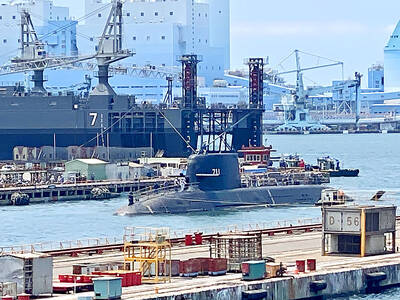
AGING: While Japan has 22 submarines, Taiwan only operates four, two of which were commissioned by the US in 1945 and 1946, and transferred to Taiwan in 1973 Taiwan would need at least 12 submarines to reach modern fleet capabilities, CSBC Corp, Taiwan chairman Chen Cheng-hung (陳政宏) said in an interview broadcast on Friday, citing a US assessment. CSBC is testing the nation’s first indigenous defense submarine, the Hai Kun (海鯤, Narwhal), which is scheduled to be delivered to the navy next month or in July. The Hai Kun has completed torpedo-firing tests and is scheduled to undergo overnight sea trials, Chen said on an SET TV military affairs program. Taiwan would require at least 12 submarines to establish a modern submarine force after assessing the nation’s operational environment and defense

A white king snake that frightened passengers and caused a stir on a Taipei MRT train on Friday evening has been claimed by its owner, who would be fined, Taipei Rapid Transit Corp (TRTC) said yesterday. A person on Threads posted that he thought he was lucky to find an empty row of seats on Friday after boarding a train on the Bannan (Blue) Line, only to spot a white snake with black stripes after sitting down. Startled, he jumped up, he wrote, describing the encounter as “terrifying.” “Taipei’s rat control plan: Release snakes on the metro,” one person wrote in reply, referring
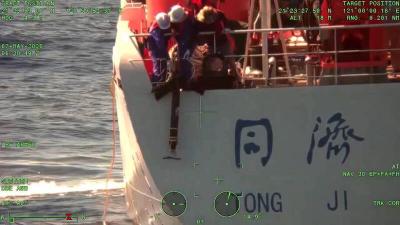
The coast guard today said that it had disrupted "illegal" operations by a Chinese research ship in waters close to the nation and driven it away, part of what Taipei sees a provocative pattern of China's stepped up maritime activities. The coast guard said that it on Thursday last week detected the Chinese ship Tongji (同濟號), which was commissioned only last year, 29 nautical miles (54km) southeast of the southern tip of Taiwan, although just outside restricted waters. The ship was observed lowering ropes into the water, suspected to be the deployment of scientific instruments for "illegal" survey operations, and the coast
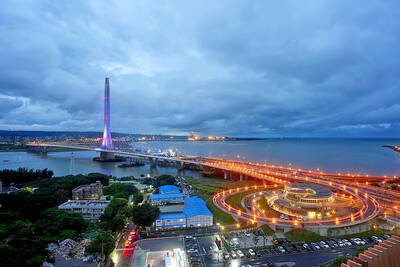
An inauguration ceremony was held yesterday for the Danjiang Bridge, the world’s longest single-mast asymmetric cable-stayed bridge, ahead of its official opening to traffic on Tuesday, marking a major milestone after nearly three decades of planning and construction. At the ceremony in New Taipei City attended by President William Lai (賴清德), Premier Cho Jung-tai (卓榮泰), Minister of Transportation and Communications Chen Shih-kai (陳世凱) and New Taipei City Mayor Hou Yu-ih (侯友宜), the bridge was hailed as both an engineering landmark and a long-awaited regional transport link connecting Tamsui (淡水) and Bali (八里)


 RSS
RSS