

An all-volunteer civilian medical team looking after former president Chen Shui-bian (陳水扁), who has been diagnosed as having a degenerative brain disease, yesterday called on the authorities to parole Chen and allow him to be reunited with his family for the Lunar New Year holiday.
Members of the medical team, which includes National Taiwan University Hospital physician and aspirant for Taipei mayor Ko Wen-je (柯文哲), and doctors Kuo Cheng-deng (郭正典) and Janice Chen (陳昭姿), made the call at a press conference held in Taipei yesterday, along with the former president’s attorney, Cheng Wen-lung (鄭文龍), and his son, Chen Chih-chung (陳致中).
Chen Shui-bian, who is serving a 20-year prison term for corruption, was sent to Taichung Veterans General Hospital for surgery to treat sleep apnea on Tuesday last week. He has since returned to Taichung Prison’s Pei Teh Hospital, where a special medical zone has been set up for him.
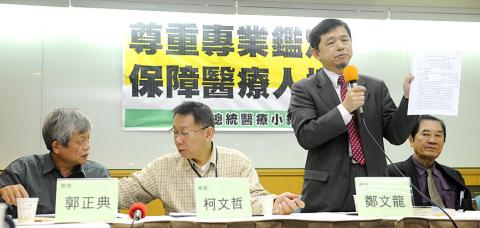
Photo: George Tsorng, Taipei Times
Cheng wen-lung said the Taipei District Court’s announcement on Dec. 20 that the former president’s trial on charges of corruption and seizing confidential government documents had been suspended due to concerns about his health cited a medical report produced by a team led by Kaohsiung Chang Gung Memorial Hospital vice superintendent Chen Shun-sheng (陳順勝).
The report said the former president had been diagnosed with various complications, including severe depression, a speech impediment, sleep apnea, non-typical Parkinson’s disease, a speech disorder, mild cerebral atrophy, poor memory and early signs of dementia, among other symptoms.
Citing the report, the district court concluded that “Chen Shui-bian’s life or health would be at risk,” the lawyer said.
Ko called on the authorities to consider paroling the former president during the Lunar New Year holiday at the end of this month and eventually to release him so that he can be cared for at home.
Chen Shui-bian’s sense of direction, spatial awareness and mathematical skills are all degrading, Ko said, adding that the former president could not even give the correct answer to the equation 100 minus seven when he visited him on Thursday.
Ko said that he did not understand how a former president of the nation could have come to be in such a state, adding that a civilized society treats its enemies and captives in a civilized way.
It is sad for Taiwanese society to have witnessed such a historical tragedy, but now that the judicial system has seen medical proof that Chen Shui-bian is not fit to stand trial, it should consider releasing him or at least give him medical parole so he can be cared for at home, Ko said.
Democratic Progressive Party Legislator Chen Ting-fei (陳亭妃) said that if former Executive Yuan secretary-general Lin Yi-shih (林益世), who was sentenced to seven years and four months in prison by the Taipei District Court for accepting about NT$60 million (US$2 million) in bribes from a contractor in May last year, could return home for the holidays, she saw no reason why the former president should not.
She said that Chen Shui-bian had said that Taichung Prison was a “shithole” before his condition worsened, adding that the former president would wish to be treated at home if it were possible.
Chen Chih-chung said that his father’s condition had not improved after he was transferred to Pei Teh Hospital in April last year, adding that a change of environment — medical parole at home — would be required if his father’s condition is to improve.
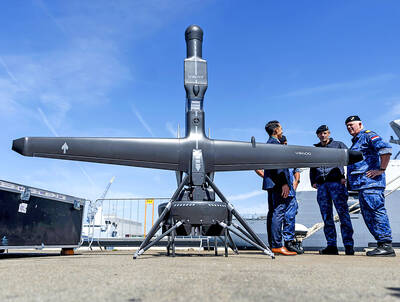
DEFENSE PROCUREMENT: Taiwan could become the largest operator of V-BAT drones outside the US once they are delivered, the Ministry of National Defense said The navy and the coast guard are acquiring 292 units of MQ-35A V-BAT vertical takeoff and landing (VTOL) surveillance drones manufactured by US-based defense technology company Shield AI, making Taiwan one of the largest buyers of the drone. The Coast Guard Administration budgeted NT$1.2 billion (US$37.1 million) to buy 12 drones, which have been delivered, Shield AI said in a report on Oct 13. The navy is planning to spend NT$36 billion under a four-year program code-named Project Yuan Xiao (遠鴞) to acquire 280 V-BAT drones, the Ministry of National Defense’s fiscal 2027 report showed. The combined procurement is expected
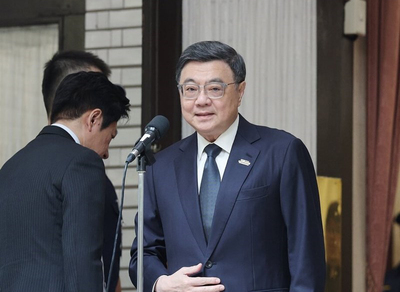
The government would continue monitoring online rumors that a pneumonic plague outbreak has spread from Russia into China and could enhance existing quarantine measures, Premier Cho Jung-tai (卓榮泰) said today. During a legislative meeting, Democratic Progressive Party Legislator Wang Ting-yu (王定宇) said rumors were circulating that the disease had spread across several Chinese provinces. He asked Cho whether the government was prepared to prevent the disease from spreading to Taiwan, given the frequent exchanges between Taiwan and China, and how concerned the government was about the alleged outbreak. The Ministry of Health and Welfare implemented border quarantine measures after briefing the Executive Yuan

MAYORAL RACE: Su Chiao-hui made gains by persuading undecided voters and winning over voters in KMT-leaning districts, a pollster said Legislator Su Chiao-hui (蘇巧慧), the Democratic Progressive Party’s (DPP) candidate for New Taipei City mayor, has a 13.1 percentage point lead over her Chinese Nationalist Party (KMT) rival Lee Shu-chuan (李四川), a poll released yesterday showed. The poll, commissioned by the Taipei Trust in Democracy Association, showed that 43.1 percent of respondents said they would vote for Su, up 7.9 percentage points from a poll conducted in late August, while support for Lee was at 30 percent, down 4.7 percentage points. It showed that 48.6 percent of respondents thought Su would make a suitable mayor, compared with 35.9 percent for Lee. Independent candidate
A Chinese People's Liberation Army (PLA) Navy aircraft carrier group was being monitored after entering the western Pacific, the Ministry of National Defense said today, after Beijing yesterday criticized Taiwan for using a water cannon against a Chinese fishing boat near the Pratas Islands (Dongsha Islands, 東沙群島). A Chinese naval task group led by the aircraft carrier Liaoning (遼寧) yesterday sailed to the western Pacific for training, Chinese state-run Xinhua news agency quoted the PLA Navy as saying. “The drill is part of the annual routine training plan aimed at testing and improving the troops’ combat readiness and enhancing their ability to


 RSS
RSS