


Democratic Progressive Party (DPP) Legislator Lin Chia-lung (林佳龍) beat fellow lawmaker Tsai Chi-chang (蔡其昌) in a public opinion poll to win the party’s primary for the Greater Taichung mayoral election in December, the party announced yesterday.
“Lin has won in an accumulated public opinion poll, which included surveys conducted by three companies on Monday night and pitted both candidates against Taichung Mayor Jason Hu (胡志強),” DPP Secretary-General Lin Hsi-yao (林錫耀) told a press conference.
Lin beat Hu in support rates, 44.7 percent to 23.6 percent, while Tsai also edged Hu by 34.3 percent to 29.1 percent. Lin and Tsai were both elected in the Greater Taichung constituency in the last legislative election.
Under the DPP’s regulations, if all aspirants beat the designated rival in public opinion polls, the one with the highest support wins.
Lin, 49, said his win shows Greater Taichung residents recognized his 10 years of hard work in the constituency. He also praised Tsai’s sportsmanship throughout the primary.
However, Lin said his lead over Hu in the primary could be misleading because Greater Taichung has always been an election battleground. Complacency could be dangerous, he said.
Born and raised in Yunlin County, Lin has built up close ties with Taichung over the past decade and has always made clear his intention to run for the mayor after moving to the city.
He ran in the 2005 mayoral election, but lost to Hu. He wanted to run in 2010, but withdrew from the DPP’s primary to make way for former DPP secretary-general Su Jia-chyuan (蘇嘉全) to challenge Hu.
The Yale-educated Lin served as a consultant to the National Security Council, head of the former Government Information Office, Executive Yuan spokesperson and deputy secretary-general of the Presidential Office during the 2000 to 2008 administration of former president Chen Shui-bian (陳水扁).
Taichung is considered a key battleground for both the DPP and the Chinese Nationalist Party (KMT) in seven-in-one special municipality elections in December.
Tsai said he was proud of what he has achieved in the 55 days since he announced on Nov. 5 that he would contest the primary.
Meanwhile, Hu remains mum on his plans.
“I am not a candidate for the mayoral election. I will not comment on the DPP primary,” he said.
The 66-year-old Hu, who served as Taichung mayor for eight years before being elected as Greater Taichung mayor following the city’s upgrade to a special municipality, has seen his support rating decline recently. The KMT has urged him to discuss his election plans amid concerns about his ratings, but he remains noncommittal.
KMT spokesman Yang Wei-chung (楊偉中) said the party will spend more time finalizing its candidates for Greater Taichung and other special municipalities where the electoral situation is complicated.
Greater Taichung Deputy Mayor Shyu Jong-shyong (徐中雄) said he was willing to run for mayor, but only if Hu decides not to seek re-election.
“I think there is a 90 percent chance that Hu will seek re-election. If he decides to run, I will support him,” Shyu said.
Vice Premier Hsiao Chia-chi (蕭家淇), and KMT Legislator Lu Shiow-yen (盧秀燕) are also possible KMT contenders.
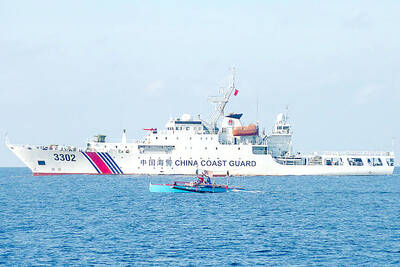
EXPANSIONIST: China deploys an average of 40 to 50 warships and coast guard vessels daily in the South China Sea, despite pledges not to militarize the region, an official said China is attempting to expand its influence across the First Island Chain and increase pressure on Japan by sending coast guard vessels into waters off of Taiwan under the pretext of maritime negotiations with Japan and the Philippines, a national security official said yesterday. China’s recent actions in the waters east of Taiwan and Japan and the Philippines’ exclusive economic zones (EEZ) are attempts to establish dominance in First Island Chain waters, said the official who declined to be named, adding that this is “expansion disguised as law enforcement.” Framing China’s actions solely as a cross-strait issue is a serious misjudgment that
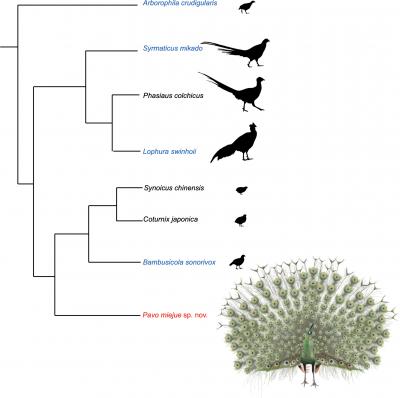
Through analyzing fossil evidence, a research team at National Taiwan University (NTU) discovered the largest endemic bird to have lived in Taiwan, naming it Pavo miejue, or extinct peafowl (滅絕孔雀). The Mikado pheasant, which is printed on the back of the NT$1,000 bank note, was previously believed to be the biggest endemic bird to Taiwan. The research team’s findings suggest that Pavo miejue lived during the Pleistocene epoch tens of thousands of years ago. It is the first endemic extinct bird species discovered and formally named in Taiwan. The study was coauthored by NTU Institute of Ecology and Evolutionary Biology professor Tsai Cheng-hsiu (蔡政修),
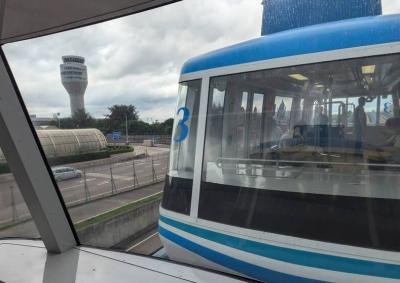
Taiwan Taoyuan International Airport is to suspend its automated Skytrain service connecting Terminal 1 and Terminal 2 starting on July 1 to facilitate connection works for the upcoming Terminal 3, the airport operator said today. Passengers and staff who need to travel between the two terminals after the suspension can instead use the Taoyuan MRT or the airport's 24-hour shuttle bus service, Taoyuan International Airport Corp said. The Taoyuan MRT Airport Line directly links the two terminals, while the shuttle buses are to operate around the clock, the company added. The Skytrain provides free transportation between the airport’s two terminals for travelers and
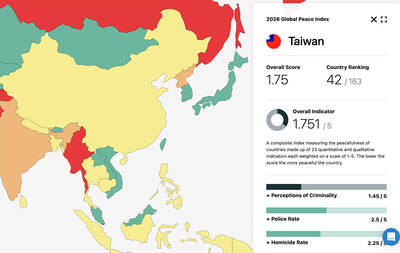
Taiwan ranked 42nd in terms of peacefulness among 163 countries, down five places from last year, according to this year’s Global Peace Index. With an overall score of 1.751, Taiwan dropped from 37th last year, the report published by the global Institute for Economics and Peace showed. The overall score measures a country’s level of peacefulness using 23 quantitative and qualitative indicators across three domains — ongoing domestic and international conflict, societal safety and security, and militarization. While Taiwan ranked 42nd worldwide, it was listed in ninth place among the 19 Asian-Pacific countries in the report, after New Zealand, Singapore, Japan, Malaysia,


 RSS
RSS