


Thousands of protected turtles rescued from being smuggled to China are crowded into a temporary shelter under poor conditions, animal rights’ advocates said yesterday, urging the government to impose heavier punishments on smugglers of protected animals.
Government statistics showed 9,336 China-bound Asian yellow pond turtles and yellow margined box turtles (also known as “snake-eating turtles”) — rare and endangered species that are protected in Taiwan — had been rescued between 2006 and this year, but the actual number being smuggled was probably much higher, the Life Conservationist Association said.
More than 5,000 turtles were rescued in just two months — 1,446 snake-eating turtles and 1,180 Asian yellow pond turtles in August and 1,358 snake-eating turtles and 1,081 Asian yellow pond turtles in September — association executive director Ho Tsung-hsun (何宗勳) said.
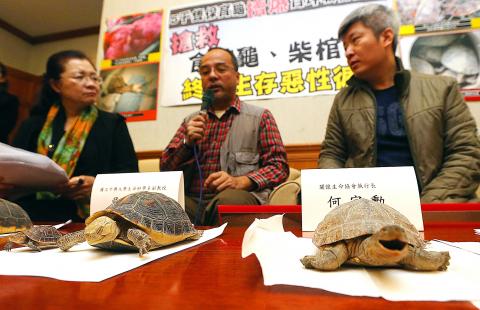
Photo: CNA
Although the Forestry Bureau commissioned Wu Sheng-hai (吳聲海), an associate professor in National Chung Hsing University’s department of life sciences, to shelter and treat the intercepted turtles before releasing them in their original habitats, the school’s limited resources cannot support such an enormous number of turtles, the association said.
The light punishment does not deter smugglers, it said.
“Sometimes the bureau suddenly calls and says that it needs shelter for about 2,000 turtles, and the turtles fill up our small shelter space immediately — averaging 30 or more turtles in every ping [3.3m2] — which gives them a very poor quality of life,” Wu said.
Showing photographs of grayish turtles covered in mud and piled on top one another in nets and boxes, Wu said the shelter was originally intended for birds that had been injured and were unable to fly.
It was not designed to house a huge number of turtles, he said.
“They like to stay in shaded areas, and you can see that because the shelter space is limited, they end up crowded together in the corners,” he said.
Many turtles were dehydrated, starved or injured by the time they were rescued, and some needed to be fed with feeding tubes, he said.
The turtles need a better environment to recover, but due to limited resources and space, “the survival rate of the turtles [in the shelter] has always been low,” Wu said.
The survival rate this year is only about 40 percent, the association said.
Forestry Bureau wildlife conservation section head Lin Kuo-chang (林國彰) said the agency would find additional space for at least 1,500 turtles before the end of the year.
Lin also urged the public to report any cases of smuggling to local conservation bureaus.

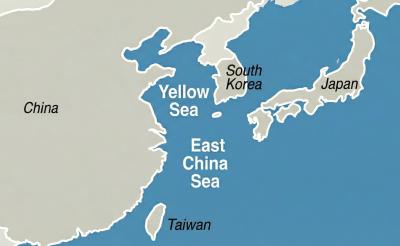
China has reserved offshore airspace in the Yellow Sea and East China Sea from March 27 to May 6, issuing alerts usually used to warn of military exercises, although no such exercises have been announced, the Wall Street Journal (WSJ) reported yesterday. Reserving such a large area for 40 days without explanation is an “unusual step,” as military exercises normally only last a few days, the paper said. These alerts, known as Notice to Air Missions (Notams), “are intended to inform pilots and aviation authorities of temporary airspace hazards or restrictions,” the article said. The airspace reserved in the alert is

South Korea is planning to revise its controversial electronic arrival card, a step Taiwanese officials said prompted them to hold off on planned retaliatory measures, a South Korean media report said yesterday. A Yonhap News Agency report said that the South Korean Ministry of Foreign Affairs is planning to remove the “previous departure place” and “next destination” fields from its e-arrival card system. The plan, reached after interagency consultations, is under review and aims to simplify entry procedures and align the electronic form with the paper version, a South Korean ministry official said. The fields — which appeared only on the electronic form

More than 6,000 Taiwanese students have participated in exchange programs in China over the past two years, despite the Mainland Affairs Council’s (MAC) “orange light” travel advisory, government records showed. The MAC’s publicly available registry showed that Taiwanese college and university students who went on exchange programs across the Strait numbered 3,592 and 2,966 people respectively. The National Immigration Agency data revealed that 2,296 and 2,551 Chinese students visited Taiwan for study in the same two years. A review of the Web sites of publicly-run universities and colleges showed that Taiwanese higher education institutions continued to recruit students for Chinese educational programs without

A bipartisan group of US senators has introduced a bill to enhance cooperation with Taiwan on drone development and to reduce reliance on supply chains linked to China. The proposed Blue Skies for Taiwan Act of 2026 was introduced by Republican US senators Ted Cruz and John Curtis, and Democratic US senators Jeff Merkley and Andy Kim. The legislation seeks to ease constraints on Taiwan-US cooperation in uncrewed aerial systems (UAS), including dependence on China-sourced components, limited access to capital and regulatory barriers under US export controls, a news release issued by Cruz on Wednesday said. The bill would establish a "Blue UAS


 RSS
RSS