


Yosusuke Ota, a Japanese photographer who documented animals left behind in the 20km exclusion zone surrounding Japan’s Fukushima Dai-ichi nuclear power plant after the earthquake and tsunami in March 2011, spoke about his experience with the audience at an anti-nuclear film festival in Taipei yesterday.
The photograph exhibition, “The Abandoned Animals of Fukushima” — showing at the Zero-Nuke Festival hosted by the Green Citizens’ Action Alliance in Taipei’s Songshan Cultural and Creative Park — portrays the plight of pet and farm animals in the aftermath of the disaster.
In the photographs the animals are still trying to survive in the disaster-struck area from which residents have all been forcibly evacuated: Dogs or cats wander the ruins of residential houses, an ostrich stands in the middle of an empty street, and pigs escaped from barns cool themselves in puddles on the road.
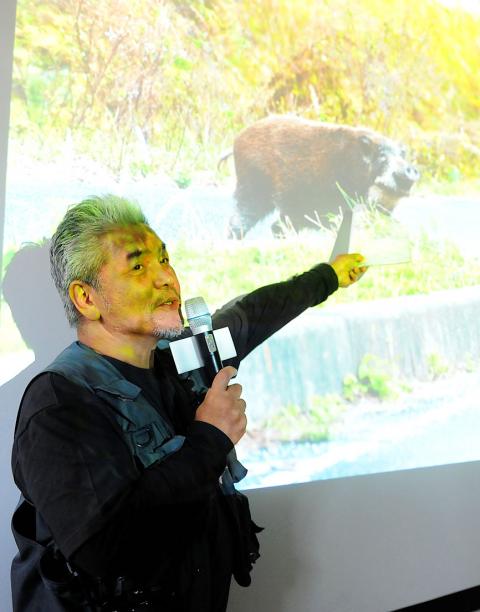
Photo: Wang Min-wei, Taipei Times
Corpses of animals that died of hunger or illness are scattered across the landscape.
Ota has also published two documentary photobooks, The Animals Left Behind and The Animals Still Waiting.
Ota said it was his love for cats that first drove him to enter the area to capture images of pets and farm animals left behind, but what he observed affected him far more than he had expected, and started him thinking about what he could do to help them.
Showing a video clip of his first trip to a cow barn, he said what he had seen was “like hell,” and while a few cows had already died of hunger or thirst, one remaining cow moaned loudly and painfully, as if expecting food from him.
Helplessness and a sense of sorrow overtook Ota and other visitors who tried to feed or give water to the animals they saw.
Ota said some pets died because they were chained up or kept in cages and some starved because they stayed in their houses as if waiting for their owners to return.
While showing a photograph of a sign that read “an area for good living,” Ota added that the place has become “a place to which people never return.”
Ota has continued to sneak into the evacuation zone with volunteers to document and help the animals. He said that after two years, cats are the main survivors as most dogs have died and most pigs and cows either died of hunger and illness or were culled by the government.
Less than half of the more than 5,000 dogs living in the area were saved and about 350 of the original 3,500 cows in the area are gathered at a 32-hectare ranch that the volunteers call the “Ranch of Hope.”
However, volunteers say that since cow feed is expensive, they do not know how long the rescue project can continue.
As for Ota himself, after experimenting with different ways to feed the remaining cats in the area, he finally set up 41 feed boxes and provides feed three times a month at his own expense.

FUKUOKA SITUATION: Japanese media reported that the pathogen is expected to be identified by the summer, while the CDC downplayed the idea that it was hMPV A “mysterious cold-like illness” reported in Japan’s Fukuoka Prefecture does not seem to be a new disease, but Japanese authorities have been asked about the situation, the Centers for Disease Control (CDC) said yesterday. The Fukuoka Prefectural Medical Association on Wednesday told a news conference that a “mystery cold” that has become a hot topic on social media is “highly likely to be caused by some kind of viral infection,” Japan’s KBC News reported. “Many people are experiencing symptoms starting with a sore throat, followed by a runny nose, phlegm and a severe cough,” KBC News reported, citing association officials. Health authorities are

Nvidia Corp CEO Jensen Huang (黃仁勳) arrived in Taiwan yesterday ahead of upcoming AI and technology events, saying he plans to meet with clients and Taiwan Semiconductor Manufacturing Co Chairman C.C. Wei (魏哲家) during his visit. After landing at Taipei Songshan Airport, Huang posed for photos with fans and handed out Yakult drinks to reporters and supporters waiting at the scene, saying he has “a lot to do” during the trip. Asked about reports that Nvidia’s planned headquarters site in Taipei’s Beitou Shilin Technology Park could break ground on May 27, Huang said that if the company holds an event, he would

The Ministry of Finance this afternoon announced the winning numbers for the March-April uniform invoice lottery. The winning number for the NT$10 million (US$318,060) special prize is 19531471, and the winning number for the NT$2 million grand prize is 85941329. Three numbers were drawn for the NT$200,000 first prize: 07225810, 20231230 and 83518781. Those with receipts matching the last seven digits of any of the first-prize numbers will win the NT$40,000 second prize, while those matching the last six digits will win the NT$10,000 third prize. Those whose receipts match the last five digits of the first-prize numbers can claim the NT$4,000 fourth prize,

SIX SUBSIDIES: The monthly allowance for older farmers is to increase to NT$10,000, and NT$5,000 is to be given to homemakers under the national pension system, Lai said The government is to implement major welfare policies for disadvantaged groups, including raising the monthly allowance for older farmers to NT$10,000 and providing homemakers with NT$5,000 per month, President William Lai (賴清德) said yesterday. Lai made the remarks during a visit to Wangling Temple in Chiayi County, saying that the planned increases were being introduced amid economic growth and an increase in tax revenue. Touting a policy, in which the government plans to provide a monthly allowance of NT$5,000 for every child under the age of 18 in a bid to address Taiwan’s low birthrate, Lai said that if received for the


 RSS
RSS