


Workers carrying out sewer repairs in downtown Taipei recently dug up possibly century-old iron rails, shedding light on the history of the transit system under Japanese rule.
A team from the Taipei City Government’s Public Works Department was excavating the roads to maintain the sewers on Nov. 14, near the western entrance of the 228 Peace Park, along Hengyang Street and Huaining Street.
The workers unearthed a trove of old iron rails. More were found as they went on digging, and they eventually uncovered more than 100 of the rusty, earth-encrusted iron rail bars.
Lin Yi-hung (林一宏) of the nearby National Taiwan Museum was alerted and inspected the find.
Lin said that on first appraisal, the iron rails most likely came from the Japanese-built light rail system in service more than 100 years ago, which linked the old Shimen Street, the present day Hengyang Street area, to the old business district, Manga District (艋舺), which is now known as Wanhua District (萬華).
He said that during Japanese colonial rule (1895 to 1945), the government initiated urban renewal to develop what was then downtown Taipei. Some of the city’s stone walls were dismantled for use as construction materials, mainly Qilian rocks from Beitou District (北投), he said.
The Qilian rocks found along with the iron rails on Nov. 14 likely came from the old city walls, Lin said, while the iron rails likely came from an early light rail line, which were possibly reused to cover the sewers during the Japanese urban renewal of Taipei.
“The Japanese-built light rail system was mainly for delivery of freight goods or for carrying workers. As such, it was an important mode of transportation and economic development for local regions in the early years,” Lin said.
“The Japanese built it not only in Taipei, but in other places as well. Rueifang District (瑞芳) in what is now New Taipei City (新北市) also had one for transport during its heyday as a booming gold-mining town,” he added.
Manga was a major business hub during the early decades of the Japanese-rule era and trade depended on the light rail line to transport goods.
The light rail transport was funded and operated by private sector companies, with businesses and cargo merchants paying fees to transport cargo, Lin said.
He said the rail line went through what is today the intersection of Zhonghua Road and Chengdu Road, and made stops at the western gate of the old Taipei city wall, which is now the site of Taipei’s Ximen MRT Station.
Lin said the iron rails that were unearthed represented more than a century of history, if they did indeed come from the light rail linking the city center to Manga.
However, he said that more work would be needed to confirm the finding, as conclusions can be made only after consulting historical documents.
Workers at the scene said they were putting aside portions of the old iron rail find in case other agencies or cultural institutions wanted to claim them, otherwise the rails will be sent for recycling as scrap iron.
Lin said the excavation is not at a designated historic site, so he could not request an immediate halt to the engineering work under regulations of the Cultural Heritage Preservation Act (文化資產保存法).
“As an cultural historian, I urge the Taipei City Department of Cultural Affairs, national museums or other government agencies to come forward and protect these historic artifacts,” Lin said.
We must not leave these valuable cultural materials from our history to be dumped on the roadside and treated as scrap metal,” he added.
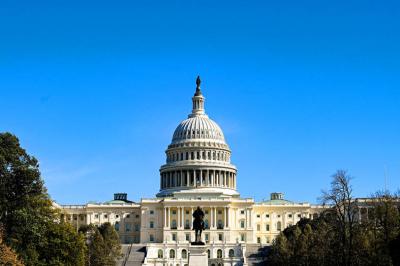
The US House of Representatives yesterday passed the PROTECT Taiwan Act, which stipulates that Washington would exclude China from participating in major global financial organizations if its actions directly threaten Taiwan’s security. The bill, proposed by Republican US Representative Frank Lucas, passed with 395 votes in favor and two against. It stipulates that if China’s actions pose any threat to Taiwan’s security, economic or social systems, the US would, “to the maximum extent practicable,” exclude China from international financial institutions, including the G20, the Bank for International Settlements and the Financial Stability Board. The bill makes it clear that China
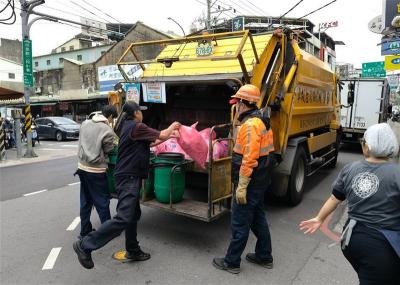
Garbage and recycling schedules are to vary from Saturday through Sunday next week over the Lunar New Year holiday period. The following collection information is from the governments of the six special municipalities. Taipei Regular service: Sunday to Monday next week. No service: Tuesday to Thursday next week. Extra service: Friday next week. Regular service resumes: Saturday next week. New Taipei City Extra service: Sunday. Adjusted collection time: Monday next week — garbage collection is to begin in the morning and end at 6pm. No service: Tuesday to Thursday next week. Regular service resumes: Friday next week. Note: Garbage can be dropped off at 70

A KFC branch in Kaohsiung may be fined between NT$60,000 and NT$200 million (US$1,907 and US$6.37 million), after a customer yesterday found an entire AAA battery inside an egg tart, the Kaohsiung Department of Health said today. The customer was about to microwave a box of egg tarts they had bought at the fast-food restaurant’s Nanzih (楠梓) branch when they checked the bottom and saw a dark shadow inside one of them, they said in a Threads post. The customer filmed themself taking the egg tart apart to reveal an entire AAA battery inside, which apparently showed signs of damage. Surveillance footage showed
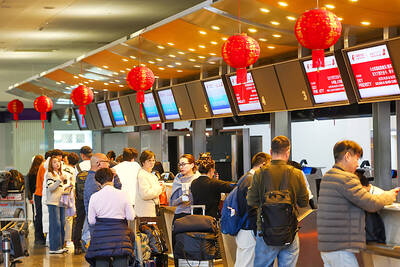
GROUP EFFORT: The number of inbound travelers rose 11 to 12 percent last month, with a significant increase in tourists from Europe and North America, an official said The government aims to attract 9.4 million visitors this year, the Tourism Administration said yesterday, citing last year’s success in diversifying tourist markets. Taiwan last year drew about 8.57 million international arrivals, 72.3 percent of pre-COVID-19 levels. By contrast, the nation had about 18.94 million outbound tourists last year, surpassing the pre-COVID-19 level of 17.1 million. The estimated tourism revenue deficit was about NT$700.9 billion (US$22.22 billion). Taoyuan International Airport Corp expects more than 160,000 passengers to pass through the nation’s largest airport daily during the Lunar New Year holiday, which begins on Saturday. As of Jan. 30, the nation’s average hotel occupancy rate


 RSS
RSS