


Questions over what role the eldest daughter of former vice president Lien Chan (連戰) played in a nutrition supplement company whose weight-loss pills were found to contain unauthorized drugs persisted yesterday, as she denied connections with the company.
Democratic Progressive Party (DPP) Legislator Lee Ying-yuan (李應元) and DPP Taipei City Councilor Juan Chao-hsiung (阮昭雄) held a joint press conference yesterday alleging that Lien Hui-hsin (連惠心) not only holds 70 percent of the company’s shares, but is also involved in its management and operation.
Lien Hui-hsin, in a written statement, yesterday dismissed allegations that she cofounded the company with Tseng Hsin-yi (曾心怡), the general manager and a major stockholder.
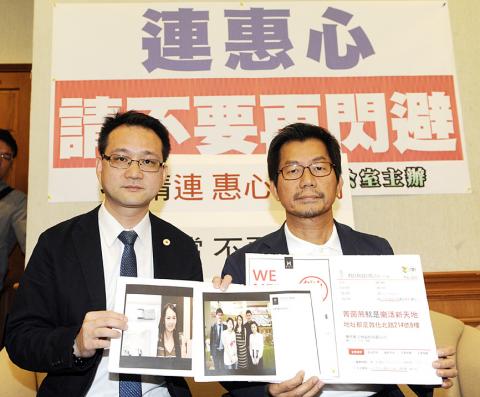
Photo: Chen Chih-chu, Taipei Times
“I have never been involved in the company’s management. We are also searching for the truth, and I will not dodge my responsibility if there is any,” the written statement said.
Her lawyer, Fang Wen-shuan (方文萱), said Lien Hui-hsin had only agreed to promote the company for free, rather than serving as a product spokesperson.
The company’s weight-loss product—Wellslim Plus+ —was found to contain cetilistat, a lipase inhibitor that is designed to treat obesity. Taipei City’s Department of Health said the drug is still undergoing clinical trials and the Ministry of Health and Welfare has not approved its use.
Lien Hui-hsin’s brother, former Taipei EasyCard Corp chairman Sean Lien (連勝文), said that he had taken the pills on the recommendation of his sister, but she likely did not know what was in the pills.
“I don’t think my sister knows the pill contains an unauthorized drug. I feel sorry about the incident,” he said.
Taipei Mayor Hau Lung-bin (郝龍斌) said celebrities should be more cautious about advertising products, adding that the city government would help consumers who had purchased the pills seek compensation from the company.
“It is a heavy responsibility representing food products or medicines. [Celebrities] should make sure the products are safe before agreeing to advertise them,” Hau said.
Additional reporting by staff writer

FUKUOKA SITUATION: Japanese media reported that the pathogen is expected to be identified by the summer, while the CDC downplayed the idea that it was hMPV A “mysterious cold-like illness” reported in Japan’s Fukuoka Prefecture does not seem to be a new disease, but Japanese authorities have been asked about the situation, the Centers for Disease Control (CDC) said yesterday. The Fukuoka Prefectural Medical Association on Wednesday told a news conference that a “mystery cold” that has become a hot topic on social media is “highly likely to be caused by some kind of viral infection,” Japan’s KBC News reported. “Many people are experiencing symptoms starting with a sore throat, followed by a runny nose, phlegm and a severe cough,” KBC News reported, citing association officials. Health authorities are

Nvidia Corp CEO Jensen Huang (黃仁勳) arrived in Taiwan yesterday ahead of upcoming AI and technology events, saying he plans to meet with clients and Taiwan Semiconductor Manufacturing Co Chairman C.C. Wei (魏哲家) during his visit. After landing at Taipei Songshan Airport, Huang posed for photos with fans and handed out Yakult drinks to reporters and supporters waiting at the scene, saying he has “a lot to do” during the trip. Asked about reports that Nvidia’s planned headquarters site in Taipei’s Beitou Shilin Technology Park could break ground on May 27, Huang said that if the company holds an event, he would

The Ministry of Finance this afternoon announced the winning numbers for the March-April uniform invoice lottery. The winning number for the NT$10 million (US$318,060) special prize is 19531471, and the winning number for the NT$2 million grand prize is 85941329. Three numbers were drawn for the NT$200,000 first prize: 07225810, 20231230 and 83518781. Those with receipts matching the last seven digits of any of the first-prize numbers will win the NT$40,000 second prize, while those matching the last six digits will win the NT$10,000 third prize. Those whose receipts match the last five digits of the first-prize numbers can claim the NT$4,000 fourth prize,
Former president Ma Ying-jeou (馬英九) yesterday expressed “shock and regret” over a statement issued by his wife without his consent, and rejected her assertion that his eldest sister, Ma Yi-nan (馬以南), would manage his medical care or act as his spokesperson amid an ongoing embezzlement probe into his foundation. Ma Ying-jeou in a statement said he was shocked by a statement by his wife, Chou Mei-ching (周美青), regarding his affairs. Ma Yi-nan “must not” be in charge of his healthcare and other personal affairs, nor can she be allowed to represent the Ma family, the former president said. He said he was also


 RSS
RSS