


Religious groups of various faiths yesterday voiced their strong opposition to legislation allowing for same-sex marriage and family diversity, saying that same-sex marriage might lead to the eventual destruction of human society.
“Legalizing same-sex marriage is a reverse tide in the international movement for sexual liberation, it is not progressive, rather, it is a downward step that will lead to the collapse of civilizations,” Unification Church Taiwan vice president Paul Chang (張全鋒) told a press conference hosted by the Alliance of Religious Groups for the Love of Families Taiwan at the Legislative Yuan.
“Legalizing same-sex marriage is legalizing adultery, incest and group sex,” he said.
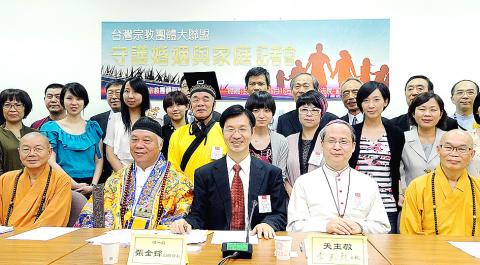
Photo: Fang Pin-chao, Taipei Times
He said the gay rights movement seeks to create more homosexuals through group sex.
“We must understand how dangerous it is, because once such legislation is passed, our children will be taught at school that it is OK to be gay, which will lead to very serious consequences for our society,” he said.
Whether looking for an Eastern or Western perspective, marriage should for a union between a man and a woman, Chang said.
“From our traditional perspective, it is in line with the heavenly way for a man and a woman to get married,” Chang said. “From the Christian perspective, God has created men and women, and blessed their union.”
Chang also spoke against allowing gay couples to adopt children, saying that children raised in same-sex families are more likely to become criminals or victims of sexual violence.
Chen Chih-hung (陳志宏), a Taiwan Lutheran Church bishop, said that marriage between a man and woman is the best system, and that legalizing same-sex marriage would encourage more people to become homosexuals, which would destroy the marriage system.
“If, one day, after the bill to legalize same-sex marriage is passed, if your child or grandchild tells you that he or she is homosexual, and thus your family lineage would stop right there, can you accept it?” Chen asked.
He also said that Taiwan already has a large number of people with AIDS.
“Would you like to see more people being infected with AIDS due to same-sex marriage? Would you like to see the birthrate continues to decline due to same-sex marriage?” he said.
Buddhist master Shih Ching-yao (釋淨耀) said the religious leaders were speaking out because they “feel it is our responsibility to stand up for family values and the stability of our society.”
“The family is the basis of social stability. How will we able to maintain social stability if people of the same sex could form a family?” Shih said.
He said it is also the duty of a family to produce children.
“People should not sacrifice this important moral value just because they want to enjoy sex,” he said.
“Many Western countries have legalized same-sex marriage, but no Asian country has done so,” Shih said. “I hope that Taiwan will learn from countries upholding the right values, not from those who follow bad values.”

Considering that most countries issue more than five denominations of banknotes, the central bank has decided to redesign all five denominations, the bank said as it prepares for the first major overhaul of the banknotes in more than 24 years. Central bank Governor Yang Chin-lung (楊金龍) is expected to report to the Legislative Yuan today on the bank’s operations and the redesign’s progress. The bank in a report sent to the legislature ahead of today’s meeting said it had commissioned a survey on the public’s preferences. Survey results showed that NT$100 and NT$1,000 banknotes are the most commonly used, while NT$200 and NT$2,000

The Centers for Disease Control (CDC) yesterday reported the first case of a new COVID-19 subvariant — BA.3.2 — in a 10-year-old Singaporean girl who had a fever upon arrival in Taiwan and tested positive for the disease. The girl left Taiwan on March 20 and the case did not have a direct impact on the local community, it said. The WHO added the BA.3.2 strain to its list of Variants Under Monitoring in December last year, but this was the first imported case of the COVID-19 variant in Taiwan, CDC Deputy Director-General Lin Ming-cheng (林明誠) said. The girl arrived in Taiwan on

South Korea is planning to revise its controversial electronic arrival card, a step Taiwanese officials said prompted them to hold off on planned retaliatory measures, a South Korean media report said yesterday. A Yonhap News Agency report said that the South Korean Ministry of Foreign Affairs is planning to remove the “previous departure place” and “next destination” fields from its e-arrival card system. The plan, reached after interagency consultations, is under review and aims to simplify entry procedures and align the electronic form with the paper version, a South Korean ministry official said. The fields — which appeared only on the electronic form

The Ministry of Foreign Affairs (MOFA) is suspending retaliation measures against South Korea that were set to take effect tomorrow, after Seoul said it is updating its e-arrival system, MOFA said today. The measures were to be a new round of retaliation after Taiwan on March 1 changed South Korea's designation on government-issued alien resident certificates held by South Korean nationals to "South Korea” from the "Republic of Korea," the country’s official name. The move came after months of protests to Seoul over its listing of Taiwan as "China (Taiwan)" in dropdown menus on its new online immigration entry system. MOFA last week


 RSS
RSS