


Liberty Times (LT): What prompted you to step forward to found the Constitution 133 Alliance and promote the recall campaign?
Neil Peng (馮光遠): I thought about doing this when the controversy over the government-sponsored rock musical Dreamers (夢想家) emerged in 2011. The root cause of the controversy is undoubtedly President Ma Ying-jeou (馬英九), because no government official would ever dare to squander NT$230 million (US$7.67 million) of taxpayers’ money on a musical performance if not expressly commanded to do so by the president.
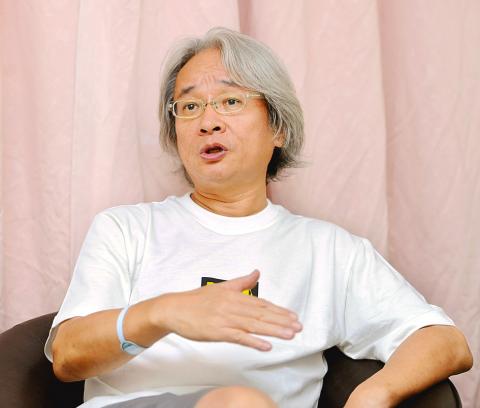
Photo: Liao Chen-huei, Taipei Times
That exorbitant sum — approximately equal to the annual incomes of 100 performing arts groups — was spent in just two nights. This was so preposterous that howls of rage could be heard all over the country. As artistic performers ourselves, we [the alliance] are particularly aware of the adverse impact that this case could have on the performing arts industry.
One of the more recent events that inspired the alliance was the signing of the cross-strait service trade agreement. People started to realize the possible threats the pact could pose to the nation after publisher Rex How (郝明義) took exception to the treaty [How has since resigned from his post as a national policy adviser.]
National Taiwan University economics department chairwoman Jang Show-ling’s (鄭秀玲) penetrating analysis of the pact also revealed the alarming fact that the agreement could be the spark that starts a prairie fire.
LT: Why has the alliance chosen to initiate a recall campaign against incompetent legislators as the way to right the perceived wrongs in politics and society?
Peng: Ma has set the nation on fire on numerous occasions and we, the people, are always the ones left to put out the flames. Since there is no way our firefighting efforts could ever outpace the government’s rate of sparking blazes, we asked ourselves: “Why not just get rid of the arsonists?”
Taiwanese voters are accustomed to the idea of having an election every four years and are always overly excited and enthusiastic during election season. However, they often feel powerless after realizing that they may have elected the wrong person, although it is their constitutional right to recall inept officials.
We must awaken Taiwanese to the realization that this right is an essential supplement to the democratic electoral system and this is what the recall campaign is aiming to accomplish. The alliance hopes to depose lawmakers that only defend and answer to Ma, because such legislators are not the representatives of the people, they are rubber stamps for the president.
People who think they can stay away from politics and mind their own business are often the ones who end up suffering the most. They may not be thinking about politics, but politics affects them regardless. As recent events have taught us, we must come forward when the nation needs us to — there is no such thing as keeping out of politics.
I criticize politicians a lot, but critical words will not change anything because they can always turn a deaf ear to what I am saying. That is why we must put our words into actions that can put officials under real pressure, and nothing stresses a lawmaker more than the thought of being recalled.
I believe that there are many Chinese Nationalist Party (KMT) members who resent and despise Ma, but are too afraid that they will become the victims of the KMT’s dirty tactics to speak up. However, by launching the recall campaign we will be able to subject these lawmakers to the pressure of public opinion.
With his second and final term as president set to expire in 2016, Ma could not care less about public opinions and people’s views.
However, if the recall effort succeeds, he might have to start watching his back, because once people start removing incompetent lawmakers aligned with him, they are just one step away from deposing the president if he implements policies that go against the public interest.
LT: How do you plan to overcome the high threshold for recalling a legislator?
Peng: We are planning to distribute letters of commitment to all legislators asking them whether they are in favor of passing an amendment [to the Civil Servants Election and Recall Act (公職人員選舉罷免法)] to lower the recall threshold. Those who oppose the plan would be deemed incompetent lawmakers who only pursue their personal interests rather than the good of the nation.
We will also ask candidates for next year’s legislative election to include support for the amendment in their campaign platforms. Those who refuse to do so will be labeled as thinking that being elected is akin to being given a free pass that allows them to sit back and cast aside their responsibilities once they assume office.
As for those who do comply with our requests, we will still monitor their performance if they are elected.
LT: What concrete measures does the alliance plan on taking to attain its goals
Peng: Due to financial constraints, we are aiming to launch a blog that will serve as the starting point for our campaign.
We are also planning to compile a report detailing people’s right to recall, which we will distribute along with other forms required to remove officials via the Internet.
Once we draw up a list of the legislators to be included in the recall campaign, we will publish their names on the blog and begin our recall bid, which requires a minimum of 2 percent of the total electorate in each legislators’ respective electoral districts to propose the bid for it to be legitimate. The motion must also be jointly petitioned by no less than 13 percent of the total electorate if it is to be put to a vote.
KMT Legislator Wu Yu-sheng (吳育昇) recently threatened to initiate a recall motion against lawmakers aligned with Democratic Progressive Party (DPP) Chairman Su Tseng-chang (蘇貞昌) or former DPP chairperson Tsai Ing-wen (蔡英文). Since every citizen is entitled to exercise their right to recall elected officials, Wu should feel free to carry out his threat as long as he has just cause for doing so.
The selection of legislators to be put up for removal will be carried out mainly based on their responses to the letters of commitment because unwillingness to make these pledges is a pretty solid indicator of incompetence.
In addition, we will compare lawmakers’ campaign platforms to what they have done after being elected to determine if they “qualify” for the campaign, while conducting an online survey asking people to list the legislators they think are key figures in the Ma camp.
We plan to finish this preparatory phase within a month and then begin the recall efforts.
The campaign will judge lawmakers by their performance, rather than their political affiliation. Those who have lived up to their duties have nothing to worry about because Taiwanese are not idiots and would never endorse the baseless removal of an elected representative.
LT: Issues such as the Fourth Nuclear Power Plant in New Taipei City’s (新北市) Gongliao District (貢寮) and the cross-strait service trade pact are not as black and white as the case of late army corporal Hung Chung-chiu (洪仲丘). Do you think the public has reached a consensus on these issues?
Peng: Taking the nuclear plant as an example, recent public opinion polls have shown that, after months of discussions and debates on the fate of the unfinished plant, the number of people opposed to nuclear energy far exceeds those who favor it.
This shows that the public has come to realzie that the government’s statistics on nuclear energy and the plant are outright lies and deceptive strategies, and that the Ma administration is made up of a bunch of frauds. They have realized that it is only these fraudsters who are benefiting from political manipulation.
Even though these issues may not be as sensational as the Hung case, they are closely intertwined with the safety and livelihoods of future generations.
In addition to being the determining factor in the fate of the country’s small and medium-sized enterprises, the service pact could fuel land and property speculations, which would make a few individuals wealthy, but be detrimental to the well-being of the majority.
The bursting of most economic bubbles usually starts with property speculation, which results in a misallocation of capital toward housing that inevitably leads to a serious national financial crisis. The upside of all this is that people are paying more attention to these issues than they did before and I believe it will only take a little more time for them to start listening.
We all know that ratifying the service trade agreement will be tantamount to opening the nation’s door to a Chinese Trojan horse.
If people allow the back-room deal to be written into law without subjecting it to close and thorough scrutiny, they will have no one else to blame but themselves for the suffering that will ensue.
However, what we are seeing now is people becoming acutely aware of the dangerous impact the treaty may have, as the government stubbornly turns a deaf ear to their repeated calls for it to re-negotiate the pact.
If the government insists on defying the people’s will, the public will eventually find a way to set these wrongs right.
Sure, people are forgetful, but the alliance will be there to refresh their memories by compiling records of each lawmaker’s remarks during legislative sessions, which as a matter of record, are something they can neither conceal nor deny.
Taiwanese voters have been letting politicians off the hook too easily for too long. That is why we are holding officials to account for the mistakes they make today and for all the wrong they have done over the years.
Ma’s plummeting approval ratings may be the result of his inaction on and disregard of a range of national issues, such as the KMT’s illegitimate assets, the pending “Sunshine bills” and his broken “6-3-3” campaign promise [a pledge to achieve an annual economic growth rate of 6 percent, annual per capita income of US$30,000 and annual unemployment of less than 3 percent.]
However, Ma would not have gotten away with his failure to make good on his campaign promises were it not for some legislators serving as his accomplices. Will the people care if all of the president’s checks bounce? I think they will if they take the initiative to punish incompetent lawmakers through recall petitions.
If we do not square our accounts with politicians now, we will be giving them permission to keep bullying us.
Translated by Staff Writer Stacy Hsu

FUKUOKA SITUATION: Japanese media reported that the pathogen is expected to be identified by the summer, while the CDC downplayed the idea that it was hMPV A “mysterious cold-like illness” reported in Japan’s Fukuoka Prefecture does not seem to be a new disease, but Japanese authorities have been asked about the situation, the Centers for Disease Control (CDC) said yesterday. The Fukuoka Prefectural Medical Association on Wednesday told a news conference that a “mystery cold” that has become a hot topic on social media is “highly likely to be caused by some kind of viral infection,” Japan’s KBC News reported. “Many people are experiencing symptoms starting with a sore throat, followed by a runny nose, phlegm and a severe cough,” KBC News reported, citing association officials. Health authorities are

Nvidia Corp CEO Jensen Huang (黃仁勳) arrived in Taiwan yesterday ahead of upcoming AI and technology events, saying he plans to meet with clients and Taiwan Semiconductor Manufacturing Co Chairman C.C. Wei (魏哲家) during his visit. After landing at Taipei Songshan Airport, Huang posed for photos with fans and handed out Yakult drinks to reporters and supporters waiting at the scene, saying he has “a lot to do” during the trip. Asked about reports that Nvidia’s planned headquarters site in Taipei’s Beitou Shilin Technology Park could break ground on May 27, Huang said that if the company holds an event, he would

Carrefour Taiwan is to begin using a new name from the start of July, but it cannot divulge the name until then, the chairman of the supermarket chain's parent company said today. President Chain Store Co chairman Lo Chih-hsien (羅智先) was asked by reporters after a shareholders' meeting to confirm whether the company has settled on a new name for the supermarket brand. In March, the government-registered name of two Carrefour Taiwan branches was quietly changed to "Le Chia Kang" (樂家康) in Chinese, raising speculation that has been selected as the name. Lo said that because of local regulations and contractual obligations, the
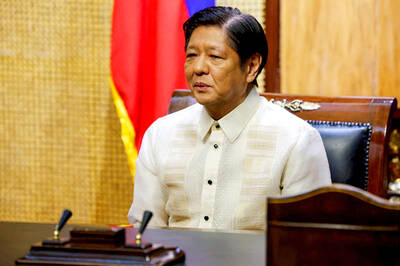
The Philippines would likely be involved in any conflict over Taiwan due to its proximity to the democracy claimed by China, President Ferdinand Marcos Jr said, reiterating a stance that risks angering Beijing. “In the Philippines, we do not have a choice because Taiwan is so close to the Philippines and we have almost 200,000 Filipino nationals living and working in Taiwan,” Marcos said in an interview with Japanese media in Manila on Monday. The Philippine leader’s comments come ahead of a state visit to Japan next week, where he is to meet with Japanese Prime Minister Sanae Takaichi to discuss security


 RSS
RSS