


China’s rise has attracted an increasing number of Taiwanese entertainers and businesspeople to the world’s second-largest economy, and while some are willing to gain fame and fortune at the expense of their national identity, an 11-year-old professional ballroom dancer and her father say nothing is worth such sacrifice.
Cheng Yu-hsin (鄭玉歆) has been dubbed the “little ballroom dancing diva” after she staged a duo performance with her father, Cheng Chu-hung (鄭竹宏), also a professional ballroom dancer, on a Taiwanese talent show and bagged the championship.
Cheng Yu-hsin started learning ballroom dancing at the age of six and won her first medal at age eight.
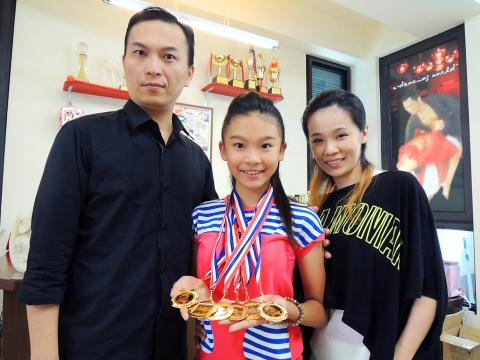
Photo: Wang Jung-hsiang, Taipei Times
Over the course of the past three years, the 11-year-old has added more than 200 medals to her list of accolades, including six gold medals at this year’s World Chinese Cup International Standard Dance Transnational Invitational.
However, the Chengs faced a crossroad in December last year when they were invited to perform in a Chinese talent show, China’s Got Talent (中國達人秀), in Shanghai.
“Everything had gone smoothly until a few minutes before my husband and daughter were supposed to go on stage,” Cheng Chu-hung’s wife, Huang Tzu-ling (黃子玲), said earlier this week.
“The show’s director and some staff suddenly asked them to say in the preview to their performance that they came from ‘China, Kaohsiung’ (中國高雄), otherwise the part featuring them could be edited out,” Huang said.
Huang added that the director also tried to persuade them by saying repeatedly that they stood a good chance of getting the judges’ approval and that they could even earn the opportunity to launch a performance tour.
Although making an appearance on the show would have guaranteed them a shot at fame, the father and daughter decided to follow their hearts and tell the live audience that “we come from Taiwan Kaohsiung,” Huang said.
Huang said the statement apparently displeased the program’s director and staff members, as of the four judges on the talent show — including Taiwanese singer Annie Yi (伊能靜), Hong Kong superstar Leon Lai (黎明) and two Chinese entertainers — only Yi gave the Chengs her approval, while one of them even blatantly told the pair that “he simply doesn’t want to give them his approval.”
“The incident involving Aboriginal Taiwanese singer Yeh Wei-ting’s (葉瑋庭) made me realize the predicaments faced by most Taiwanese entertainers wanting to make a name for themselves in China, but I’m glad I chose to stick to my beliefs,” Cheng Chu-hung said.
Cheng Chu-hung was referring to the controversial statement Yeh made last month on the Chinese talent show The Voice of China (中國好聲音), in which she said she came from “China Taipei Pingtung District” (中國台北屏東區).

UPGRADE: The Kang Ding-class frigate is replacing its Chaparall missiles with Tien Chien II and Hua Yang VLS, which would provide it with long-range, 360° air defense Taiwan plans to produce 1,200 to 1,376 Hai Chien II missiles (海劍二, Sea Sword II) — also known as TC-2N — to serve as the standard air defense system of the navy’s surface combatant fleet, a source said yesterday. Last week, the Hai Chien II, the naval version of the Tien Kung II missile (天劍二, Sky Sword II), completed a live-fire test in waters off the National Chungshan Institute of Science and Technology’s Jiupeng facility (九鵬) in Pingtung County’s Manjhou Township (滿州). The MIM72 Chaparral and other dated air defense missiles that currently arm Taiwanese ships have inadequate range to combat Chinese

REASONS FOR TRAVEL: An assistant professor said that proposed amendments to penalize drivers if they used drugs overseas would not deter people from traveling People who operate a motor vehicle under the influence of marijuana would have their driver’s license revoked, even if they used the substance while overseas, the Ministry of Transportation and Communications said yesterday, citing proposed amendments to the Road Traffic Management and Penalty Act (道路交通管理處罰條例). The amendments would also authorize the government to revoke the licenses of people determined to have used Category 1 or Category 2 narcotics, even if they were not operating a vehicle while under the influence of drugs, as well as ban them from taking the license test for three years, the ministry said. People aged 18 or

GLOBALGIVING: ‘ Caving to external pressure is not acceptable for an organization that has cultivated justice reform and human rights for 30 years,’ one NGO said A slew of non-government organizations (NGOs) have withdrawn from the GlobalGiving fundraising platform after it announced it would use “Chinese Taipei” instead of “Taiwan” from next month. The Taiwan Good Rice Association wrote on Facebook on Friday that it was informed on April 28 via a teleconference call of the change, which was made because the platform wanted to operate in China. Taiwan Good Rice is to terminate all cooperative relationships with GlobalGiving in response to the platform’s “unilateral and non-negotiable” decision to remove references to Taiwan, the NGO said. “Taiwan is in the official name of Taiwan Good Rice Association and the

HEAVY WEATHER: Typhoon Jangmi is due to crash straight into the Ryukyus as airlines look to shift flights to larger aircraft or cancel flights to Okinawa entirely Taiwan’s international air carriers announced flight adjustments over the weekend as Typhoon Jangmi is forecast to hit the Ryukyu Islands today and tomorrow. The Central Weather Administration (CWA) upgraded Jangmi from a tropical storm to a typhoon at 8am yesterday, with the eye located 580km south of Naha city. It was moving north at 19kph. Today, China Airlines’ CI-120, CI-121, CI-122 and CI-123 flights between Taoyuan and Naha, Okinawa, have been canceled as well as CI-132 and CI-133 between Kaohsiung and Naha. EVA Air’s BR-112, BR-113, BR-186 and BR-185 flights between Taoyuan and Naha are also canceled. Low-cost carrier Tigerair Taiwan canceled IT-230,


 RSS
RSS