


In preparation for an anti-nuclear parade this afternoon, the Taiwan Environmental Protection Union — which is organizing the protest — and a number of Aboriginal activists staged a demonstration on Ketagalan Boulevard in front of the Presidential Office in Taipei yesterday morning.
The activists said the parade expressed their determination to prevent nuclear waste from being disposed of in Aboriginal areas.
Sending up smoke signals on Ketagalan Boulevard reflected the traditional signaling method used by the nation’s Aboriginal tribes, the anti-nuclear activists said, adding that the action was taken to summon more people to participate in today’s parade.
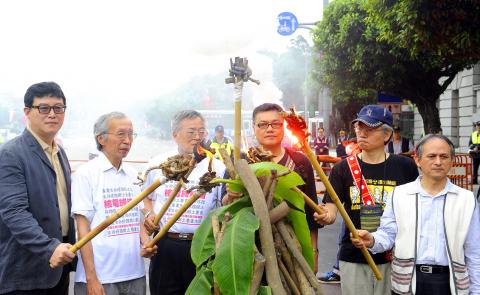
Photo: George Tsorng, Taipei Times
“When natural disasters occur, or when Aboriginal tribes are being attacked by their enemies, the head of the tribe gathers young people to light a fire as quickly as they can,” and the smoke from the fire is used to call for help an Amis Aborigine said.
Jiru Haruq, a priest from Hualien County’s Sioulin Township (秀林), said that one of the sites being considered as a spent nuclear fuel repository is in Sioulin, but when Taiwan Power Co carried out exploratory drilling at the site for evaluation purposes, it only told the village head that the drilling was for making tunnels.
It is wrong of the government to take advantage of people’s lack of knowledge about nuclear power and seek to dispose of nuclear waste in these areas, he added.
Nuclear-Free Homeland Alliance executive director Lee Cho-han (李卓翰) said the government should not think about expanding the use of nuclear power when it has not solved the problem of nuclear waste disposal.
The assembly point for the anti-nuclear parade is at Sun Yat-sen Memorial Hall at 2pm today.
The parade will set out at 3pm and is scheduled to reach Ketagalan Boulevard at 5pm, where an evening event will be held until 8pm.

Considering that most countries issue more than five denominations of banknotes, the central bank has decided to redesign all five denominations, the bank said as it prepares for the first major overhaul of the banknotes in more than 24 years. Central bank Governor Yang Chin-lung (楊金龍) is expected to report to the Legislative Yuan today on the bank’s operations and the redesign’s progress. The bank in a report sent to the legislature ahead of today’s meeting said it had commissioned a survey on the public’s preferences. Survey results showed that NT$100 and NT$1,000 banknotes are the most commonly used, while NT$200 and NT$2,000
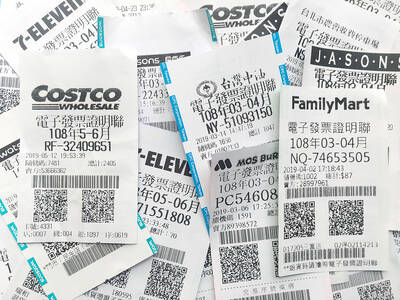
A NT$39 receipt for two bottles of tea at a FamilyMart was among the NT$10 million (US $312,969) special prize winners in the January-February uniform invoice lottery. FamilyMart said that two NT$10 million-winning receipts were issued at its stores, as well as two NT$2 million grand prizes and three NT$200,000 first prizes. The two NT$10 million receipts were issued at stores in Pingtung County and Yilan County’s Dongshan Township (冬山). One winner spent just NT$39 on two bottles of tea, while another spent NT$80 on water, tea and coffee, the company said. Meanwhile, 7-Eleven reported three NT$10 million winners — in New Taipei

The Centers for Disease Control (CDC) yesterday reported the first case of a new COVID-19 subvariant — BA.3.2 — in a 10-year-old Singaporean girl who had a fever upon arrival in Taiwan and tested positive for the disease. The girl left Taiwan on March 20 and the case did not have a direct impact on the local community, it said. The WHO added the BA.3.2 strain to its list of Variants Under Monitoring in December last year, but this was the first imported case of the COVID-19 variant in Taiwan, CDC Deputy Director-General Lin Ming-cheng (林明誠) said. The girl arrived in Taiwan on

ANNUAL EVENT: Two massive Pokemon balloons are to be set up in Daan Park, with an event zone operating from 10am to 6pm This year’s Taipei Floral Picnic is to be held at Daan Park today and tomorrow, featuring an exclusive Pokemon Go event, a themed food market, a coffee rave picnic area and stage performances, the Taipei Department of Information and Tourism said yesterday. Two massive Pokemon balloons are to be set up in the park as attractions, with an exclusive event zone operating from 10am to 6pm, it said. Participants who complete designated tasks on-site would have a chance to receive limited-edition souvenirs, it added. People could also try the newly launched game Pokemon Pokopia in the trial area, the department said. Three PokeStops are


 RSS
RSS