


A Taiwanese eatery famed for its dumplings was crowned Asia’s best restaurant, while restaurants in Beijing claimed the lion’s share of spots in the top 10 of a new survey of the food-obsessed region’s best dining.
Din Tai Fung (鼎泰豐) in Taipei was ranked No. 1 in the inaugural “101 Best Restaurants in Asia” list, released yesterday by US-based food Web site The Daily Meal, which conducts similar polls in the US and Europe.
“Ultimately we chose ... a place best-known for doing one thing absolutely perfectly,” said Colman Andrews, editorial director of The Daily Meal, adding that they were aware that their choosing the restaurant, which has spun off into an international chain, would be controversial.
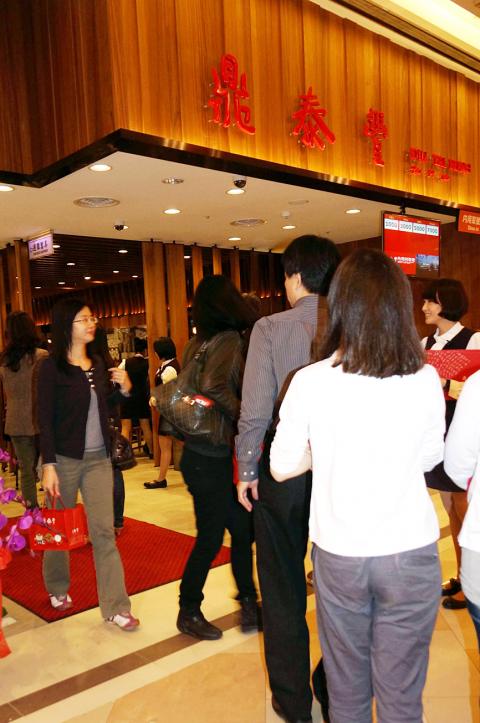
Photo: CNA
Half of the top 10 restaurants were in Beijing, with Duck de Chine — noted for its Peking duck — in second place and the Chinese-style nouvelle cuisine Green T. House in third.
“Our feeling is that Shanghai has had a good reputation as a restaurant city for some time, due both to a strong regional cuisine and the early incursions of Western celebrity chefs ... but that Beijing is definitely catching up,” Andrews said. “It’s an imperfect analogy, but in a way the culinary contrast between the two mirrors that between New York City and Washington DC. The former is more famous as a food city, but Washington increasingly offers serious competition — usually just with a little less fanfare.”
Food critics, writers and long-term foreign residents in Asia, among others, voted on a list of restaurants pulled together over a six-month nomination period — considering cuisine, style, value and overall buzz — to select the top 101.
Beijing’s Temple Restaurant came in fourth, while Capital M, a modern Australian restaurant overlooking Tiananmen Square, was fifth. Another Beijing establishment, Dali Court, hit seventh.
Varq, in the Indian capital, New Delhi, came in sixth.
The top 10 were rounded out by Hong Kong’s venerable Lung King Heen and Michel Bras TOYA, Japon, a Michelin three-star restaurant on Japan’s northernmost island, Hokkaido.
Andrews said that Asia’s flourishing restaurant scene was developing some interesting new trends. Five Indian restaurants made the list, including one in Bangalore.
“India, indeed, will continue to develop in restaurant terms — and I hope not entirely through the efforts of the top hotel chains — but I also think South Korea shows great promise and frankly I’m surprised that more of its top restaurants didn’t place on our list,” he said.
The top South Korean restaurant was The Byeokje Galbi in Seoul, which came in at 30.
The list included restaurants in Taiwan, Cambodia, China, Hong Kong, India, Indonesia, Japan, Macau, South Korea, Singapore, Sri Lanka, Thailand and Vietnam and can be found on: www.thedailymeal.com/101-best-restaurants-asia.

NATIONAL SECURITY: Authorities are working to confirm the identities of the military personnel involved and investigating possible illegal conduct and regulatory violations Authorities are probing possible national security implications after Kinmen police and immigration officers on Sunday found a Chinese woman allegedly posing as a tourist while engaging in prostitution involving more than 10 military personnel. The woman, surnamed Chen (陳), has since been deported, authorities said, adding that investigators are still working to confirm the identities of those implicated, as the records only listed code names and aliases. The case stemmed from a report received by the Kinmen District Prosecutors’ Office on Friday last week from the Jinhu Precinct of the Kinmen County Police Bureau. On Sunday, police, along with the National Immigration

GLOBALGIVING: ‘ Caving to external pressure is not acceptable for an organization that has cultivated justice reform and human rights for 30 years,’ one NGO said A slew of non-government organizations (NGOs) have withdrawn from the GlobalGiving fundraising platform after it announced it would use “Chinese Taipei” instead of “Taiwan” from next month. The Taiwan Good Rice Association wrote on Facebook on Friday that it was informed on April 28 via a teleconference call of the change, which was made because the platform wanted to operate in China. Taiwan Good Rice is to terminate all cooperative relationships with GlobalGiving in response to the platform’s “unilateral and non-negotiable” decision to remove references to Taiwan, the NGO said. “Taiwan is in the official name of Taiwan Good Rice Association and the

HEAVY WEATHER: Typhoon Jangmi is due to crash straight into the Ryukyus as airlines look to shift flights to larger aircraft or cancel flights to Okinawa entirely Taiwan’s international air carriers announced flight adjustments over the weekend as Typhoon Jangmi is forecast to hit the Ryukyu Islands today and tomorrow. The Central Weather Administration (CWA) upgraded Jangmi from a tropical storm to a typhoon at 8am yesterday, with the eye located 580km south of Naha city. It was moving north at 19kph. Today, China Airlines’ CI-120, CI-121, CI-122 and CI-123 flights between Taoyuan and Naha, Okinawa, have been canceled as well as CI-132 and CI-133 between Kaohsiung and Naha. EVA Air’s BR-112, BR-113, BR-186 and BR-185 flights between Taoyuan and Naha are also canceled. Low-cost carrier Tigerair Taiwan canceled IT-230,

Chinese Nationalist Party (KMT) Chairwoman Cheng Li-wun (鄭麗文) yesterday briefed her party’s Central Standing Committee regarding her scheduled visit to the US between Monday next week and June 16, saying that her purpose would be to persuade the US that the Republic of China (ROC) Constitution was a “one China” constitution that would foster stable and peaceful cross-strait relations. The ROC Constitution is the most important defense for all Taiwanese citizens, as it upholds our democracy and has contributed to our robust economy, which aligns with international and US interests, she said. “We would not be troublemakers and drag the US under,”


 RSS
RSS