


Female leaders of the anti-nuclear power movement in Taiwan said they became involved in the issue and the development of the movement because they were confident that women could play a “pivotal” role in the campaign that has swept the nation.
“I am glad that so many people stepped up and took action to voice their opinions on this important issue, but this is just the beginning. The road ahead is still long,” Irene Chen (陳藹玲), Fubon Cultural and Educational Foundation board director and founder of Mom Loves Taiwan, an association for mothers against nuclear power, said yesterday.
Chen, one of the leading figures in raising public awareness of the controversial construction of the Fourth Nuclear Power Plant in New Taipei City’s (新北市) Gongliao District (貢寮), spoke to reporters on the sidelines of a forum one day after nationwide anti-nuclear demonstrations. An estimated 200,000 people participated in the protests on the eve of the second anniversary of Japan’s Fukushima Dai-ichi nuclear power plant accident.
At the forum, organized by the Taiwan Environmental Protection Union, Chen said she did not pay attention to the issue until November last year, but she understood that “late is better than never” and women should step forward and make their voices heard.
After studying the issue, Chen contacted her friends, most of whom are artists, film directors or entertainers, to coordinate efforts to raise public awareness by releasing short films and other promotional materials.
The “celebrity effect” that Chen’s initiative generated was considered by some as the primary reason why the movement’s momentum has snowballed in a short period of time.
Chen credited Tokyo-based Taiwanese writer Liu Li-erh (劉黎兒), who also attended the forum, as her inspiration, as Liu was the first writer to write regularly on Japan’s nuclear situation and anti-nuclear movement in the aftermath of the 2011 disaster.
Women in Japan, especially those who have children, took instant and substantial actions right after the incident, Liu said, by demanding transparent and accurate information, strict food safety standard as well organization of anti-nuclear events that asked the Japanese government to abandon nuclear energy in an effort that has become known as the “Mother’s revolution” in Japan.
Inspired by a similar event in Japan, Liu said Taiwanese women planned to organize an “anti-nuclear 4-5-6” event in Taiwan, with a gathering to protest construction of the Fourth Nuclear Power Plant to be held at 6pm every Friday at Liberty Square in Taipei so people could gather and plan their next moves.
“We should not let the movement’s momentum fade,” Liu said.
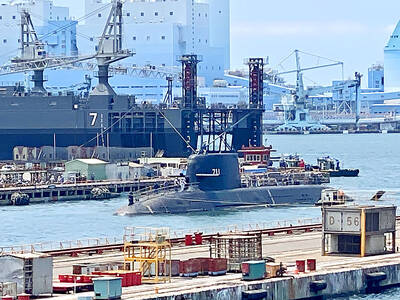
AGING: While Japan has 22 submarines, Taiwan only operates four, two of which were commissioned by the US in 1945 and 1946, and transferred to Taiwan in 1973 Taiwan would need at least 12 submarines to reach modern fleet capabilities, CSBC Corp, Taiwan chairman Chen Cheng-hung (陳政宏) said in an interview broadcast on Friday, citing a US assessment. CSBC is testing the nation’s first indigenous defense submarine, the Hai Kun (海鯤, Narwhal), which is scheduled to be delivered to the navy next month or in July. The Hai Kun has completed torpedo-firing tests and is scheduled to undergo overnight sea trials, Chen said on an SET TV military affairs program. Taiwan would require at least 12 submarines to establish a modern submarine force after assessing the nation’s operational environment and defense

A white king snake that frightened passengers and caused a stir on a Taipei MRT train on Friday evening has been claimed by its owner, who would be fined, Taipei Rapid Transit Corp (TRTC) said yesterday. A person on Threads posted that he thought he was lucky to find an empty row of seats on Friday after boarding a train on the Bannan (Blue) Line, only to spot a white snake with black stripes after sitting down. Startled, he jumped up, he wrote, describing the encounter as “terrifying.” “Taipei’s rat control plan: Release snakes on the metro,” one person wrote in reply, referring
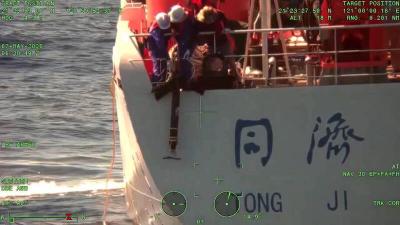
The coast guard today said that it had disrupted "illegal" operations by a Chinese research ship in waters close to the nation and driven it away, part of what Taipei sees a provocative pattern of China's stepped up maritime activities. The coast guard said that it on Thursday last week detected the Chinese ship Tongji (同濟號), which was commissioned only last year, 29 nautical miles (54km) southeast of the southern tip of Taiwan, although just outside restricted waters. The ship was observed lowering ropes into the water, suspected to be the deployment of scientific instruments for "illegal" survey operations, and the coast
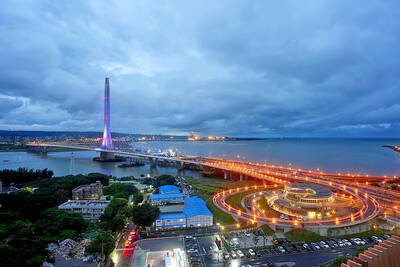
An inauguration ceremony was held yesterday for the Danjiang Bridge, the world’s longest single-mast asymmetric cable-stayed bridge, ahead of its official opening to traffic on Tuesday, marking a major milestone after nearly three decades of planning and construction. At the ceremony in New Taipei City attended by President William Lai (賴清德), Premier Cho Jung-tai (卓榮泰), Minister of Transportation and Communications Chen Shih-kai (陳世凱) and New Taipei City Mayor Hou Yu-ih (侯友宜), the bridge was hailed as both an engineering landmark and a long-awaited regional transport link connecting Tamsui (淡水) and Bali (八里)


 RSS
RSS