


Former Chinese Nationalist Party (KMT) chairman Lien Chan (連戰) yesterday said he was going to China to promote engagement across the Taiwan Strait.
“The purpose of my trip is very simple — to boost bilateral exchanges by reviewing past developments and projecting future growth trends,” Lien said prior to his departure for Beijing.
Lien, who is traveling at the head of a delegation of more than 30 political figures and business executives, said he had not visited Beijing in nearly two years.
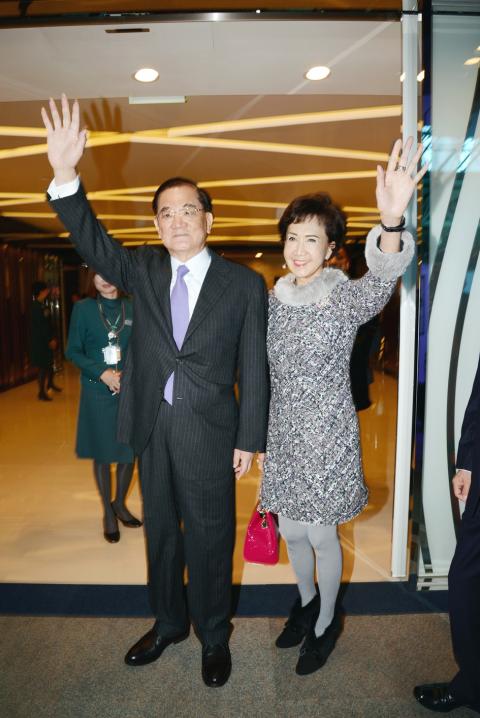
Photo: CNA
“I want to take advantage of this trip to get an overview of the latest developments there and meet old friends and good pals of mine, as well as make new friends,” he said.
“Today happens to be the Lantern Festival on the Chinese Lunar calendar. This is a really good time to make a nostalgic, yet forward-looking journey,” he added.
Lien said that while cross-strait relations have made substantial progress in various aspects since the crucial years of 2005 and 2008, there was still ample room for improvement.
In 2005, Lien met Chinese President Hu Jintao (胡錦濤) for the first time in Beijing in his capacity as then-opposition KMT chairman. The meeting was widely credited as an ice-breaking event that helped thaw the long-stalled cross-strait relations.
Bilateral engagements made another breakthrough in 2008, when the the KMT returned to power and institutionalized cross-strait talks were resumed.
During his current visit to Beijing, Lien said he would exchange views with the Chinese side on how to expand and deepen bilateral engagements based on past achievements and current foundations.
Lien further said he was not visiting China for any partisan or personal interests.
“The trip is mainly for maintaining lasting peace, stability and prosperity across the Taiwan Strait,” Lien added.
Chinese authorities reportedly took the initiative to invite Lien to visit Beijing.
He is scheduled to meet with China’s president-in-waiting, Chinese Vice President Xi Jinping (習近平), today, making him the first influential Taiwanese figure to meet with Xi since he took over the helm of the Communist Communist Party (CCP) in November last year.
Xi, who has seldom addressed Taiwan-related topics in public since he assumed the post as CCP general secretary, is widely expected to outline his vision for cross-strait relations during his meeting with Lien.
Lien will hold a press conference in Beijing at 11am today after his meeting with Xi earlier in the day, according to reports from Beijing.
The members of Lien’s delegation include KMT vice chairmen Lin Fong-cheng (林豐正) and John Chiang (蔣孝嚴), New Party Chairman Yok Mu-ming (郁慕明), Lien’s son, Sean Lien (連勝文), and several business tycoons, such as Hon Hai Group chairman Terry Gou (郭台銘) and Ruentex Group chairman Samuel Yin (尹衍樑).
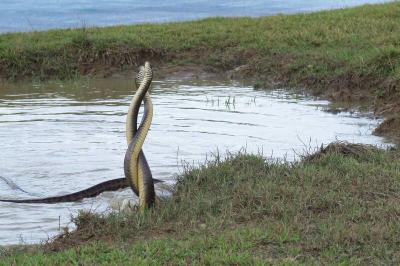
Kenting National Park service technician Yang Jien-fon (楊政峰) won a silver award in World Grand Prix Photography Awards Spring Season for his photograph of two male rat snakes intertwined in combat. Yang’s colleagues at Kenting National Park said he is a master of nature photography who has been held back by his job in civil service. The awards accept entries in all four seasons across six categories: architectural and urban photography, black-and-white and fine art photography, commercial and fashion photography, documentary and people photography, nature and experimental photography, and mobile photography. Awards are ranked according to scores and divided into platinum, gold and

More than half of the bamboo vipers captured in Tainan in the past few years were found in the city’s Sinhua District (新化), while other districts had smaller catches or none at all. Every year, Tainan captures about 6,000 snakes which have made their way into people’s homes. Of the six major venomous snakes in Taiwan, the cobra, the many-banded krait, the brown-spotted pit viper and the bamboo viper are the most frequently captured. The high concentration of bamboo vipers captured in Sinhua District is puzzling. Tainan Agriculture Bureau Forestry and Nature Conservation Division head Chu Chien-ming (朱健明) earlier this week said that the

The Chinese Nationalist Party (KMT) caucus yesterday said it opposes the introduction of migrant workers from India until a mechanism is in place to prevent workers from absconding. Minister of Labor Hung Sun-han (洪申翰) on Thursday told the Legislative Yuan that the first group of migrant workers from India could be introduced as early as this year, as part of a government program. The caucus’ opposition to the policy is based on the assessment that “the risk is too high,” KMT caucus secretary-general Lin Pei-hsiang (林沛祥) said. Taiwan has a serious and long-standing problem of migrant workers absconding from their contracts, indicating that

SPACE VETERAN: Kjell N. Lindgren, who helps lead NASA’s human spaceflight missions, has been on two expeditions on the ISS and has spent 311 days in space Taiwan-born US astronaut Kjell N. Lindgren is to visit Taiwan to promote technological partnerships through one of the programs organized by the US for its 250th national anniversary. Lindgren would be in Taiwan from Tuesday to Saturday next week as part of the US Bureau of Educational and Cultural Affairs’ US Speaker Program, organized to celebrate the 250th anniversary of the signing of the Declaration of Independence, the American Institute in Taiwan (AIT) said in a statement yesterday. Lindgren plans to engage with key leaders across the nation “to advance cutting-edge technological partnerships and inspire the next generation of scientists and engineers,”


 RSS
RSS