


Minister of Justice Tseng Yung-fu (曾勇夫) yesterday dismissed a remark by the Control Yuan that the judicial system was responsible for imprisoned former president Chen Shui-bian’s (陳水扁) health.
“What we have had said about [Chen’s] health condition was not groundless but based on the information provided by professional physicians,” Tseng said.
Tseng added that Taipei Prison, where Chen had been imprisoned since December 2010 before he was admitted to Taoyuan General Hospital in September last year to receive treatment, “has made great efforts to take care of his health.”
Chen received the best possible treatment in Taipei Prison, Tseng said.
Control Yuan members on Friday endorsed an investigation into how the judicial system handled Chen’s health complaints.
The 62-year-old former president, serving an 18-and-a-half-year prison sentence on corruption charges following a controversial trial, has been treated at the Taipei Veterans General Hospital since September last year for suspected depression and other health problems.
In October last year, Chen was diagnosed with severe depression compounded with anxiety and somatization disorder, among other ailments.
Chen’s voluntary civilian medical team have said that the severity of Chen’s conditions was dismissed and some serious neurological problems were ignored.
The report conducted by Control Yuan member Huang Huang-hsiung (黃煌雄) found that Chen’s illness could be attributed to his prison environment.
It also found that the ministry and Taipei Prison did not deal appropriately with Chen’s heath conditions and on several occasions downplayed Chen’s health issues.
Following the report, National Taiwan University Hospital physician Ko Wen-je (柯文哲), a member of Chen’s voluntary civilian medical team, said that Chen’s health issues have turned him into a “wreck.”
Asked by reporters for comment, Tseng said he disagreed with Ko.
“The question depends on the perspective you take on the issue,” Tseng said.
He did not elaborate, nor did he respond to Huang’s remarks that the report implicitly suggested that Chen should be granted medical parole.
While Huang’s report suggested that medical parole for Chen might be in order, the High Court on Friday ruled that Chen and his wife, Wu Shu-jen (吳淑珍), should each serve 20 years in prison.
In addition to the prison terms of the former first couple, the High Court ordered Chen and Wu to pay NT$250 million (US$8.4 million) and NT$200 million in fines respectively.
The former first lady, who uses a wheelchair, was judged unfit to serve her prison term of 17.5 years.
The High Court based its decision to combine all the prison terms of the first couple on Article 51 of the Criminal Code before it was amended in 2005, because the crimes had been committed before then, legal experts said.
The original article stipulated that the maximum combined term for any individual given multiple sentences should be 20 years, unless those sentences include life in prison.
Meanwhile, Democratic Progressive Party Chairman Su Tseng-chang (蘇貞昌) yesterday repeated his call for granting Chen medical parole.
The Control Yuan and Chen’s medical team have both asserted the necessity for Chen to be granted medical parole, he said.
“Ma should not hesitate [on granting medical parole]. Nor should he prevent the former president from receiving his medical rights,” Su said.
Additional reporting by Chris Wang

FUKUOKA SITUATION: Japanese media reported that the pathogen is expected to be identified by the summer, while the CDC downplayed the idea that it was hMPV A “mysterious cold-like illness” reported in Japan’s Fukuoka Prefecture does not seem to be a new disease, but Japanese authorities have been asked about the situation, the Centers for Disease Control (CDC) said yesterday. The Fukuoka Prefectural Medical Association on Wednesday told a news conference that a “mystery cold” that has become a hot topic on social media is “highly likely to be caused by some kind of viral infection,” Japan’s KBC News reported. “Many people are experiencing symptoms starting with a sore throat, followed by a runny nose, phlegm and a severe cough,” KBC News reported, citing association officials. Health authorities are

Nvidia Corp CEO Jensen Huang (黃仁勳) arrived in Taiwan yesterday ahead of upcoming AI and technology events, saying he plans to meet with clients and Taiwan Semiconductor Manufacturing Co Chairman C.C. Wei (魏哲家) during his visit. After landing at Taipei Songshan Airport, Huang posed for photos with fans and handed out Yakult drinks to reporters and supporters waiting at the scene, saying he has “a lot to do” during the trip. Asked about reports that Nvidia’s planned headquarters site in Taipei’s Beitou Shilin Technology Park could break ground on May 27, Huang said that if the company holds an event, he would

The Ministry of Finance this afternoon announced the winning numbers for the March-April uniform invoice lottery. The winning number for the NT$10 million (US$318,060) special prize is 19531471, and the winning number for the NT$2 million grand prize is 85941329. Three numbers were drawn for the NT$200,000 first prize: 07225810, 20231230 and 83518781. Those with receipts matching the last seven digits of any of the first-prize numbers will win the NT$40,000 second prize, while those matching the last six digits will win the NT$10,000 third prize. Those whose receipts match the last five digits of the first-prize numbers can claim the NT$4,000 fourth prize,
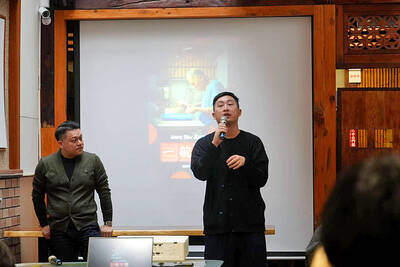
Taiwan Travelogue (臺灣漫遊錄), which earlier this week became the first Taiwanese novel to win the International Booker Prize, is to be adapted into a television series through a Taiwan-Japan coproduction, producer Chang Chen-yu (張辰漁) said yesterday. Chang, a producer at World Softest Production Film Co, wrote on Facebook that the company had been searching for projects with international appeal that retain a strong Taiwanese identity after colleagues and Japanese partners strongly recommended the novel. After reading the book, Chang said he immediately decided to pursue the screen rights. “A great story has the power to transcend time and borders, and connect countless people,”


 RSS
RSS