


The coffee chain 85°C must pay an employee NT$74,000 in damages after she developed constrictive tenosynovitis and tendinitis due to long hours of work, the Taichung District Court ruled on Thursday.
The plaintiff, surnamed Wang (王), started working at the company’s centralized factory in Greater Taichung’s Nantun District (南屯) in 2005. Tasked with packaging, Wang said she had to maintain a fixed posture for three to eight hours per day, during which she had to cut 100 to 250 frozen cakes.
In April 2010, Wang visited a doctor because of chronic hand pain. She was diagnosed with constrictive tenosynovitis, commonly known as trigger finger syndrome, in her right thumb and also tendinitis.
Constrictive tenosynovitis is a condition where the superficial and deep flexor tendon of the finger becomes inflamed and the tendon experiences a nodular enlargement, either making the finger painful to move or sometimes locking it in place. The condition usually occurs in the index or ring finger, but occasionally in the thumbs as well.
After quitting her job in May 2010, Wang obtained medical proof from the China University University Hospital that her injuries were occupational, winning her NT$117,000 in compensation from the Labor Insurance Bureau. She also filed suit against 85°C, seeking NT$333,000 in compensation.
Though 85°C denied that Wang’s injuries resulted from her work, the judge in the ruling said the doctor’s diagnosis confirmed that her condition had come from overly repetitive actions of grabbing and holding things.
However, as the company had not violated labor regulations nor asked Wang to work beyond normal hours, there was no basis for her demand for psychologically related compensation, the ruling said.
Saying that Wang had lost income of more than 200 workdays due to her injuries, the court ruled that the firm must pay her NT$74,000 in damages.
Chung Ching-ju (鐘靜如), the company’s public relations and sales director, said it would consult with its lawyers on how to react after it received the ruling in writing.
However, Chung said the company had centralized its factories prior to 2005 and cakes were all cut by machines. Unless certain occasions required production that exceeded the machines’ capacity, it would not need to have its staff slicing cakes, she said.
Wang was also a deputy section chief, Chung said, which meant she was not slicing cakes everyday because she would have had management duties aside from her routine work.
It was impossible to slice that many cakes a day, Chung added.
According to regulations, medical staff must first visit the working environment prior to awarding the patient proof of injury, Chung said the company doubted the veracity of the medical proof as the doctor who signed the certificate had not visited the factory.

FUKUOKA SITUATION: Japanese media reported that the pathogen is expected to be identified by the summer, while the CDC downplayed the idea that it was hMPV A “mysterious cold-like illness” reported in Japan’s Fukuoka Prefecture does not seem to be a new disease, but Japanese authorities have been asked about the situation, the Centers for Disease Control (CDC) said yesterday. The Fukuoka Prefectural Medical Association on Wednesday told a news conference that a “mystery cold” that has become a hot topic on social media is “highly likely to be caused by some kind of viral infection,” Japan’s KBC News reported. “Many people are experiencing symptoms starting with a sore throat, followed by a runny nose, phlegm and a severe cough,” KBC News reported, citing association officials. Health authorities are

Nvidia Corp CEO Jensen Huang (黃仁勳) arrived in Taiwan yesterday ahead of upcoming AI and technology events, saying he plans to meet with clients and Taiwan Semiconductor Manufacturing Co Chairman C.C. Wei (魏哲家) during his visit. After landing at Taipei Songshan Airport, Huang posed for photos with fans and handed out Yakult drinks to reporters and supporters waiting at the scene, saying he has “a lot to do” during the trip. Asked about reports that Nvidia’s planned headquarters site in Taipei’s Beitou Shilin Technology Park could break ground on May 27, Huang said that if the company holds an event, he would

The Ministry of Finance this afternoon announced the winning numbers for the March-April uniform invoice lottery. The winning number for the NT$10 million (US$318,060) special prize is 19531471, and the winning number for the NT$2 million grand prize is 85941329. Three numbers were drawn for the NT$200,000 first prize: 07225810, 20231230 and 83518781. Those with receipts matching the last seven digits of any of the first-prize numbers will win the NT$40,000 second prize, while those matching the last six digits will win the NT$10,000 third prize. Those whose receipts match the last five digits of the first-prize numbers can claim the NT$4,000 fourth prize,
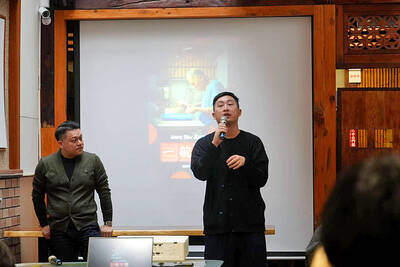
Taiwan Travelogue (臺灣漫遊錄), which earlier this week became the first Taiwanese novel to win the International Booker Prize, is to be adapted into a television series through a Taiwan-Japan coproduction, producer Chang Chen-yu (張辰漁) said yesterday. Chang, a producer at World Softest Production Film Co, wrote on Facebook that the company had been searching for projects with international appeal that retain a strong Taiwanese identity after colleagues and Japanese partners strongly recommended the novel. After reading the book, Chang said he immediately decided to pursue the screen rights. “A great story has the power to transcend time and borders, and connect countless people,”


 RSS
RSS