


A man surnamed Chiu (邱) yesterday accused smartphone manufacturer HTC of illegally laying off hundreds of part-time workers in July.
Chiu was one of hundreds of part-time employees fired without warning by HTC, who never signed contracts with them, he said at a press conference organized by Democratic Progressive Party (DPP) Legislator Cheng Li-chiun (鄭麗君).
HTC recently sent him a text message requesting his emergency recruitment, Chiu said, adding that it made him feel the company thought of him like “human trash, without dignity.”
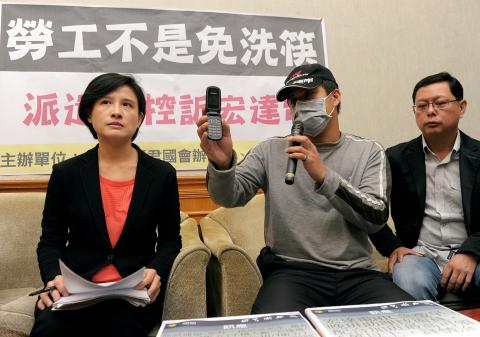
Photo: CNA
Chiu said he had worked at the company for nearly one year, for more than 12 hours each day, yet received no severance pay after being let go and did not qualify for unemployment benefits.
“Why is this company allowed to dismiss part-time workers at will?” he asked.
The company’s conduct has hurt its image as a renowned international brand which values corporate social responsibility, Taiwan Labor Front secretary-general Sun Yu-lien (孫友聯) said.
Cheng said he suspected HTC was abusing cheap labor and part-time hiring since its need for manpower has been obvious, adding that the company had violated the Council Of Labor Affairs’ regulations on part-time employment, which require written contracts for part-time employees and advance notice before said contract is terminated.
The lawmaker said that, as a company backed by the government, HTC should shoulder more social responsibility and the council should investigate temporary employment agencies for conducting illegal hiring practices.
Huang Chi-ya (黃琦雅) of the council’s Department of Labor Relations said HTC had violated Article 16 of the Labor Standards Act (勞動基準法) by not giving Chiu a 10-day notice before firing him and that the council would launch a probe of the company. If violations are proven, the company would be facing a fine up to NT$300,000 (US$10,000).

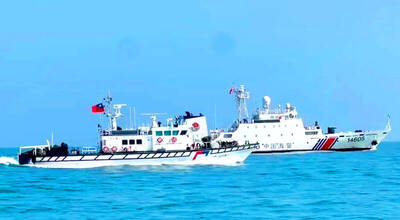
The military has spotted two Chinese warships operating in waters near Penghu County in the Taiwan Strait and sent its own naval and air forces to monitor the vessels, the Ministry of National Defense (MND) said. Beijing sends warships and warplanes into the waters and skies around Taiwan on an almost daily basis, drawing condemnation from Taipei. While the ministry offers daily updates on the locations of Chinese military aircraft, it only rarely gives details of where Chinese warships are operating, generally only when it detects aircraft carriers, as happened last week. A Chinese destroyer and a frigate entered waters to the southwest
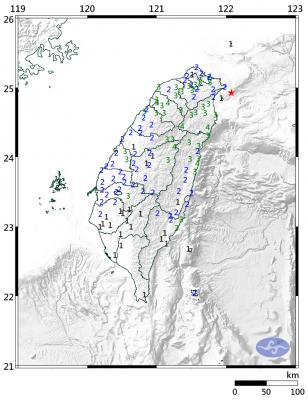
A magnitude 6.1 earthquake struck off the coast of Yilan County at 8:39pm tonight, the Central Weather Administration (CWA) said, with no immediate reports of damage or injuries. The epicenter was 38.7km east-northeast of Yilan County Hall at a focal depth of 98.3km, the CWA’s Seismological Center said. The quake’s maximum intensity, which gauges the actual physical effect of a seismic event, was a level 4 on Taiwan’s 7-tier intensity scale, the center said. That intensity level was recorded in Yilan County’s Nanao Township (南澳), Hsinchu County’s Guansi Township (關西), Nantou County’s Hehuanshan (合歡山) and Hualien County’s Yanliao (鹽寮). An intensity of 3 was
Instead of focusing solely on the threat of a full-scale military invasion, the US and its allies must prepare for a potential Chinese “quarantine” of Taiwan enforced through customs inspections, Stanford University Hoover fellow Eyck Freymann said in a Foreign Affairs article published on Wednesday. China could use various “gray zone” tactics in “reconfiguring the regional and ultimately the global economic order without a war,” said Freymann, who is also a nonresident research fellow at the US Naval War College. China might seize control of Taiwan’s links to the outside world by requiring all flights and ships entering or leaving Taiwan
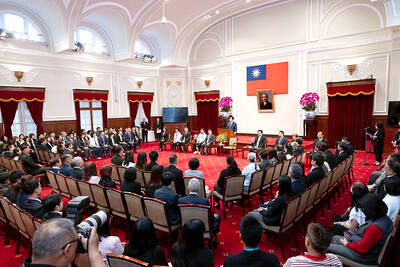
The next minimum wage hike is expected to exceed NT$30,000, President William Lai (賴清德) said yesterday during an award ceremony honoring “model workers,” including migrant workers, at the Presidential Office ahead of Workers’ Day today. Lai said he wished to thank the awardees on behalf of the nation and extend his most sincere respect for their hard work, on which Taiwan’s prosperity has been built. Lai specifically thanked 10 migrant workers selected for the award, saying that although they left their home countries to further their own goals, their efforts have benefited Taiwan as well. The nation’s industrial sector and small businesses lay


 RSS
RSS