


The Institute of Nuclear Energy Research (INER) yesterday denied accusations from an environmentalist that it has long been illegally discharging radioactively contaminated waste water into irrigation channels in Taoyuan County’s Dasi Township (大溪) and threatening the nearby Kanjin Aboriginal Community (崁津部落).
Residents of Kanjin, a predominantly Amis Aboriginal community on the bank of the Dahan River (大漢溪), have been concerned over the past few days after Green Formosa Front board member Lin Chang-mau (林長茂) on Thursday accused the INER of releasing contaminated wastewater into the local irrigation system.
Lin supported his claim by saying that dead frogs and mice had been found in the irrigation channel.
“We’re very worried because we not only use the water for the irrigation of our vegetable crops and rice, we also drink the underground water since we don’t have running water,” community spokeswoman Tsai Hui-lan (蔡惠蘭) said.
Chen Fu-sheng (陳福聲), a Kanjin resident, said that back in the 1980s, the INER once dug up a large quantity of soil at a site near the village.
“At the time, I thought they were building a fish pond, but they covered it afterward and closed off the area with barbed wire,” Chen said. “I suspect they may have buried something there.”
Chen said he used to grow mountain yams on a farm next to the closed-off area. However, after the INER’s construction, nothing grows on the plot of land anymore.
As an irrigation channel flows through the closed-off area and then into Kanjin, Kanjin Chieftain Chang Ching-lin (張清林) said he feared that even if the water is clean, “it may get contaminated while flowing through the restricted area before flowing into our village.”
INER and Atomic Energy Council (AEC) officials, who visited the community at the invitation of Chinese Nationalist Party (KMT) Legislator Liao Kuo-tung (廖國棟) of the Amis tribe, rebutted the claims and guaranteed that the water released by the institute into the irrigation system is safe, saying it has been processed and water samples from irrigation channels as well as soil and plant samples from the area are inspected every three months.
“The INER has been in the area for over 40 years and most INER employees, including myself, my family and my colleagues who came with me today, live here,” INER director-general Ma Yin-pang (馬殷邦) told the Kanjin residents. “Hence we take the nuclear safety issue very seriously. If something goes wrong, it affects not only you, but also ourselves and our children.”
INER Health Physics Division deputy director Wang Jeng-jong (王正忠) said that while the wastewater from the institute is released into the irrigation system, it would be processed before releasing.
“After its release, we will periodically take samples of water, soil and plants to check, and then our examination report will be presented to the AEC, they will conduct their own testing while also commissioning an independent third-party lab to test at the same time,” Wang said. “The AEC intends to then compare results from different sources to check their accuracy.”
Ma added that it was very unlikely the frogs and mice in the irrigation channel died as a result of radioactive contamination.
“It must be a very high dose of radiation to kill animals,” Ma said. “Animals and humans survived the radiation leak at the Fukushima nuclear power plant in Japan last year, so you know the contamination must be much stronger than that to kill animals.”
He said the restricted area was a plot of land that had been sealed off after an accidental leak of contaminated water from the INER.
“We reacted responsibly by immediately closing off the area, digging up the soil and storing it in a secure place within the INER, leaving the land idle and going back to check the radioactive value periodically,” Ma said. “So far, we haven’t detected anything unusual.”
At the request of the community, the AEC took water samples from locations designated by residents and promised to report the results within a week.

REASONS FOR TRAVEL: An assistant professor said that proposed amendments to penalize drivers if they used drugs overseas would not deter people from traveling People who operate a motor vehicle under the influence of marijuana would have their driver’s license revoked, even if they used the substance while overseas, the Ministry of Transportation and Communications said yesterday, citing proposed amendments to the Road Traffic Management and Penalty Act (道路交通管理處罰條例). The amendments would also authorize the government to revoke the licenses of people determined to have used Category 1 or Category 2 narcotics, even if they were not operating a vehicle while under the influence of drugs, as well as ban them from taking the license test for three years, the ministry said. People aged 18 or

GLOBALGIVING: ‘ Caving to external pressure is not acceptable for an organization that has cultivated justice reform and human rights for 30 years,’ one NGO said A slew of non-government organizations (NGOs) have withdrawn from the GlobalGiving fundraising platform after it announced it would use “Chinese Taipei” instead of “Taiwan” from next month. The Taiwan Good Rice Association wrote on Facebook on Friday that it was informed on April 28 via a teleconference call of the change, which was made because the platform wanted to operate in China. Taiwan Good Rice is to terminate all cooperative relationships with GlobalGiving in response to the platform’s “unilateral and non-negotiable” decision to remove references to Taiwan, the NGO said. “Taiwan is in the official name of Taiwan Good Rice Association and the

HEAVY WEATHER: Typhoon Jangmi is due to crash straight into the Ryukyus as airlines look to shift flights to larger aircraft or cancel flights to Okinawa entirely Taiwan’s international air carriers announced flight adjustments over the weekend as Typhoon Jangmi is forecast to hit the Ryukyu Islands today and tomorrow. The Central Weather Administration (CWA) upgraded Jangmi from a tropical storm to a typhoon at 8am yesterday, with the eye located 580km south of Naha city. It was moving north at 19kph. Today, China Airlines’ CI-120, CI-121, CI-122 and CI-123 flights between Taoyuan and Naha, Okinawa, have been canceled as well as CI-132 and CI-133 between Kaohsiung and Naha. EVA Air’s BR-112, BR-113, BR-186 and BR-185 flights between Taoyuan and Naha are also canceled. Low-cost carrier Tigerair Taiwan canceled IT-230,
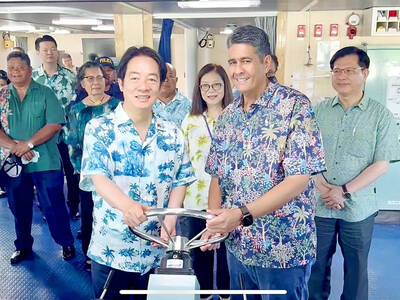
MULTIPRONGED APPROACH: China has sought to pressure Palau across a number of fronts, but the island nation has staunchly resisted overtures to ditch Taiwan Palau has been firm in backing Taiwan despite Chinese pressure that uses tourism economics, cyberattacks and criminal infiltration as tools to threaten the Pacific ally into renouncing its recognition of Taiwan as a sovereign state. The Presidential Office yesterday announced that Vice President Hsiao Bi-khim (蕭美琴) would visit Palau from Saturday to Wednesday next week at the invitation of Palauan President Surangel Whipps Jr. Whipps in April said in an interview that China had outspokenly asked Palau to “denounce Taiwan.” “And we have said: ‘We have no enemies, but nobody tells us who our friends are,’” he said. Whipps has told reporters multiple times


 RSS
RSS