


“War criminal” is not the first expression that comes to mind when seeing white-haired Chou Ching-feng in his living room in central Taiwan, sipping tea with his daughter, son-in-law and grandchildren.
However, nearly 70 years ago, he worked for the Japanese army in what is now Malaysia, guarding Australian prisoners in one of the numerous prisoner-of-war (POW) camps that were scattered across occupied Southeast Asia.
“The Japanese officers told us to beat the prisoners, and beat them hard. They were very meticulous about that,” said Chou, now 86.
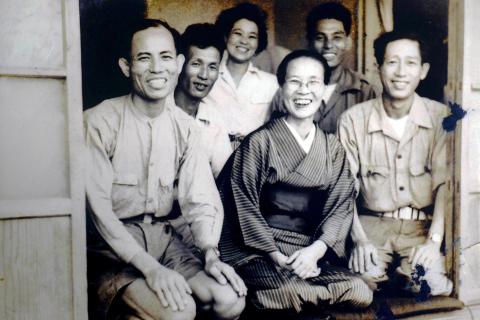
Photo: Chou Ching-feng, AFP
He is one of about 160 Taiwanese who were punished for their activities in World War II. Eleven were executed.
However, Chou sees himself as a victim and wants compensation from Japan, which he says took the best years of his life and turned them into a long march through the prison camps — on both sides of the barbed wire.
Japan is repeatedly pressed by its neighbors to do more to atone for its wartime actions.
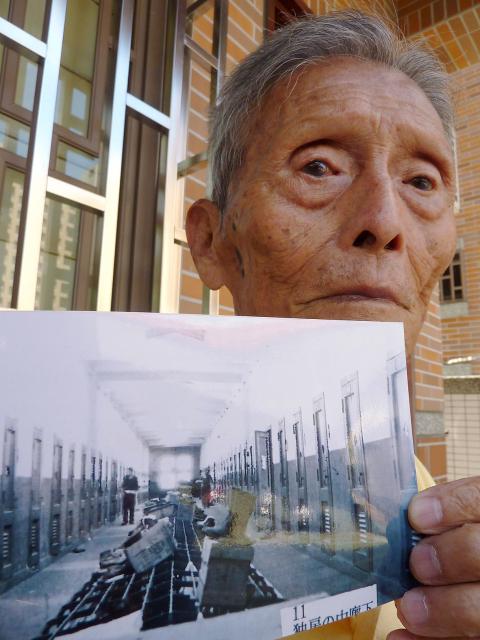
Photo: Peter Harmsen, AFP
For Chou, the Taiwan he grew up in was a Japanese colony and had been one for decades. He had gone to a Japanese school and even had a Japanese name — Okamoto Yoshiaki.
His family was poor, and when, in 1943, he saw an advertisement for Taiwanese volunteers to serve overseas in the Japanese armed forces, he signed up.
A former teacher of his, who was Japanese, was furious.
“Why do you want to get involved in that?” he asked, exasperated. “Stay at home.”
Chou did not listen to him. He needed the money.
After a short period of training in Taiwan, he was sent to northern Borneo, in what is now Malaysia, to serve in the prison camps.
The Japanese camps were among the worst horror stories of the war. More than 27 percent of all Western prisoners died, while in German-run camps in Europe, less than 3 percent of US and British POWs lost their lives.
Chou said he was immediately brought into a culture of brutality where beatings formed the main currency and where everyone, prisoners and guards alike, fit into a hierarchy of violence.
Chou witnessed what happened after an officer had grown impatient with a guard who was too “soft” on a prisoner.
The officer told the guard to come over and punched him straight in the face.
“This is how you hit a prisoner,” the officer said, rubbing his knuckles.
Chou and the other Taiwanese guards were issued simple Japanese uniforms without insignia — since they did not have any rank — but to outsiders they looked Japanese all the same.
So on the occasional trip to the nearest major city, Kuching, it took some work to connect with members of the local Chinese community.
“They’d be a little hesitant, until they realized that we were Chinese, too, and then they’d loosen up, but we couldn’t talk too much. The Japanese had strict rules against fraternizing with the local population,” he said.
Even before Chou arrived in Borneo, the war was going badly for the Japanese, and as the front drew nearer, the families back home were understandably worried. Chou wrote letters to put them at ease.
“We couldn’t write any details. So it was very general, ‘I’m fine, everything is quiet,’ and so on. Just to make sure they didn’t worry too much. But it took six months for a letter to reach home,” he said.
As the Allied forces closed in, food supplies became scarcer, and a meal for an emaciated prisoner consisted of a bowl of rice sprinkled with salt.
In the end, to reduce the number of mouths they had to feed, the Japanese resorted to killing their prisoners, according to Lee Chan-ping (李展平), a Taiwanese historian who has studied Taiwan’s former camp guards in detail.
Chou said he himself did not take part in the executions, but he knew other Taiwanese who were forced to shoot unarmed men under the threat of being killed themselves if they did not carry out their orders.
When the war ended in the summer of 1945, the captors became the captives. Chou moved into the primitive huts he had been guarding for many months.
Shortly afterwards, he was sentenced to 15 years in jail. Nearly seven decades later he said he did not abuse any prisoners — a claim that is almost impossible to verify.
Over the following years, Chou moved from one Asian prison camp to another, until 1953, when he was taken to a Japan emerging from US occupation.
He was in a group of convicts, Japanese and Taiwanese, who were placed in Tokyo’s Sugamo Prison, a facility specifically used to incarcerate war criminals.
While the Japanese were allowed to go home, only reporting back to the prison authorities every month, the Taiwanese were made to stay, Chou said.
It would be three-and-a-half years before his own sentence was reduced and he was allowed to return to Taiwan.
“Everything was so different, so developed,” said Chou, who had left Taiwan as a boy of 18 and now returned as a man of 31.
He soon found work and he has lived more than half a century in relative comfort. However, he would like the Japanese government to make up for the youth he says he never got to enjoy.
His view is echoed by Lee, who said people like Chou should be compensated for the extra years spent in jail in Tokyo. He compared the situation with that in Europe, where the fall of the Berlin Wall proved closure of sorts for Europe’s post-war division.
“Germany is apologizing left and right for its behavior during the war. Japan is not like that,” Lee said.
When asked if he is optimistic he will see compensation, even today when only a couple of guards are left, Chou’s reply is straightforward: “Not too optimistic.”
The US House of Representatives yesterday passed the PROTECT Taiwan Act, which stipulates that Washington would exclude China from participating in major global financial organizations if its actions directly threaten Taiwan’s security. The bill, proposed by Republican US Representative Frank Lucas, passed with 395 votes in favor and two against. It stipulates that if China’s actions pose any threat to Taiwan’s security, economic or social systems, the US would, “to the maximum extent practicable,” exclude China from international financial institutions, including the G20, the Bank for International Settlements and the Financial Stability Board. The bill makes it clear that China
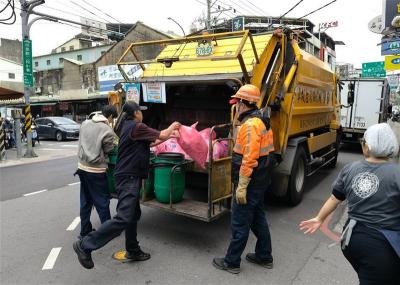
Garbage and recycling schedules are to vary from Saturday through Sunday next week over the Lunar New Year holiday period. The following collection information is from the governments of the six special municipalities. Taipei Regular service: Sunday to Monday next week. No service: Tuesday to Thursday next week. Extra service: Friday next week. Regular service resumes: Saturday next week. New Taipei City Extra service: Sunday. Adjusted collection time: Monday next week — garbage collection is to begin in the morning and end at 6pm. No service: Tuesday to Thursday next week. Regular service resumes: Friday next week. Note: Garbage can be dropped off at 70
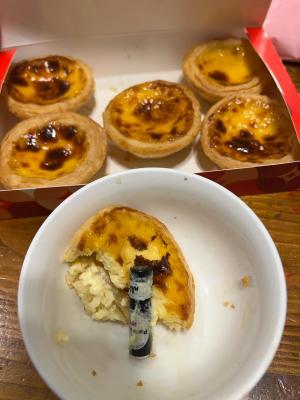
A KFC branch in Kaohsiung may be fined between NT$60,000 and NT$200 million (US$1,907 and US$6.37 million), after a customer yesterday found an entire AAA battery inside an egg tart, the Kaohsiung Department of Health said today. The customer was about to microwave a box of egg tarts they had bought at the fast-food restaurant’s Nanzih (楠梓) branch when they checked the bottom and saw a dark shadow inside one of them, they said in a Threads post. The customer filmed themself taking the egg tart apart to reveal an entire AAA battery inside, which apparently showed signs of damage. Surveillance footage showed
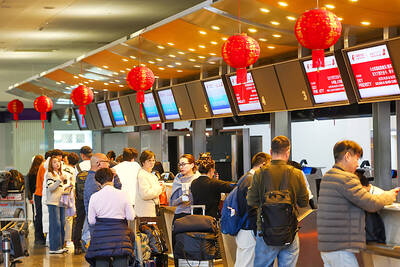
GROUP EFFORT: The number of inbound travelers rose 11 to 12 percent last month, with a significant increase in tourists from Europe and North America, an official said The government aims to attract 9.4 million visitors this year, the Tourism Administration said yesterday, citing last year’s success in diversifying tourist markets. Taiwan last year drew about 8.57 million international arrivals, 72.3 percent of pre-COVID-19 levels. By contrast, the nation had about 18.94 million outbound tourists last year, surpassing the pre-COVID-19 level of 17.1 million. The estimated tourism revenue deficit was about NT$700.9 billion (US$22.22 billion). Taoyuan International Airport Corp expects more than 160,000 passengers to pass through the nation’s largest airport daily during the Lunar New Year holiday, which begins on Saturday. As of Jan. 30, the nation’s average hotel occupancy rate


 RSS
RSS