


Anal sex, gay bathhouses and recreational drugs. Those are among the topics that readers of Gay Sex Guru: Safer Sex Guide For Gay Men (男同志性愛達人手冊) will learn about as they flip through the pages of the new guide.
Published by Taiwan Tongzhi Hotline Association, the manual is designed to promote sexual health and disease prevention in the gay community from a pragmatic point of view, physicians and gay rights activists said.
Gender/Sexuality Rights Association Taiwan secretary-general Wang Ping (王蘋) said that closing one’s eyes to sex and recreational drug use was to avoid real life.
Sex education has to address individuals’ needs and be rooted in real-life experiences so that people can learn useful information and make informed decisions, she said.
The Tongzhi Hotline first published a gay sex manual in 2005, using educational material from the UK. The content of the new handbook is based on the experiences of local communities and written by members of the association. Moreover, unlike most sex education materials available in Taiwan that use drawings and cartoons for illustration purposes, real persons were recruited to get the message across in the guide.
“We have learned from Western experience that human models are more attractive than cartoon figures, and if you want people to learn, you need to attract their attention first,” said Tu Ssu-cheng (杜思誠), director of policy advocacy at the association.
The manual offers plenty of grassroots, detailed knowledge on safe sex. For example, the chapter on gay saunas provides information ranging from how to pack for an outing to Taiwan’s gay bathhouses to how to say no to invitations.
In the chapter on recreational drugs, the most common types of party drugs are introduced and suggestions are made to help readers keep the risk to a minimum.
“Sometimes, wearing condoms is just not a viable option. So we will say ‘OK, you can do this or that’ ... rather than: ‘No, you have to wear it,’” Tu said. “Our approach is to reduce harm by offering practical advice.”
The main objective of the book is to provide correct safe-sex knowledge, clarify confusion and break sex myths, Tu added.
“The sex education taught at school is designed from a heterosexual point of view. So there are gays who don’t know it is best to use condoms and lubricants, and to apply the lubricant all over the condom instead of on the tip,” he said. “There is a big gap to fill.”
Physician Luo I-chun (羅一鈞), who works at the Centers for Disease Control, pointed to the lack of sufficient sex education for teenagers, adding that it was not uncommon for young people to think that sexually transmitted diseases can not be transmitted through oral sex or that they can be detected simply by examining the appearances of external genital organs.
Ironically, the manual is off-limits to people under 18 because of its “R” rating.
Hsu Hao-chien (徐豪謙), founder of High School Uniforms Federation, a social network for young gays and lesbians, said that safe sex needs to be learned and practiced, not just a thing people suddenly know about when they reach 18.
The guidebook is available for free at the office of Tongzhi Hotline, gay saunas and bathhouses, LGBT-friendly stores, LGBT resource centers and HIV/AIDS organizations across the country.

LOUD AND PROUD Taiwan might have taken a drubbing against Australia and Japan, but you might not know it from the enthusiasm and numbers of the fans Taiwan might not be expected to win the World Baseball Classic (WBC) but their fans are making their presence felt in Tokyo, with tens of thousands decked out in the team’s blue, blowing horns and singing songs. Taiwanese fans have packed out the Tokyo Dome for all three of their games so far and even threatened to drown out home team supporters when their team played Japan on Friday. They blew trumpets, chanted for their favorite players and had their own cheerleading squad who dance on a stage during the game. The team struggled to match that exuberance on the field, with
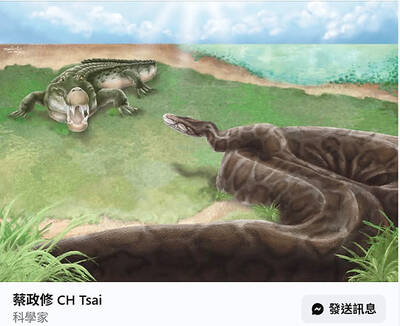
Taiwanese paleontologists have discovered fossil evidence that pythons up to 4m long inhabited Taiwan during the Pleistocene epoch, reporting their findings in the international scientific journal Historical Biology. National Taiwan University (NTU) Institute of Ecology and Evolutionary Biology associate professor Tsai Cheng-hsiu (蔡政修) led the team that discovered the largest snake fossil ever found in Taiwan. The single trunk vertebra was discovered in Tainan at the Chiting Formation, dated to between 400,000 and 800,000 years ago in the Middle Pleistocene, the paper said. The area also produced Taiwan’s first avian fossil, as well as crocodile, mammoth, saber-toothed cat and rhinoceros fossils, it said. Discoveries

Taiwanese paleontologists have discovered fossil evidence that pythons up to 4m long inhabited Taiwan during the Pleistocene epoch, reporting their findings in the international scientific journal Historical Biology. National Taiwan University (NTU) Institute of Ecology and Evolutionary Biology associate professor Tsai Cheng-hsiu (蔡政修) led the team that discovered the largest snake fossil ever found in Taiwan. A single trunk vertebra was discovered in Tainan at the Chiting Formation, dated to between 800,000 to 400,000 years ago in the Middle Pleistocene, the paper said. The area also produced Taiwan’s first avian fossil, as well as crocodile, mammoth, sabre-toothed cat and rhinoceros fossils, it said. Discoveries

Whether Japan would help defend Taiwan in case of a cross-strait conflict would depend on the US and the extent to which Japan would be allowed to act under the US-Japan Security Treaty, former Japanese minister of defense Satoshi Morimoto said. As China has not given up on the idea of invading Taiwan by force, to what extent Japan could support US military action would hinge on Washington’s intention and its negotiation with Tokyo, Morimoto said in an interview with the Liberty Times (sister paper of the Taipei Times) yesterday. There has to be sufficient mutual recognition of how Japan could provide


 RSS
RSS