


Falun Gong members, Tibetan independence supporters and the Taiwan Solidarity Union (TSU) yesterday staged protests against Chinese officials who are in Taipei for a round of cross-strait negotiations, resulting in brief clashes with police.
Thwarted by tight security, none of them were able to get close to the Grand Hotel, where Association of Relations Across the Taiwan Straits (ARATS) Chairman Chen Yunlin (陳雲林) was staying.
The protests continued for a second straight day following Chen’s arrival on Wednesday, with the most intense demonstration taking place at the foot of the hill the hotel is on.
Three members of the Taiwan Tibetan Welfare Association, including its president, Dachompa Payama, clashed with the police at about 10:30am, when they tried to pass through the heavily guarded checkpoint before being pushed back.
Waving the Tibetan flag and chanting: “We want freedom,” “China out of Tibet now” and “Tibet belongs to the Tibetans,” the protesters demanded to meet Chen to force their point that China keep its hands off Tibet.
A total of 51 Tibetans have burned themselves to death since 2009 to protest against Chinese oppression, Dachompa said, adding that Tibetans in Taiwan could not sit on the sidelines and do nothing for their compatriots in China.
Dachompa also warned Taiwan’s government not to trust Beijing, because China had promised Tibet autonomy in the past.
“Why do you think so many Tibetans have set themselves ablaze? Taiwan has better watch out … it could become the second Tibet,” he said.
The Tibetans submitted a letter of appeal to Tien Chung-yung (田中勇), a representative of Taiwan’s Straits Exchange Foundation, before Greater Tainan Councilor Wang Ding-yu (王定宇) and Taipei City Councilor Tung Chung-yen (童仲彥), and Democratic Progressive Party (DPP) members did the same.
The DPP members demanded President Ma Ying-jeou’s (馬英九) government address a pair of recent issues involving China: the removal of Republic of China flags from an Olympics promotional event in London and the detention of Taiwanese Falun Gong practitioner Bruce Chung (鍾鼎邦).
Beyond the checkpoint, hundreds of Falun Gong members packed the sidewalks on Zhongshan N Road Sec 3 with members holding banners condemning Chinese oppression and demanding Beijing immediately release Chung.
Chung’s daughter, Chung Ai (鍾愛), said her mother, Lee Ya-min (李雅敏), on Wednesday met with her father in China’s Jianxi Province with the help of Chinese Nationalist Party (KMT) Legislator Alex Tsai (蔡正元) and that Bruce Chung appeared to be in good condition.
Chung Ai said she hoped the Ma administration would bring her father back as soon as possible.
Falun Gong Taiwan spokesperson Teresa Chu (朱婉琪) said the protest would continue throughout the night and today until the Chinese delegation leaves.
Meanwhile, about 50 protesters gathered in the Taipei Fine Art Museum for a TSU-organized protest yesterday. The TSU had to call off its protest at the hotel after its motorcade was stopped by the police.
Hsiao Kuan-yu (蕭貫譽), director of the TSU’s Department of Organization, asked the demonstrators to go to the hotel on foot.
About 10 protesters were later stopped by the police again on the Chungshan Bridge. Three TSU members who pretended to be tourists were able to get into the hotel briefly at about 1pm, but were immediately escorted out.

The Ministry of Finance this afternoon announced the winning numbers for the March-April uniform invoice lottery. The winning number for the NT$10 million (US$318,060) special prize is 19531471, and the winning number for the NT$2 million grand prize is 85941329. Three numbers were drawn for the NT$200,000 first prize: 07225810, 20231230 and 83518781. Those with receipts matching the last seven digits of any of the first-prize numbers will win the NT$40,000 second prize, while those matching the last six digits will win the NT$10,000 third prize. Those whose receipts match the last five digits of the first-prize numbers can claim the NT$4,000 fourth prize,

SIX SUBSIDIES: The monthly allowance for older farmers is to increase to NT$10,000, and NT$5,000 is to be given to homemakers under the national pension system, Lai said The government is to implement major welfare policies for disadvantaged groups, including raising the monthly allowance for older farmers to NT$10,000 and providing homemakers with NT$5,000 per month, President William Lai (賴清德) said yesterday. Lai made the remarks during a visit to Wangling Temple in Chiayi County, saying that the planned increases were being introduced amid economic growth and an increase in tax revenue. Touting a policy, in which the government plans to provide a monthly allowance of NT$5,000 for every child under the age of 18 in a bid to address Taiwan’s low birthrate, Lai said that if received for the
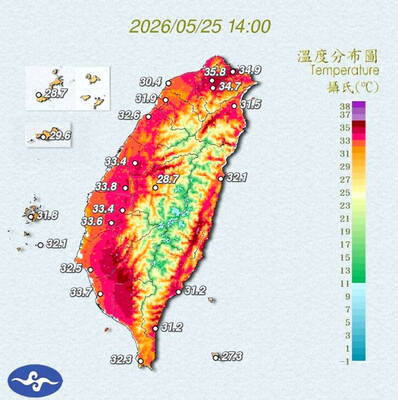
STAY COOL: The HPA recommended that people stay hydrated, use air-conditioning or fans while indoors, wear loose-fitting clothes and walk in the shade while outdoors Employers must implement measures such as installing cooling equipment, and providing drinking water and rest breaks for outdoor workers starting from Monday next week, the Taipei Department of Labor said on Sunday. Employers who fail to comply could face fines of NT$30,000 to NT$300,000 under the Occupational Safety and Health Act (職業安全衛生法), the department said. Businesses in Taipei employing fewer than 100 workers, as well as registered self-employed workers with labor insurance coverage, could receive on-site assessments and guidance from occupational safety consultants to help them apply for central government subsidies to implement or improve heat-protection measures, it said. Under the Ministry of

NATIONAL SECURITY: Authorities are working to confirm the identities of the military personnel involved and investigating possible illegal conduct and regulatory violations Authorities are probing possible national security implications after Kinmen police and immigration officers on Sunday found a Chinese woman allegedly posing as a tourist while engaging in prostitution involving more than 10 military personnel. The woman, surnamed Chen (陳), has since been deported, authorities said, adding that investigators are still working to confirm the identities of those implicated, as the records only listed code names and aliases. The case stemmed from a report received by the Kinmen District Prosecutors’ Office on Friday last week from the Jinhu Precinct of the Kinmen County Police Bureau. On Sunday, police, along with the National Immigration


 RSS
RSS