


Two Taiwanese independence supporters plan to hand-paint a 30.5m long mural on the wall of a company in Corvallis, Oregon, in an effort to increase awareness in the US that Taiwan is an independent country.
According to Taiwanese painter Chao Tsung-song (趙宗宋), the idea of a mural dedicated to Taiwanese independence was originally proposed by David Lin (林銘新), a Taiwanese businessman who owns Corvallis Micro Technology.
“I met Lin during the run-up to the presidential election this year, and he mentioned wanting to decorate the wall of his company with a mural promoting Taiwanese independence so more US citizens would support us,” Chao said.

Photo: Chang Ling-chu, Taipei Times
As Corvallis Micro Technology is located off Interstate No. 5 (I-5), Lin hoped the strategic location of the mural would help by informing Americans driving past that Taiwan is an independent country, Chao said.
Despite Chao’s interest in the project, he found it difficult to persuade other Taiwanese painters to take part in the endeavor.
It was at that point that Chao turned to a relative, Lucy Yueh-chien Lu (盧月鉛), who emigrated to Canada more than a decade ago. She agreed to take part and the two of them started preparations to paint the mural.
However, the subject matter of the work meant that painters looking to develop a career in China were “unable” to take part, Lu said.
In addition, because the mural was being painted on the outside of a building, which meant that the artists had to use mechanical lifts to reach higher levels, elderly artists were excluded from the project, she said.
“Currently Chao and I are the only artists working on the project,” Lu said, adding that they plan to finish the mural at the end of next month, before the autumn rainy season sets in. They are also hoping to elicit the aid of locals in the coloring of the work.
The mural is to be divided into two parts, one featuring Taipei 101, the Divine Tree (神木) on Ali-shan (阿里山), Jade Mountain and Taiwan’s indigenous flora and fauna.
Tibetan independence will be the subject of the other part of the mural.
Tibet is an issue of interest to many Westerners and by focusing on Tibetan independence the mural is more likely to attract the attention of US citizens and thereby better promote Taiwanese independence, Lu said.

Yangmingshan National Park authorities yesterday urged visitors to respect public spaces and obey the law after a couple was caught on a camera livestream having sex at the park’s Qingtiangang (擎天崗) earlier in the day. The Shilin Police Precinct in Taipei said it has identified a suspect and his vehicle registration number, and would summon him for questioning. The case would be handled in accordance with public indecency charges, it added. The couple entered the park at about 11pm on Thursday and began fooling around by 1am yesterday, the police said, adding that the two were unaware of the park’s all-day live

Fast food chain McDonald's is to raise prices by up to NT$5 on some products at its restaurants across Taiwan, starting on Wednesday next week, the company announced today. The prices of all extra value meals and sharing boxes are to increase by NT$5, while breakfast combos and creamy corn soup would go up by NT$3, the company said in a statement. The price of the main items of those meals, if ordered individually, would remain the same. Meanwhile, the price of a medium-sized lemon iced tea and hot cappuccino would rise by NT$3, extra dipping sauces for chicken nuggets would go up
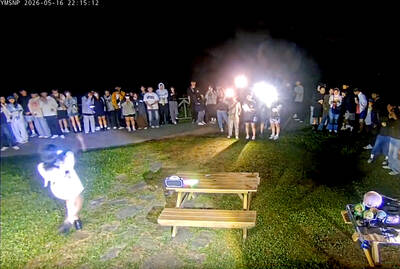
Yangmingshan National Park’s Qingtiangang (擎天崗) nature area has gone viral after a park livestream camera observed a couple in the throes of intimate congress, which was broadcast live on YouTube, drawing large late-night crowds and sparking a backlash over noise, bright lights and disruption to wildlife habitat. The area’s livestream footage appeared to show a couple engaging in sexual activity on a picnic table in the park on Friday last week, with the uncensored footage streamed publicly online. The footage quickly spread across social media, prompting a tide of visitors to travel to the site to “check in” and recreate the

Minister of Digital Affairs Lin Yi-ching (林宜敬) yesterday cited regulatory issues and national security concerns as an expert said that Taiwan is among the few Asian regions without Starlink. Lin made the remarks on Facebook after funP Innovation Group chief executive officer Nathan Chiu (邱繼弘) on Friday said Taiwan and four other countries in Asia — China, North Korea, Afghanistan and Syria — have no access to Starlink. Starlink has become available in 166 countries worldwide, including Ukraine, Malaysia, the Philippines and Vietnam, in the six years since it became commercial, he said. While China and North Korea block Starlink, Syria is not


 RSS
RSS