


A Taiwanese aviation firm and a US defense contractor have signed a memorandum of understanding (MOU) signaling the official start of a strategic partnership on aircraft refitting projects and component manufacturing.
Aerospace Industrial Development Corp (AIDC) announced yesterday it had signed the MOU with Lockheed Martin Corp on Wednesday at the week-long 2012 International Air Show in Farnborough, in the UK.
AIDC president Butch Hsu (徐延年) and Lockheed Martin vice president of international business development Ana Wugofski signed the document expanding the strategic relationship and promoting the joint exploration of opportunities for both companies in an upgrade program for Taiwan’s 146 F-16A/Bs.
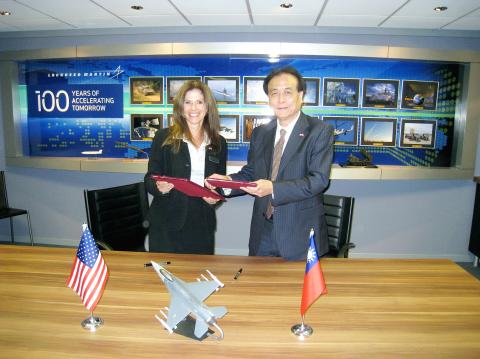
Photo courtesy of AIDC
Although the US government turned down Taiwan’s request for 66 F-16C/Ds in September last year, US President Barack Obama notified Congress of a US$5.8 billion retrofit package for Taiwan’s aging fleet of F-16A/Bs.
According to AIDC spokesperson Mike Lee (李適彰), as Lockheed Martin is the original producer of the F-16s, signing the MOU would allow the retrofitting project to be held in Taiwan, provided Lockheed Martin won the bid to oversee the retrofit project.
Only one other company, BAE Systems, has the capability to perform the upgrades on the F-16s, but it does not appear to have been considered for the program.
If the retrofit project could be done in Taiwan, it would create a lot of jobs, Lee said.
Lockheed Martin has sent personnel to evaluate the company and said AIDC “is the only aerospace company in Taiwan” that possessed the technology and capacity requirements for the retrofit project, Lee said.
Founded in 1969, AIDC is a state-owned corporation that is capable of airplane design, research and development, systems integration, production, maintenance, logistic support and upgrades to airplane systems. Its has partnerships in seven countries and with 19 international aerospace corporations.
Vice president and deputy for F-16/F-2/T-50 programs at Lockheed Martin Aeronautics Roderick McLean said on Wednesday that AIDC was capable and that Lockheed was “confident this collaboration effort will position both of our companies to better support our Taiwan customer.”
Meanwhile, Hsu said that as the retrofit package exceeded all past operational capability upgrade packages, it was a significant milestone for AIDC to work with Lockheed on the project.
“We cherish the foundation of mutual trust developed with our most important partner and we are confident that our joint efforts would be able to satisfy the Republic of China Air Force’s requirements for quality, timely delivery and acceptable price,” Hsu said.
Commenting on the necessity of setting up maintenance hangars and joint component manufacturing, AIDC said it was trying to enlist the support of the Ministry of Economic Affairs.
“In accordance with the Ministry of National Defense’s policy of downsizing the military and promoting voluntary military service, we hope to combine the efforts of affiliated domestic industries and build a world-class F-16 maintenance center in Taiwan with the aid of Lockheed Martin, so as to elevate Taiwan’s ability to conduct its own repairs,” Hsu said.

NATIONAL SECURITY: Authorities are working to confirm the identities of the military personnel involved and investigating possible illegal conduct and regulatory violations Authorities are probing possible national security implications after Kinmen police and immigration officers on Sunday found a Chinese woman allegedly posing as a tourist while engaging in prostitution involving more than 10 military personnel. The woman, surnamed Chen (陳), has since been deported, authorities said, adding that investigators are still working to confirm the identities of those implicated, as the records only listed code names and aliases. The case stemmed from a report received by the Kinmen District Prosecutors’ Office on Friday last week from the Jinhu Precinct of the Kinmen County Police Bureau. On Sunday, police, along with the National Immigration

GLOBALGIVING: ‘ Caving to external pressure is not acceptable for an organization that has cultivated justice reform and human rights for 30 years,’ one NGO said A slew of non-government organizations (NGOs) have withdrawn from the GlobalGiving fundraising platform after it announced it would use “Chinese Taipei” instead of “Taiwan” from next month. The Taiwan Good Rice Association wrote on Facebook on Friday that it was informed on April 28 via a teleconference call of the change, which was made because the platform wanted to operate in China. Taiwan Good Rice is to terminate all cooperative relationships with GlobalGiving in response to the platform’s “unilateral and non-negotiable” decision to remove references to Taiwan, the NGO said. “Taiwan is in the official name of Taiwan Good Rice Association and the
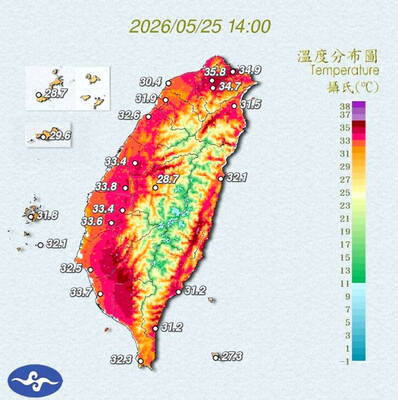
STAY COOL: The HPA recommended that people stay hydrated, use air-conditioning or fans while indoors, wear loose-fitting clothes and walk in the shade while outdoors Employers must implement measures such as installing cooling equipment, and providing drinking water and rest breaks for outdoor workers starting from Monday next week, the Taipei Department of Labor said on Sunday. Employers who fail to comply could face fines of NT$30,000 to NT$300,000 under the Occupational Safety and Health Act (職業安全衛生法), the department said. Businesses in Taipei employing fewer than 100 workers, as well as registered self-employed workers with labor insurance coverage, could receive on-site assessments and guidance from occupational safety consultants to help them apply for central government subsidies to implement or improve heat-protection measures, it said. Under the Ministry of

Chinese Nationalist Party (KMT) Chairwoman Cheng Li-wun (鄭麗文) yesterday briefed her party’s Central Standing Committee regarding her scheduled visit to the US between Monday next week and June 16, saying that her purpose would be to persuade the US that the Republic of China (ROC) Constitution was a “one China” constitution that would foster stable and peaceful cross-strait relations. The ROC Constitution is the most important defense for all Taiwanese citizens, as it upholds our democracy and has contributed to our robust economy, which aligns with international and US interests, she said. “We would not be troublemakers and drag the US under,”


 RSS
RSS