


The Chinese Nationalist Party (KMT) once owed former Chinese Communist Party leader Mao Zedong (毛澤東) several paychecks during the time he served as a KMT official, historical documents have revealed.
The documents showed that the KMT was experiencing a shortage of funds at one point and could not pay Mao, whose salary was about 120 silver dollars per month, Shao Ming-huang (邵銘煌), director of the KMT’s historical archives, said yesterday.
The records prove that Mao was not only a KMT member, but was also on the party’s payroll, working as a secretary in the department of organization at the party’s Shanghai branch, Shao said.
Mao was not the only KMT staff member who was owed back pay, he was selected to negotiate a settlement, on behalf of the others, with Sun Yat-sen (孫逸仙), a founding member of the KMT who later became the founding father of the Republic of China.
The party settled the issue with Mao and the other workers after they agreed to accept a “pay cut,” Shao said.
The payroll receipt is currently on display at an exhibition at the KMT’s headquarters in Taipei City.
In 1924, the KMT adopted a new policy of recognizing a “United Soviet Union and acceptance of communism,” with the aim of obtaining assistance from Russia and joining forces with the Chinese Communist Party (CCP) to carry out a “northern expedition,” Shao said.
It was the first attempt at collaboration between the two parties, he added.
There were many CCP founding members who had also joined the KMT, he said, notable examples being Li Dazhao (李大釗) and Chen Duxiu (陳獨秀).
The KMT archives is very popular among Chinese tourists, Shao said.

LOUD AND PROUD Taiwan might have taken a drubbing against Australia and Japan, but you might not know it from the enthusiasm and numbers of the fans Taiwan might not be expected to win the World Baseball Classic (WBC) but their fans are making their presence felt in Tokyo, with tens of thousands decked out in the team’s blue, blowing horns and singing songs. Taiwanese fans have packed out the Tokyo Dome for all three of their games so far and even threatened to drown out home team supporters when their team played Japan on Friday. They blew trumpets, chanted for their favorite players and had their own cheerleading squad who dance on a stage during the game. The team struggled to match that exuberance on the field, with
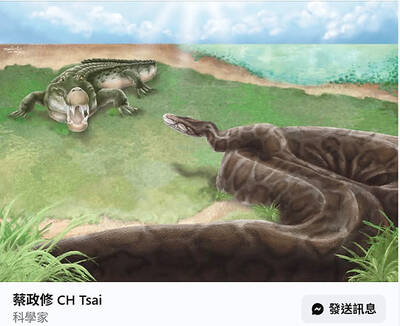
Taiwanese paleontologists have discovered fossil evidence that pythons up to 4m long inhabited Taiwan during the Pleistocene epoch, reporting their findings in the international scientific journal Historical Biology. National Taiwan University (NTU) Institute of Ecology and Evolutionary Biology associate professor Tsai Cheng-hsiu (蔡政修) led the team that discovered the largest snake fossil ever found in Taiwan. The single trunk vertebra was discovered in Tainan at the Chiting Formation, dated to between 400,000 and 800,000 years ago in the Middle Pleistocene, the paper said. The area also produced Taiwan’s first avian fossil, as well as crocodile, mammoth, saber-toothed cat and rhinoceros fossils, it said. Discoveries

Taiwanese paleontologists have discovered fossil evidence that pythons up to 4m long inhabited Taiwan during the Pleistocene epoch, reporting their findings in the international scientific journal Historical Biology. National Taiwan University (NTU) Institute of Ecology and Evolutionary Biology associate professor Tsai Cheng-hsiu (蔡政修) led the team that discovered the largest snake fossil ever found in Taiwan. A single trunk vertebra was discovered in Tainan at the Chiting Formation, dated to between 800,000 to 400,000 years ago in the Middle Pleistocene, the paper said. The area also produced Taiwan’s first avian fossil, as well as crocodile, mammoth, sabre-toothed cat and rhinoceros fossils, it said. Discoveries
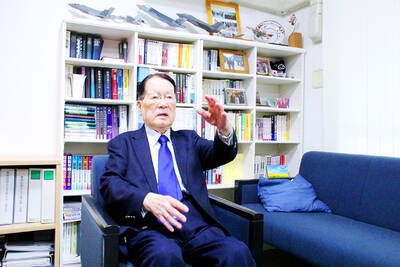
Whether Japan would help defend Taiwan in case of a cross-strait conflict would depend on the US and the extent to which Japan would be allowed to act under the US-Japan Security Treaty, former Japanese minister of defense Satoshi Morimoto said. As China has not given up on the idea of invading Taiwan by force, to what extent Japan could support US military action would hinge on Washington’s intention and its negotiation with Tokyo, Morimoto said in an interview with the Liberty Times (sister paper of the Taipei Times) yesterday. There has to be sufficient mutual recognition of how Japan could provide


 RSS
RSS