


President Ma Ying-jeou (馬英九) said yesterday he was hopeful China’s next rulers would maintain improving relations and that anointed Chinese leader Xi Jinping’s (習近平) understanding of cross-strait issues would help keep economic cooperation on track.
Ma, in his first interview with foreign media since he won re-election in January, also said the two sides would continue to build closer economic, financial and trade relations before tackling thornier issues, such as political or military dialogue.
Ties would progress even after a broad reshuffle of the top Chinese leadership, Ma predicted. Chinese President Hu Jintao (胡錦濤) is expected to retire as Chinese Communist Party (CCP) chief at the CCP National Congress later this year and as president in March next year, completing the transition to a younger generation headed by Xi, now Chinese vice president.
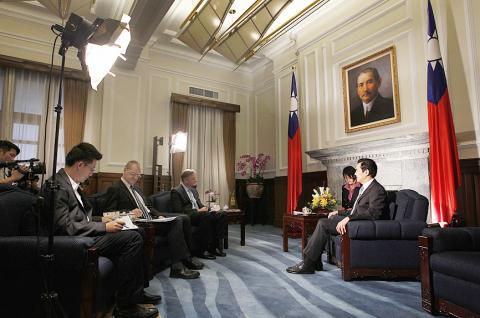
Photo: Pichi Chuang, Reuters
“Xi Jinping has had past experience in Fujian so his understanding of Taiwan is very deep,” Ma said, referring to the Chinese province directly across the Taiwan Strait that has close cultural, business and trade ties with Taiwan.
Xi served as an official in the province since 1985, rising to governor from 2000 to 2002.
“Based on what has happened over the past four years between us and China, current relations are mutually beneficial. So we do not expect cross-strait ties to have significant changes due to the leadership change,” Ma said.
Ma stressed his formula for Taiwan-China relations in his first term has been to handle “pressing matters before less pressing ones, easily resolved issues before difficult ones, and economic matters before political.”
Catchphrases aside, Ma’s policies of economic rapprochement and opening to China are widely interpreted as having eased the potential of Taiwan becoming a geopolitical flashpoint and he now declares relations at their most stable in 60 years.
Nevertheless, he could face pressure in his second term from the new Chinese leadership for more action on political links.
“They will exert some pressure. If they push and they don’t get, there will be fewer economic concessions,” said Joseph Cheng (鄭宇碩), a China politics expert at City University in Hong Kong. “I think it’s a very typical carrot-and-stick situation. If there’s a breakthrough, there’ll be more economic goodies. If not, there will be a cooling down and fewer economic goodies.”
Perhaps mindful of the potential for such pressure, Ma conducted his interview with caution — emphasizing the economic progress made and opportunities for more ahead, but being circumspect on more sensitive questions like the ouster of Chinese politician Bo Xilai (薄熙來) or the contentious political election in Hong Kong.
Asked about blind activist Chen Guangcheng (陳光誠), whom China recently allowed to travel to the US to study after a diplomatic row between Beijing and Washington, Ma said Taiwan was concerned about rights in China, particularly in light of there being 1 million Taiwanese in that country.
“We hope the mainland [sic] can face some of the issues that have happened in the past and can treat dissidents well. We are looking at this from the point of view of kindness, not based on Western human rights values, but traditional Chinese values,” Ma said.
Both sides were already in talks about an investment protection agreement that included some guarantees for individual safety and freedoms, he said.
It is through economic policies that Ma has been most successful in the perceived lowering of cross-strait tensions. He hopes to parlay that success into free-trade deals with other trading partners, which has been difficult because of China’s objections.
Ma said he was urgently trying to build a foundation that would break down protectionism and promote free trade between Taiwan and China and also other trading partners, including New Zealand and Singapore. By the end of the year, he also hoped to reopen talks on trade with the US that had been upended by a controversy over US beef imports.
However, Ma also noted there was still other work to do on Taiwan’s economy, which is dependent on exports and thus vulnerable to the current global downturn.
Ma has had a rough start to his second term as his plans run into opposition at home: An uproar over a planned capital gains tax on securities transactions aimed at addressing Taiwan’s rich-poor gap and the subsequent watering down of the plan sparked the resignation of his finance minister.
Taiwan needed to move quickly to resolve two issues — shifting its industries’ focus from just “efficiency” to “efficiency and creativity,” and opening the economy further, the president said.
“I want to finish these jobs promptly so that we can build the base for Taiwan for the next 20 to 30 years.” Ma said. “But I only have four years, so no matter how efficient I am, I won’t be able to complete all the tasks. What I can do is build the foundation.”
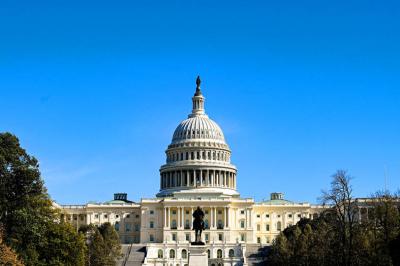
The US House of Representatives yesterday passed the PROTECT Taiwan Act, which stipulates that Washington would exclude China from participating in major global financial organizations if its actions directly threaten Taiwan’s security. The bill, proposed by Republican US Representative Frank Lucas, passed with 395 votes in favor and two against. It stipulates that if China’s actions pose any threat to Taiwan’s security, economic or social systems, the US would, “to the maximum extent practicable,” exclude China from international financial institutions, including the G20, the Bank for International Settlements and the Financial Stability Board. The bill makes it clear that China
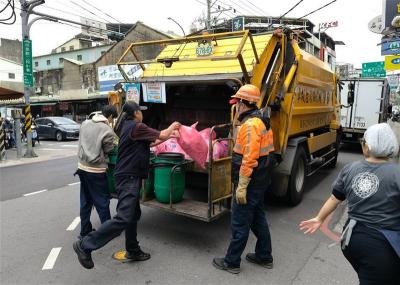
Garbage and recycling schedules are to vary from Saturday through Sunday next week over the Lunar New Year holiday period. The following collection information is from the governments of the six special municipalities. Taipei Regular service: Sunday to Monday next week. No service: Tuesday to Thursday next week. Extra service: Friday next week. Regular service resumes: Saturday next week. New Taipei City Extra service: Sunday. Adjusted collection time: Monday next week — garbage collection is to begin in the morning and end at 6pm. No service: Tuesday to Thursday next week. Regular service resumes: Friday next week. Note: Garbage can be dropped off at 70
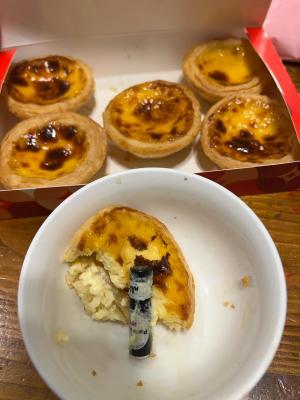
A KFC branch in Kaohsiung may be fined between NT$60,000 and NT$200 million (US$1,907 and US$6.37 million), after a customer yesterday found an entire AAA battery inside an egg tart, the Kaohsiung Department of Health said today. The customer was about to microwave a box of egg tarts they had bought at the fast-food restaurant’s Nanzih (楠梓) branch when they checked the bottom and saw a dark shadow inside one of them, they said in a Threads post. The customer filmed themself taking the egg tart apart to reveal an entire AAA battery inside, which apparently showed signs of damage. Surveillance footage showed
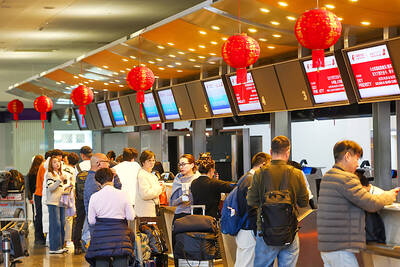
GROUP EFFORT: The number of inbound travelers rose 11 to 12 percent last month, with a significant increase in tourists from Europe and North America, an official said The government aims to attract 9.4 million visitors this year, the Tourism Administration said yesterday, citing last year’s success in diversifying tourist markets. Taiwan last year drew about 8.57 million international arrivals, 72.3 percent of pre-COVID-19 levels. By contrast, the nation had about 18.94 million outbound tourists last year, surpassing the pre-COVID-19 level of 17.1 million. The estimated tourism revenue deficit was about NT$700.9 billion (US$22.22 billion). Taoyuan International Airport Corp expects more than 160,000 passengers to pass through the nation’s largest airport daily during the Lunar New Year holiday, which begins on Saturday. As of Jan. 30, the nation’s average hotel occupancy rate


 RSS
RSS