


A foreign national and single father to a Taiwanese son is facing deportation for allegedly working illegally for the government-linked Taiwan Foundation for Democracy (TFD) in a case that raises questions over how the government handled the case.
The problems for Ben Hlavaty, a US citizen, began when he and his Taiwanese spouse divorced in May 2008. Until then, Hlavaty had an Alien Resident Certificate (ARC) through his marriage and did not need a work permit to work at the TFD, his employer since December 2007.
Aware that following his divorce his ARC would only be valid until Oct. 25 that year, Hlavaty informed his employer that if they wished him to continue working for them, TFD would have to help him apply for a work permit. The foundation subsequently contacted the Ministry of Foreign Affairs (MOFA), which founded the TFD in 2002, and asked it to assist Hlavaty.
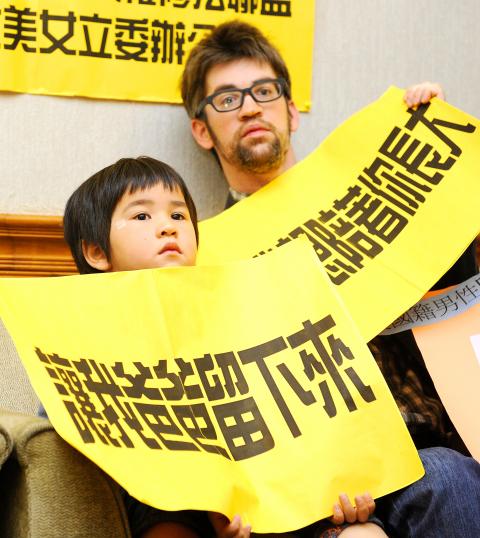
Photo: George Tsorng, Taipei Times
On Oct. 20 the same year, MOFA sent a notice to the National Immigration Agency (NIA) informing it that the foundation was extending Hlavaty’s employment for one year, until Oct. 24, 2009, and that a work permit should be issued. Six days later, Hlavaty left Taiwan for Hong Kong to reapply for an ARC and a new certificate was issued.
In October the following year, MOFA once again submitted the paperwork to the NIA so that Hlavaty could work for another year, or until Oct. 24, 2010, which again was approved.
However, on Oct. 21, 2010, the TFD informed Hlavaty it wished to terminate his employment and sent a notice to MOFA requesting the extension of his ARC until Dec. 31.
Hlavaty says that Huang Teh-fu (黃德福), appointed new president of the foundation by the administration of President Ma Ying-jeou (馬英九), fired him without cause and denied him his three-month severance pay. Hlavaty filed a petition with the Taipei City Department of Labor for wrongful dismissal.
Hlavaty and the TFD reached a settlement following mediation. Hlavaty left Taiwan on Dec. 19, 2010, and re-entered on a multiple-entry visa in January last year.
However, in May, the city’s Department of Labor sent him a notice stating he was suspected of violating Article 43 of the Employment Services Act (就業服務法) during his employment at the TFD.
“[They] demanded an explanation as to why I had been illegally working during my three-year employment with the Foundation,” Hlavaty said in a press release yesterday.
Then, in July last year, he was fined NT$30,000 for not having a permit through the proper channels.”
“On the advice of civil servants, I submitted an appeal, believing that the mistake would clear up,” he wrote.
“Then the CLA [Council of Labor Affairs] slapped me with a three-year work ban and ordered me to leave Taiwan within fourteen days,” he wrote.
After a petition with the council’s appeals committee failed, Hlavaty turned to the Executive Yuan, which turned him down on the grounds that his appeal to the council was written incorrectly. It ordered the deportation procedures to continue.
After weeks in limbo, Hlavaty’s appeal with the Taipei High Administrative Court was turned down on Thursday last week.
An official with the court told the Taipei Times yesterday that Hlavaty would soon receive the ruling document, adding that he could appeal to the Supreme Administrative Court.
Hlavaty maintains he did nothing wrong.
“[My defense] produced copies of my labor insurance from my foundation days, which must have meant that the Bureau of Labor Insurance, who [sic] is subordinate to the CLA, had found me legal during those three years,” he wrote.
“If I am going to be separated from my boy for my work in promoting Taiwan’s democracy and human rights at the request of MOFA, then I will go down fighting as an example to Isaac,” he wrote.
Hlavaty has dual custody of his son with his former wife.
Additional reporting by Rich Chang, with translation by Jake Chung, Staff Writer

FUKUOKA SITUATION: Japanese media reported that the pathogen is expected to be identified by the summer, while the CDC downplayed the idea that it was hMPV A “mysterious cold-like illness” reported in Japan’s Fukuoka Prefecture does not seem to be a new disease, but Japanese authorities have been asked about the situation, the Centers for Disease Control (CDC) said yesterday. The Fukuoka Prefectural Medical Association on Wednesday told a news conference that a “mystery cold” that has become a hot topic on social media is “highly likely to be caused by some kind of viral infection,” Japan’s KBC News reported. “Many people are experiencing symptoms starting with a sore throat, followed by a runny nose, phlegm and a severe cough,” KBC News reported, citing association officials. Health authorities are

Nvidia Corp CEO Jensen Huang (黃仁勳) arrived in Taiwan yesterday ahead of upcoming AI and technology events, saying he plans to meet with clients and Taiwan Semiconductor Manufacturing Co Chairman C.C. Wei (魏哲家) during his visit. After landing at Taipei Songshan Airport, Huang posed for photos with fans and handed out Yakult drinks to reporters and supporters waiting at the scene, saying he has “a lot to do” during the trip. Asked about reports that Nvidia’s planned headquarters site in Taipei’s Beitou Shilin Technology Park could break ground on May 27, Huang said that if the company holds an event, he would

The Ministry of Finance this afternoon announced the winning numbers for the March-April uniform invoice lottery. The winning number for the NT$10 million (US$318,060) special prize is 19531471, and the winning number for the NT$2 million grand prize is 85941329. Three numbers were drawn for the NT$200,000 first prize: 07225810, 20231230 and 83518781. Those with receipts matching the last seven digits of any of the first-prize numbers will win the NT$40,000 second prize, while those matching the last six digits will win the NT$10,000 third prize. Those whose receipts match the last five digits of the first-prize numbers can claim the NT$4,000 fourth prize,

SIX SUBSIDIES: The monthly allowance for older farmers is to increase to NT$10,000, and NT$5,000 is to be given to homemakers under the national pension system, Lai said The government is to implement major welfare policies for disadvantaged groups, including raising the monthly allowance for older farmers to NT$10,000 and providing homemakers with NT$5,000 per month, President William Lai (賴清德) said yesterday. Lai made the remarks during a visit to Wangling Temple in Chiayi County, saying that the planned increases were being introduced amid economic growth and an increase in tax revenue. Touting a policy, in which the government plans to provide a monthly allowance of NT$5,000 for every child under the age of 18 in a bid to address Taiwan’s low birthrate, Lai said that if received for the


 RSS
RSS