


The Chinese Nationalist Party (KMT) yesterday defended an Executive Yuan poll that showed an increase in support for imports of US beef containing ractopamine residue, while dismissing a pro-Taiwan independence group’s criticism of President Ma Ying-jeou’s (馬英九) handling of the issue.
The Taiwan Brain Trust think tank on Monday released a poll on the performance of Ma’s administration that showed the president’s disapproval rating had reached 62.1 percent in the wake of the government’s plan to erase a ban on US beef containing the controversial feed additive.
Taiwan Brain Trust chairman Wu Rong-i (吳榮義) said such a high disapproval rating for the president at the start of his second term illustrated the president’s incompetence, adding that increasing unhappiness with the government could lead to a motion of no confidence against the Cabinet.
KMT spokesperson Yin Wei (殷瑋) yesterday said the think tank was manipulating polls for political purposes and urged the Democratic Progressive Party (DPP) not to use the think tank to attack the Ma administration.
Yin said that DPP spokesperson Lo Chih-cheng (羅致政) is the think tank’s executive director, and Wu and vice chairman Chen Shih-meng (陳師孟) served as officials under former president Chen Shui-bian’s (陳水扁) administration, adding that “the group has released many polls in the past favoring the DPP and the credibility of its polling should be under public scrutiny.”
Yin also dismissed the think tank’s criticism of a government poll on public support for imports of US beef and said the Research, Development and Evaluation Commission conducted regular polling to better gauge public opinion.
A survey by the commission, which polled 1,084 adults from March 6 until Friday, showed an increase of 22 percentage points in support of imports of US beef containing ractopamine when four conditions established by the government were factored in, while the disapproval rate declined by 19 points.
The KMT said it would arrange for Premier Sean Chen (陳冲) to present a report on the US beef issue before its Central Standing Committee today.

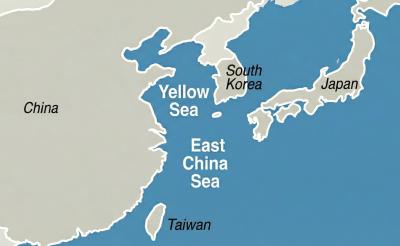
China has reserved offshore airspace in the Yellow Sea and East China Sea from March 27 to May 6, issuing alerts usually used to warn of military exercises, although no such exercises have been announced, the Wall Street Journal (WSJ) reported yesterday. Reserving such a large area for 40 days without explanation is an “unusual step,” as military exercises normally only last a few days, the paper said. These alerts, known as Notice to Air Missions (Notams), “are intended to inform pilots and aviation authorities of temporary airspace hazards or restrictions,” the article said. The airspace reserved in the alert is

NAMING SPAT: The foreign ministry called on Denmark to propose an acceptable solution to the erroneous nationality used for Taiwanese on residence permits Taiwan has revoked some privileges for Danish diplomatic staff over a Danish permit that lists “Taiwan” as “China,” Eric Huang (黃鈞耀), head of the Ministry of Foreign Affairs’ Department of European Affairs, told a news conference in Taipei yesterday. Reporters asked Huang whether the Danish government had responded to the ministry’s request that it correct the nationality on Danish residence permits of Taiwanese, which has been listed as “China” since 2024. Taiwan’s representative office in Denmark continues to communicate with the Danish government, and the ministry has revoked some privileges previously granted to Danish representatives in Taiwan and would continue to review

More than 6,000 Taiwanese students have participated in exchange programs in China over the past two years, despite the Mainland Affairs Council’s (MAC) “orange light” travel advisory, government records showed. The MAC’s publicly available registry showed that Taiwanese college and university students who went on exchange programs across the Strait numbered 3,592 and 2,966 people respectively. The National Immigration Agency data revealed that 2,296 and 2,551 Chinese students visited Taiwan for study in the same two years. A review of the Web sites of publicly-run universities and colleges showed that Taiwanese higher education institutions continued to recruit students for Chinese educational programs without
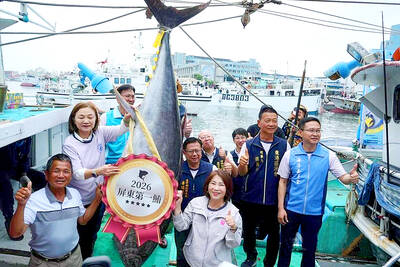
The first bluefin tuna of the season, brought to shore in Pingtung County and weighing 190kg, was yesterday auctioned for NT$10,600 (US$333.5) per kilogram, setting a record high for the local market. The auction was held at the fish market in Donggang Fishing Harbor, where the Siaoliouciou Island-registered fishing vessel Fu Yu Ching No. 2 delivered the “Pingtung First Tuna” it had caught for bidding. Bidding was intense, and the tuna was ultimately jointly purchased by a local restaurant and a local company for NT$10,600 per kilogram — NT$300 ,more than last year — for a total of NT$2.014 million. The 67-year-old skipper


 RSS
RSS