


A heritage site in Taipei that has preserved more than 70 years of history as a brothel, which was opened to the public under the management of the Collective of Sex Workers and Supporters (COSWAS), may have to close down because the new property owner had asked the group to move out of the building.
The Wen Men Building, a two-story building constructed in 1925, mainly served as a brothel for the working class during the Japanese colonial period. It became a legal brothel in 1956 and was a popular place for years until the Taipei City Government outlawed sex work in 1997, COSWAS secretary Wu Jo-ying (吳若瑩) said.
Licensed sex workers were totally banned in 2001, Wu said.
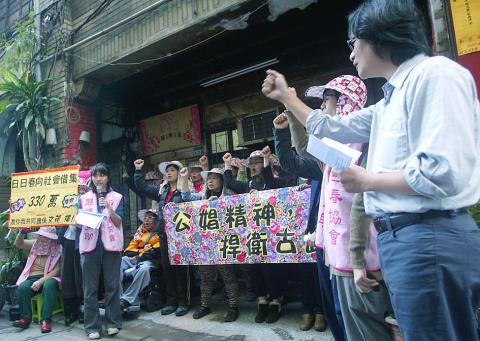
Photo: CNA
Inside the building were small rooms, each featuring a bed with floral-patterned sheets and a small dresser. Pictures of people who used to work in the building still hung on the walls, along with a faded notification paper from the city government in 1978 prohibiting people under the age of 20 from entering the building.
COSWAS, a group that supports licensed sex workers and promotes the legal working rights of women in the sex trade, had rented the first floor of the building for the past 14 years, using it as an office and an educational site for the public to learn about the history of the sex industry.
Although the building has been designated a municipal heritage site by the city’s Department of Culture Affairs in 2006, the new property owner, surnamed Liu (劉), who bought the building last year, filed a lawsuit against the group, asking it to move out.
The Shihlin District Court (士林地方法院) ruled against COSWAS last month, demanding the group vacate the building. The ruling has allowed Liu to proceed with the group’s eviction.
COSWAS and support groups held a press conference in front of the building yesterday morning, calling for the conservation of the cultural heritage site.
Wu said the group suspected that the new owner’s intention is to sell and profit from the transfer of development rights on a heritage site or for urban renewal after buying the land from the Bank of Taiwan.
COSWAS executive director Chung Chun-chu (鍾君竺) said the group had received funding from the Department of Culture Affairs in the past, but it was not informed of the property transfer until it was asked to move out by the new owner.
Wu said the department had neglected its duty by not giving the group pre-emptive rights, as stipulated in the Cultural Heritage Conservation Act (文化資產保存法), to purchase the building to preserve its cultural significance.
Based on the court’s ruling, the eviction can be temporarily halted if the group posts bond in the amount of NT$3.3 million (US$111,486), Wu said, adding that the group was seeking funding from the government as well as from the public.
John Liu (劉可強), a professor at National Taiwan University’s Graduate Institute of Building and Planning, said allowing former workers to narrate the building’s history was important in preserving the cultural meaning of Wen Meng Building.
Since the new Cabinet has said it would promote social justice, it should respect the history of such cultural sites.
“The government should allow cultural diversity in society and should not allow economic growth to take precedence over cultural values,” said Lee Hsiu-chien (李修鑑), a cultural history workshop owner.
COSWAS said it would appeal against the ruling and continue to seek support to keep the last remaining brothel heritage building.

NATIONAL SECURITY: Authorities are working to confirm the identities of the military personnel involved and investigating possible illegal conduct and regulatory violations Authorities are probing possible national security implications after Kinmen police and immigration officers on Sunday found a Chinese woman allegedly posing as a tourist while engaging in prostitution involving more than 10 military personnel. The woman, surnamed Chen (陳), has since been deported, authorities said, adding that investigators are still working to confirm the identities of those implicated, as the records only listed code names and aliases. The case stemmed from a report received by the Kinmen District Prosecutors’ Office on Friday last week from the Jinhu Precinct of the Kinmen County Police Bureau. On Sunday, police, along with the National Immigration

GLOBALGIVING: ‘ Caving to external pressure is not acceptable for an organization that has cultivated justice reform and human rights for 30 years,’ one NGO said A slew of non-government organizations (NGOs) have withdrawn from the GlobalGiving fundraising platform after it announced it would use “Chinese Taipei” instead of “Taiwan” from next month. The Taiwan Good Rice Association wrote on Facebook on Friday that it was informed on April 28 via a teleconference call of the change, which was made because the platform wanted to operate in China. Taiwan Good Rice is to terminate all cooperative relationships with GlobalGiving in response to the platform’s “unilateral and non-negotiable” decision to remove references to Taiwan, the NGO said. “Taiwan is in the official name of Taiwan Good Rice Association and the
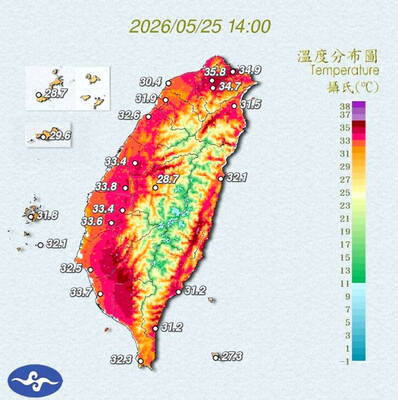
STAY COOL: The HPA recommended that people stay hydrated, use air-conditioning or fans while indoors, wear loose-fitting clothes and walk in the shade while outdoors Employers must implement measures such as installing cooling equipment, and providing drinking water and rest breaks for outdoor workers starting from Monday next week, the Taipei Department of Labor said on Sunday. Employers who fail to comply could face fines of NT$30,000 to NT$300,000 under the Occupational Safety and Health Act (職業安全衛生法), the department said. Businesses in Taipei employing fewer than 100 workers, as well as registered self-employed workers with labor insurance coverage, could receive on-site assessments and guidance from occupational safety consultants to help them apply for central government subsidies to implement or improve heat-protection measures, it said. Under the Ministry of

Chinese Nationalist Party (KMT) Chairwoman Cheng Li-wun (鄭麗文) yesterday briefed her party’s Central Standing Committee regarding her scheduled visit to the US between Monday next week and June 16, saying that her purpose would be to persuade the US that the Republic of China (ROC) Constitution was a “one China” constitution that would foster stable and peaceful cross-strait relations. The ROC Constitution is the most important defense for all Taiwanese citizens, as it upholds our democracy and has contributed to our robust economy, which aligns with international and US interests, she said. “We would not be troublemakers and drag the US under,”


 RSS
RSS