


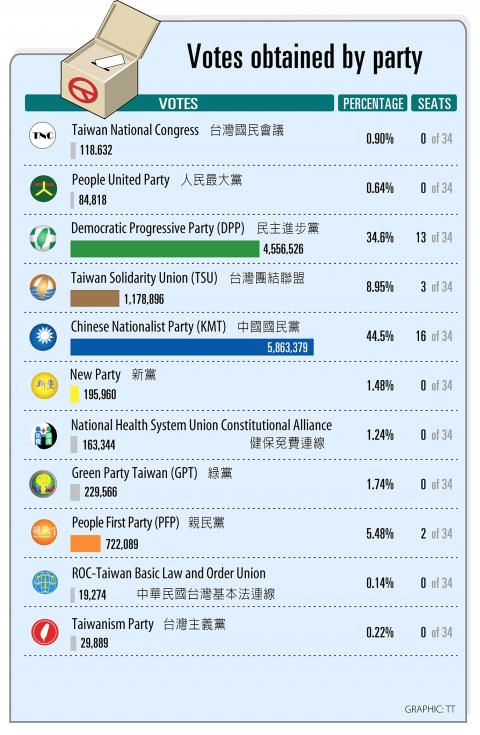
The pan-green camp yesterday made substantial gains in the legislature, with the Democratic Progressive Party (DPP) and the Taiwan Solidarity Union (TSU) obtaining more than 43 percent of votes in the legislative election, against a little more than 50 percent for the Chinese Nationalist Party (KMT) and the People First Party (PFP).
The DPP secured more than 4.5 million votes, or 34.6 percent of the vote. The TSU won 1.18 million votes, or 8.95 percent of the vote, while the KMT obtained more than 5.86 million, or 44.55 percent, and the PFP 722,000, or 5.48 percent.
Both the TSU and the PFP made their way back into the legislature by garnering more than 5 percent of the popular vote, a requirement for parties to secure legislator-at-large seats.

Photo: Huang Chih-yuan, Taipei Times
The PFP had a total of 12 candidates competing in the fourth, sixth and eighth districts of Taipei, the first district in New Taipei City (新北市), the seventh and eighth districts in Greater Taichung, the first district in Greater Tainan, in Kinmen County and the third district of Taoyuan County, as well as the mountain area and plains Aboriginal districts.
Some of them were popular legislators, including Lee Ao (李敖) and Liu Wen-hsiung (劉文雄), but almost none were able to gain sufficient votes to come out on top.
The performance of the candidates fielded by the two major parties — the KMT and the DPP — varied.
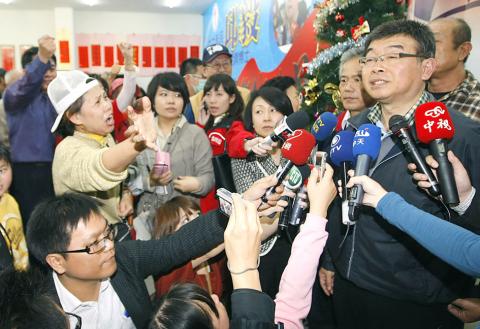
Photo: CNA
Despite the high publicity that surrounded his campaign, Chen Chih-chung (陳致中), the son of former president Chen Shui-bian (陳水扁), failed in his first bid as an independent candidate. His participation in the ninth district of Greater Kaohsiung is believed to have split the DPP vote and may have cost the DPP’s Kuo Wen-cheng’s (郭玟成) bid for re-election as he lost to KMT Legislator Lin Kuo-cheng (林國正).
Former New Party legislator Joanna Lei (雷倩), the daughter of former Vice Admiral Lei Hsueh-ming (雷學明), who left the KMT in 2007 for the New Party, also failed in her bid as an independent candidate in Zhonghe (中和), New Taipei City.
Former Lienchiang County commissioner Chen Hsueh-sheng (陳雪生), formerly of the PFP, but who ran as an independent, defeated incumbent KMT legislator Tsao Erh-chang (曹爾忠), who was seeking a sixth term in the legislature.
GRAPHIC: TT
Lin Pin-kuen (林炳坤) of the Non-Partisan Solidarity Union and the incumbent legislator for Penghu was defeated by DPP Penghu County councilor Yang Yao (楊曜). Some attributed Lin’s surprising defeat to the fact that the airport in Penghu was closed because of heavy fog, which prevented some people from returning home to vote.
Despite his failure to unseat the KMT’s Alex Fei (費鴻泰), Green Party candidate Pan Han-sheng (潘翰聲) garnered more votes this year, as the DPP and PFP did not field candidates in the seventh district of Taipei.
Former legislator Lo Fu-chu (羅福助), who was running as an independent candidate in the 12th district of New Taipei City and is rumored to have ties to organized crime, trailed the incumbent, KMT Legislator Lee Ching-hua (李慶華) and DPP candidate Shen Fa-hui (沈發惠).
Lo’s son, KMT Legislator Lo Ming-tsai (羅明才), was re-elected in the 11th district of New Taipei City.
Meanwhile, four former Government Information Office ministers also ran in the legislative elections this year, with mixed results.
Su Jun-pin (蘇俊賓), who was running for the KMT in Greater Tainan, failed to unseat DPP Legislator Hsu Tain-tsair (許添財). Johnny Chiang (江啟臣) of the KMT beat his opponent, DPP legislative nominee Kuo Chun-ming (郭俊銘), in Greater Taichung.
DPP candidates Lin Chia-long (林佳龍) and Pasuya Yao (姚文智) both won in Greater Taichung and Taipei respectively. Lin defeated the incumbent, KMT legislator Daniel Hwang (黃義交), while Pasuya Yao defeated Justin Chou (周守訓) of the KMT.
Former government spokesperson Chuang Suo-hang (莊碩漢), meanwhile, failed in his bid to unseat KMT Legislator Lu Chia-chen (盧嘉辰).

NATIONAL SECURITY: Authorities are working to confirm the identities of the military personnel involved and investigating possible illegal conduct and regulatory violations Authorities are probing possible national security implications after Kinmen police and immigration officers on Sunday found a Chinese woman allegedly posing as a tourist while engaging in prostitution involving more than 10 military personnel. The woman, surnamed Chen (陳), has since been deported, authorities said, adding that investigators are still working to confirm the identities of those implicated, as the records only listed code names and aliases. The case stemmed from a report received by the Kinmen District Prosecutors’ Office on Friday last week from the Jinhu Precinct of the Kinmen County Police Bureau. On Sunday, police, along with the National Immigration

REASONS FOR TRAVEL: An assistant professor said that proposed amendments to penalize drivers if they used drugs overseas would not deter people from traveling People who operate a motor vehicle under the influence of marijuana would have their driver’s license revoked, even if they used the substance while overseas, the Ministry of Transportation and Communications said yesterday, citing proposed amendments to the Road Traffic Management and Penalty Act (道路交通管理處罰條例). The amendments would also authorize the government to revoke the licenses of people determined to have used Category 1 or Category 2 narcotics, even if they were not operating a vehicle while under the influence of drugs, as well as ban them from taking the license test for three years, the ministry said. People aged 18 or

GLOBALGIVING: ‘ Caving to external pressure is not acceptable for an organization that has cultivated justice reform and human rights for 30 years,’ one NGO said A slew of non-government organizations (NGOs) have withdrawn from the GlobalGiving fundraising platform after it announced it would use “Chinese Taipei” instead of “Taiwan” from next month. The Taiwan Good Rice Association wrote on Facebook on Friday that it was informed on April 28 via a teleconference call of the change, which was made because the platform wanted to operate in China. Taiwan Good Rice is to terminate all cooperative relationships with GlobalGiving in response to the platform’s “unilateral and non-negotiable” decision to remove references to Taiwan, the NGO said. “Taiwan is in the official name of Taiwan Good Rice Association and the

HEAVY WEATHER: Typhoon Jangmi is due to crash straight into the Ryukyus as airlines look to shift flights to larger aircraft or cancel flights to Okinawa entirely Taiwan’s international air carriers announced flight adjustments over the weekend as Typhoon Jangmi is forecast to hit the Ryukyu Islands today and tomorrow. The Central Weather Administration (CWA) upgraded Jangmi from a tropical storm to a typhoon at 8am yesterday, with the eye located 580km south of Naha city. It was moving north at 19kph. Today, China Airlines’ CI-120, CI-121, CI-122 and CI-123 flights between Taoyuan and Naha, Okinawa, have been canceled as well as CI-132 and CI-133 between Kaohsiung and Naha. EVA Air’s BR-112, BR-113, BR-186 and BR-185 flights between Taoyuan and Naha are also canceled. Low-cost carrier Tigerair Taiwan canceled IT-230,


 RSS
RSS