


Former US national security adviser Zbigniew Brzezinski has listed Taiwan as a “geopolitically endangered species” in an article in the current edition of Foreign Policy magazine.
“With the decline of America’s global preeminence, weaker countries will be more susceptible to the assertive influence of major regional powers,” he wrote.
“India and China are rising, Russia is increasingly imperially minded, and the Middle East is growing ever more unstable,” he wrote.
“The potential for regional conflict in the absence of an internationally active America is real. Get ready for a global reality characterized by the survival of the strongest,” he wrote.
Brzezinski then lists eight countries and regions that he believes will suffer — Georgia, Taiwan, South Korea, Belarus, Ukraine, Afghanistan, Pakistan, Israel and the Greater Middle East.
On Taiwan, Brzezinski said that since 1972, the US has formally accepted Beijing’s “one China” formula, while maintaining that neither side shall alter the “status quo” by force.
He added that Beijing reserves the right to use force, which allows Washington to justify its continued arms sales to Taiwan even though, in recent years, Taiwan and China have improved their relationship.
Brzezinski, national security adviser under former US president Jimmy Carter, wrote: “America’s decline, however, would increase Taiwan’s vulnerability, leaving decision-makers in Taipei more susceptible to direct Chinese pressure and the sheer attraction of an economically successful China.”
“That, at the least, could speed up the timetable for cross-strait reunification, but on unequal terms favoring the mainland [China],” he wrote.
At stake, he wrote, is a “serious collision with China.”
A number of US experts on China and Taiwan strongly disagreed with the analysis.
One of the experts said that Brzezinski had contributed to Taiwan’s political endangerment when he was in power.
Others said that China could be overtaken itself by an internal political crisis before unification with Taiwan might occur.
Yet another expert said there was a major difference between China’s “one China” formula and the US’ “one China” policy.
“The US has not ‘accepted’ China’s claim to Taiwan, but only ‘acknowledged’ it,” he said.
On South Korea, Brzezinski said that the US’ “decline” would confront Seoul with “painful choices” to either accept Chinese regional dominance and further reliance on China to rein in the nuclear-armed North or seek a much stronger “though historically unpopular” relationship with Japan.
At stake, he said, was military and economic security on the Korean Peninsula and a general crisis of confidence in Japan and South Korea regarding the reliability of the US’ existing commitments.
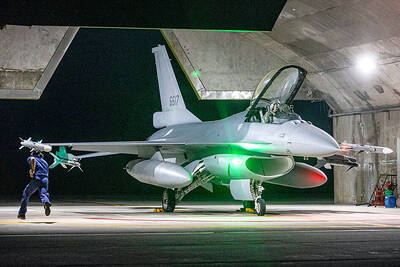
Taiwan has received more than US$70 million in royalties as of the end of last year from developing the F-16V jet as countries worldwide purchase or upgrade to this popular model, government and military officials said on Saturday. Taiwan funded the development of the F-16V jet and ended up the sole investor as other countries withdrew from the program. Now the F-16V is increasingly popular and countries must pay Taiwan a percentage in royalties when they purchase new F-16V aircraft or upgrade older F-16 models. The next five years are expected to be the peak for these royalties, with Taiwan potentially earning
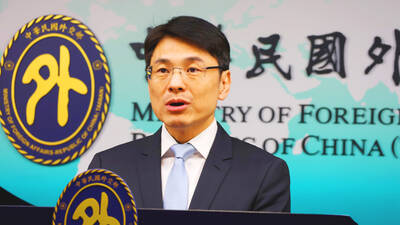
STAY IN YOUR LANE: As the US and Israel attack Iran, the ministry has warned China not to overstep by including Taiwanese citizens in its evacuation orders The Ministry of Foreign Affairs (MOFA) yesterday rebuked a statement by China’s embassy in Israel that it would evacuate Taiwanese holders of Chinese travel documents from Israel amid the latter’s escalating conflict with Iran. Tensions have risen across the Middle East in the wake of US and Israeli airstrikes on Iran beginning Saturday. China subsequently issued an evacuation notice for its citizens. In a news release, the Chinese embassy in Israel said holders of “Taiwan compatriot permits (台胞證)” issued to Taiwanese nationals by Chinese authorities for travel to China — could register for evacuation to Egypt. In Taipei, the ministry yesterday said Taiwan
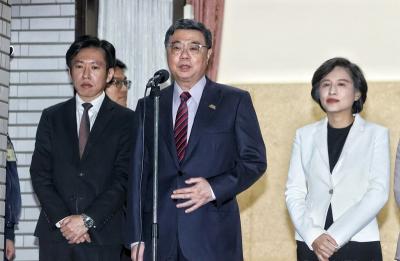
Taiwan is awaiting official notification from the US regarding the status of the Agreement on Reciprocal Trade (ART) after the US Supreme Court ruled US President Donald Trump's global tariffs unconstitutional. Speaking to reporters before a legislative hearing today, Premier Cho Jung-tai (卓榮泰) said that Taiwan's negotiation team remains focused on ensuring that the bilateral trade deal remains intact despite the legal challenge to Trump's tariff policy. "The US has pledged to notify its trade partners once the subsequent administrative and legal processes are finalized, and that certainly includes Taiwan," Cho said when asked about opposition parties’ doubts that the ART was
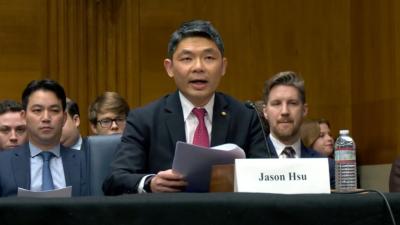
If China chose to invade Taiwan tomorrow, it would only have to sever three undersea fiber-optic cable clusters to cause a data blackout, Jason Hsu (許毓仁), a senior fellow at the Hudson Institute and former Chinese Nationalist Party (KMT) legislator, told a US security panel yesterday. In a Taiwan contingency, cable disruption would be one of the earliest preinvasion actions and the signal that escalation had begun, he said, adding that Taiwan’s current cable repair capabilities are insufficient. The US-China Economic and Security Review Commission (USCC) yesterday held a hearing on US-China Competition Under the Sea, with Hsu speaking on


 RSS
RSS