


The nation’s first university student volunteer to serve on a Greenpeace vessel — the Esperanza — shared her experiences as a defender of the marine environment in Taipei yesterday.
Amy Lan (藍之青), a 22-year old student from National Chengchi University’s department of diplomacy, became a crewmember on a mission to protect the Pacific and promote the establishment of ocean reserves in Western and Central Pacific Fisheries.
Being the youngest member of the crew and the one with the least ocean-going experience, Lan said she was quite nervous when the journey started, but after a few days of experiencing seasickness, she was able to carry out her responsibilities of communicating with Taiwanese captains of tuna fishing vessels by radio, observing changes in the ocean and assisting other crewmembers.
During the eight-week mission, Lan encountered about 10 fishing vessels, four of which were Taiwanese, which she boarded to conduct interviews and better understand fishing conditions. She also saw first-hand how longline fishing is done.
“We were fortunate to be allowed to stay on a fishing vessel for four hours to observe how they fished, but the fishermen told me that they doubted they would catch any tuna on that day because they caught only two the previous day and four the day before that,” Lan said, adding that many told her that tuna catches continued to decrease.
An unforgettable episode from her journey was when the group saved a swordfish caught in the ropes of a tuna longline and watched as it swam away. The experience led her to think about the many fish killed as byproducts of tuna fishing.
Lan said she was surprised to see the hard lives of the fishermen, working on a small fishing boats in cramped conditions for seven to eight months at a time without docking and only making meager catches.
She said the experience made her more aware of marine conservation and she is now looking forward to studying environmental policy.

In a historic first, Taiwanese officials participated in this year’s Riga Strategic Communications Dialogue in Latvia from Wednesday to Friday last week, which debuted a breakout session focused on Taiwan The event organizer, the NATO Strategic Communications Center of Excellence, displayed Taiwan’s national flag and the officials’ formal titles on their Web site. Taiwanese attendees included National Security Council (NSC) Deputy Secretary-General Lin Fei-fan (林飛帆) and deputy head of the Taipei Representative Office in the UK, Chiang Ya-chi (江雅綺). In addition to the session discussing Taiwan titled “Taiwan: Navigating Strategic Communication in a Tense Environment,” the dialogue also included sessions
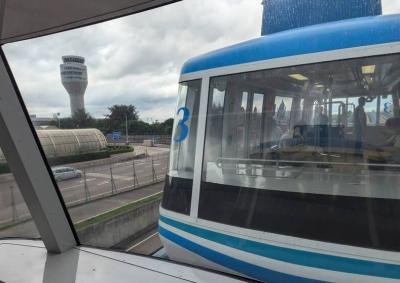
Taiwan Taoyuan International Airport is to suspend its automated Skytrain service connecting Terminal 1 and Terminal 2 starting on July 1 to facilitate connection works for the upcoming Terminal 3, the airport operator said today. Passengers and staff who need to travel between the two terminals after the suspension can instead use the Taoyuan MRT or the airport's 24-hour shuttle bus service, Taoyuan International Airport Corp said. The Taoyuan MRT Airport Line directly links the two terminals, while the shuttle buses are to operate around the clock, the company added. The Skytrain provides free transportation between the airport’s two terminals for travelers and
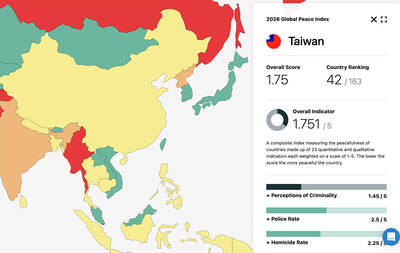
Taiwan ranked 42nd in terms of peacefulness among 163 countries, down five places from last year, according to this year’s Global Peace Index. With an overall score of 1.751, Taiwan dropped from 37th last year, the report published by the global Institute for Economics and Peace showed. The overall score measures a country’s level of peacefulness using 23 quantitative and qualitative indicators across three domains — ongoing domestic and international conflict, societal safety and security, and militarization. While Taiwan ranked 42nd worldwide, it was listed in ninth place among the 19 Asian-Pacific countries in the report, after New Zealand, Singapore, Japan, Malaysia,
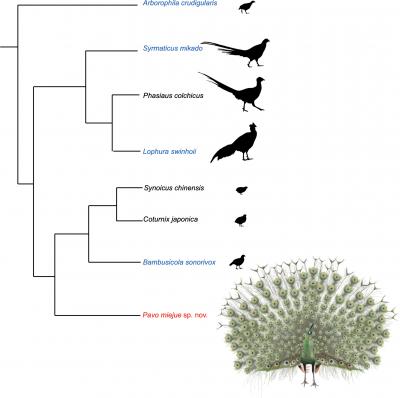
Through analyzing fossil evidence, a research team at National Taiwan University (NTU) discovered the largest endemic bird to have lived in Taiwan, naming it Pavo miejue, or extinct peafowl (滅絕孔雀). The Mikado pheasant, which is printed on the back of the NT$1,000 bank note, was previously believed to be the biggest endemic bird to Taiwan. The research team’s findings suggest that Pavo miejue lived during the Pleistocene epoch tens of thousands of years ago. It is the first endemic extinct bird species discovered and formally named in Taiwan. The study was coauthored by NTU Institute of Ecology and Evolutionary Biology professor Tsai Cheng-hsiu (蔡政修),


 RSS
RSS