


Lamenting China’s occupation of his homeland while recounting how Beijing has exploited his people and tried to destroy their culture, Japan Uyghur Association chairman Ilham Mahmut recounted how he become an activist for the independence of East Turkestan — now under Chinese rule as Xinjiang Uighur Autonomous Region — and urged Taiwanese to be cautious when dealing with China to avoid history repeating itself.
“When you try to deal with the Chinese, it is important to remember that the Chinese Communist Party [CCP] government could make hundreds or thousands of beautiful promises, but none of those will ever be realized,” Ilham told the Taipei Times in an interview on Thursday in Taipei.
“What is going on in East Turkestan or in Tibet are examples of what happens to a country when you trust China too much,” he said in response to a question about President Ma Ying-jeou’s (馬英九) proposed peace agreement with Beijing at some point within the next decade and his policies to establish closer relations with China.

Photo: Liao Chen-huei, Taipei Times
Ilham was invited to Taiwan by the Taiwan Friends of Tibet to talk about the current situation in East Turkestan, and left for Japan on Thursday.
Although discussing the situation in his own country was the main purpose of the trip, Ilham said: “We [Uighurs] are already suffering under Chinese rule, so I feel obliged to remind Taiwanese about what could be ahead for them.”
Historically, the region was home to a handful of independent states, until it came under the control of the Qing Empire in the 18th century and was given the name “Xinjiang,” which literarily means “new territory.” After the fall of the Qing Empire in 1911, two short-lived East Turkestan republics were declared, first in 1933, and the second time in 1944, which lasted until the invasion of CCP troops in 1949.
“In 1949, the East Turkestan Republic was negotiating an agreement with the CCP, when seven of its top leaders were killed in a plane crash on the way to Beijing for further talks” Ilham said. “The Chinese reported the plane crash, but many people in East Turkestan still believe that could have been part of a CCP plot, as more than 150,000 troops invaded our country shortly thereafter,” he added.
Not long after Beijing took control of East Turkestan, its troops were renamed the “Xinjiang Production and Construction Corps [XPCC]” — a semi-military organization directly administered by the central government. This corps manages a handful of cities, establishes settlements and engages in agricultural and other economic activities, according to official information on the unit.
Official figures released by the corps indicate that the population of Xinjiang is currently more than 25 million, with nearly 90 percent being Han Chinese.
“The XPCC took over the best land in East Turkestan, mostly flat arable land,” Ilham said, holding up a map of the corps’ settlement locations and a map showing different terrain in Xinjiang.
“You can see that the XPCC also took over lands along mountain ranges, so that they could be in control of sources of fresh water,” Ilham said. “That enabled them to punish disobedient Uighur villages by cutting off the water supply.”
Citing research results by Japan’s Sapporo Medical University professor Jun Takada, and information from an investigative report aired by the BBC, Ilham accused China of conducting 46 nuclear tests — though China officially says it conducted only 45 tests — in Xinjiang from 1964 to 1996 without ensuring residents remained outside a 100km exclusion zone, “which, according to Takada’s research, caused 190,000 deaths, while impacting the health of more than 1 million people in the area.”
Born in 1969, Ilham, whose hometown Kumul — or Hami in Chinese — is only about 80km from the nuclear test site at Lake Lop, recalled that when he was a young boy he often saw physically or mentally challenged children in neighboring villages.
“I did not know why at the time, but after reading Takada’s research and watching the BBC special report, I realized that such disabilities could have been a side effect of the nuclear tests,” Ilham said.
The Chinese government has not only deprived Uighurs of their political rights and natural resources, Ilham said it has also done everything it can to destroy the Uighur language and culture.
“Although the Uighur language is still alive in rural areas, most of our young people living in the cities are losing their ability to speak Uighur and converse with each other more and more in Chinese,” he said. “Because classes are mostly taught in Chinese at school and there are only about two or three hours of Uighur classes per week — our native tongue is now taught like a foreign language in the Uighur region.”
Ilham held out a picture of a plaque at the entrance to a mosque which says in Uighur that women, those under the age of 18, CCP members and government employees and retirees — are not allowed to enter the mosque.
Party members and government employees can be sacked and retirees have their pensions withdrawn if they violate this regulation, Ilham said, adding that the parents of minors that enter the mosque are also liable to be punished.
After the protests that broke out in Urumqi on July 5, 2009, a new rule was introduced, forcing Muslims to sing the People’s Republic of China national anthem and raise the Chinese flag in front of a mosque, before being allowed to attend Jumah prayers on Fridays.
“Uighurs are mostly Muslims, Islam is an important part of our culture and the Chinese government is trying to destroy it,” he said.
Ilham realized he had to leave his homeland when he was 30 and his first child was born.
“I applied to study in Japan with the objective of staying there and taking my family with me, because when I looked at the face of my newborn child, I was determined to prevent my child growing up under Chinese occupation and repression,” he said.
In 2007, after hearing that Beijing had sent more than 460,000 unmarried Uighur women between the ages of 16 and 25 to work in China’s coastal cities — many claiming they were forced into prostitution — Ilham decided that he had to not only protect his family, but also his people, and it was then that he joined the movement for human rights and independence for East Turkestan.
Recalling his life as a Uighur taught by the Chinese education system and deprived of a proper understanding of his own people’s culture and history, Ilham says that he firmly believed Taiwan was an indivisible part of China until he set foot in Japan and had free access to information from a wider range of sources
“I think that it is the will of Allah that has guided me to where I am today, I really believe so.”

NATIONAL SECURITY: Authorities are working to confirm the identities of the military personnel involved and investigating possible illegal conduct and regulatory violations Authorities are probing possible national security implications after Kinmen police and immigration officers on Sunday found a Chinese woman allegedly posing as a tourist while engaging in prostitution involving more than 10 military personnel. The woman, surnamed Chen (陳), has since been deported, authorities said, adding that investigators are still working to confirm the identities of those implicated, as the records only listed code names and aliases. The case stemmed from a report received by the Kinmen District Prosecutors’ Office on Friday last week from the Jinhu Precinct of the Kinmen County Police Bureau. On Sunday, police, along with the National Immigration
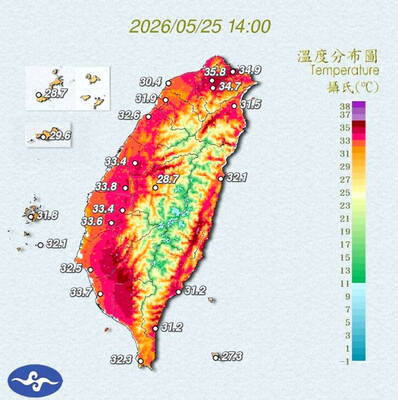
STAY COOL: The HPA recommended that people stay hydrated, use air-conditioning or fans while indoors, wear loose-fitting clothes and walk in the shade while outdoors Employers must implement measures such as installing cooling equipment, and providing drinking water and rest breaks for outdoor workers starting from Monday next week, the Taipei Department of Labor said on Sunday. Employers who fail to comply could face fines of NT$30,000 to NT$300,000 under the Occupational Safety and Health Act (職業安全衛生法), the department said. Businesses in Taipei employing fewer than 100 workers, as well as registered self-employed workers with labor insurance coverage, could receive on-site assessments and guidance from occupational safety consultants to help them apply for central government subsidies to implement or improve heat-protection measures, it said. Under the Ministry of

GLOBALGIVING: ‘ Caving to external pressure is not acceptable for an organization that has cultivated justice reform and human rights for 30 years,’ one NGO said A slew of non-government organizations (NGOs) have withdrawn from the GlobalGiving fundraising platform after it announced it would use “Chinese Taipei” instead of “Taiwan” from next month. The Taiwan Good Rice Association wrote on Facebook on Friday that it was informed on April 28 via a teleconference call of the change, which was made because the platform wanted to operate in China. Taiwan Good Rice is to terminate all cooperative relationships with GlobalGiving in response to the platform’s “unilateral and non-negotiable” decision to remove references to Taiwan, the NGO said. “Taiwan is in the official name of Taiwan Good Rice Association and the

Chinese Nationalist Party (KMT) Chairwoman Cheng Li-wun (鄭麗文) yesterday briefed her party’s Central Standing Committee regarding her scheduled visit to the US between Monday next week and June 16, saying that her purpose would be to persuade the US that the Republic of China (ROC) Constitution was a “one China” constitution that would foster stable and peaceful cross-strait relations. The ROC Constitution is the most important defense for all Taiwanese citizens, as it upholds our democracy and has contributed to our robust economy, which aligns with international and US interests, she said. “We would not be troublemakers and drag the US under,”


 RSS
RSS