


Hundreds of residents and four local self-help associations in Greater Taichung protested against the expropriation of their land in front of the Greater Taichung Government building yesterday.
Residents from Wenshan (文山) in Nantun District (南屯), Jioshe (舊社) in Beitun District (北屯), Dali District (大里), and Shinan (溪南) in Wuri Township (烏日) are facing compulsory land expropriation for the creation of industrial zones and an expansion of the Taichung MRT depot.
The organizer of the rally, Wenshan Industrial District Paoshan Self-Help Association chairperson Huang Kuo-shu (黃國書), said the government planned to seize land, farmland and houses for a price equivalent to about one-fifth of their current market value.
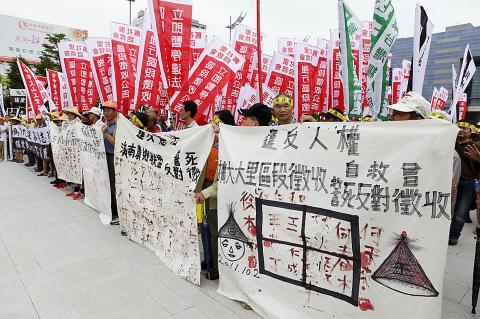
Photo: Chan Chao-yang, Taipei Times
The 193-hectare Wenshan Industrial District will leave farmers with no home and no jobs, Huang said.
People who own more than 1,620m2 of land are to be reimbursed with an equivalent plot of land at a separate location, while farmers are to receive about 40 percent of the size of their original land at another location, Huang said, as their original land, which is closer to the downtown area, would be seized by the government for a new residential zone, forcing them to relocate to more remote areas.
In addition, Huang said residents were worried that part of the industrial district would be designated as a Type A Industrial Zone, which could increase pollution in the area.
The government passed the responsibility of getting approval by the Environmental Protection Administration’s Environmental Impact Assessment to individual landowners, he said.
Taichung MRT Depot Expansion Zone Expropriation Self-Help Association chairperson Chao Chun-an (趙俊安) said hundreds of households would be uprooted as a result of government plans to expand the depot zone from 19 hectares to 85 hectares.
Shinan Self-Help Association chairperson Chang Huan-chang (張煥昌) said more than 10,000 people living in the 500 hectare area faced land expropriation for industrial use.
It is unfair for illegally built factories to become legal after the area is redesignated as an industrial zone, while small farmers will have no way to make a living because they have no resources or ability to establish factories, Chang said, adding that some residents who relied on loans would have no way to pay them back if they were forced to abandon their farms and houses.
The groups urged the central government to respect the residents’ rights to life and employment, as well as property protection as stipulated by the Constitution, and to amend the Land Expropriation Act (土地徵收條例) to avoid distortion of definitions of public benefit, which they say is often used as an excuse for land expropriation.
The groups also urged the city government to halt the land expropriation plans to protect agriculture in Taiwan, adding that food self-sufficiency and environmental protection are becoming increasingly important.

NATIONAL SECURITY: Authorities are working to confirm the identities of the military personnel involved and investigating possible illegal conduct and regulatory violations Authorities are probing possible national security implications after Kinmen police and immigration officers on Sunday found a Chinese woman allegedly posing as a tourist while engaging in prostitution involving more than 10 military personnel. The woman, surnamed Chen (陳), has since been deported, authorities said, adding that investigators are still working to confirm the identities of those implicated, as the records only listed code names and aliases. The case stemmed from a report received by the Kinmen District Prosecutors’ Office on Friday last week from the Jinhu Precinct of the Kinmen County Police Bureau. On Sunday, police, along with the National Immigration

GLOBALGIVING: ‘ Caving to external pressure is not acceptable for an organization that has cultivated justice reform and human rights for 30 years,’ one NGO said A slew of non-government organizations (NGOs) have withdrawn from the GlobalGiving fundraising platform after it announced it would use “Chinese Taipei” instead of “Taiwan” from next month. The Taiwan Good Rice Association wrote on Facebook on Friday that it was informed on April 28 via a teleconference call of the change, which was made because the platform wanted to operate in China. Taiwan Good Rice is to terminate all cooperative relationships with GlobalGiving in response to the platform’s “unilateral and non-negotiable” decision to remove references to Taiwan, the NGO said. “Taiwan is in the official name of Taiwan Good Rice Association and the

HEAVY WEATHER: Typhoon Jangmi is due to crash straight into the Ryukyus as airlines look to shift flights to larger aircraft or cancel flights to Okinawa entirely Taiwan’s international air carriers announced flight adjustments over the weekend as Typhoon Jangmi is forecast to hit the Ryukyu Islands today and tomorrow. The Central Weather Administration (CWA) upgraded Jangmi from a tropical storm to a typhoon at 8am yesterday, with the eye located 580km south of Naha city. It was moving north at 19kph. Today, China Airlines’ CI-120, CI-121, CI-122 and CI-123 flights between Taoyuan and Naha, Okinawa, have been canceled as well as CI-132 and CI-133 between Kaohsiung and Naha. EVA Air’s BR-112, BR-113, BR-186 and BR-185 flights between Taoyuan and Naha are also canceled. Low-cost carrier Tigerair Taiwan canceled IT-230,

Chinese Nationalist Party (KMT) Chairwoman Cheng Li-wun (鄭麗文) yesterday briefed her party’s Central Standing Committee regarding her scheduled visit to the US between Monday next week and June 16, saying that her purpose would be to persuade the US that the Republic of China (ROC) Constitution was a “one China” constitution that would foster stable and peaceful cross-strait relations. The ROC Constitution is the most important defense for all Taiwanese citizens, as it upholds our democracy and has contributed to our robust economy, which aligns with international and US interests, she said. “We would not be troublemakers and drag the US under,”


 RSS
RSS