

Since former Chinese Nationalist Party (KMT) spokesman Su Jun-pin (蘇俊賓) decided to run for a legislative seat about a month ago, hardly a day has passed without the state-owned Central News Agency (CNA) covering his campaign.
The KMT nominated Su as its legislative candidate for the fourth district in Greater Tainan against Hsu Tain-tsair (許添財) of the Democratic Progressive Party (DPP), who was mayor of Tainan City from 2001 to last year, before the city was merged with Tainan county and upgraded into the municipality of Greater Tainan in December last year.
From July 26 to yesterday, CNA ran a total of 35 stories about Su, often with photographs. His name appeared in the headline a total of 19 times and in seven photographs, for reports on his campaign activities, while there were a further seven other reports about his views on various political issues.
Hsu received far less news coverage from CNA and no photographs were published.
A search of the news archive at the national news agency for the same period found that Hsu’s name was mentioned in passing in only eight stories, all of which had nothing whatsoever to do with his campaign.
Of the eight stories in question, three were from the 19 news reports on Su’s campaign in which Hsu was mentioned as his chief rival, the other five were only tangentially related to his election campaign.
CNA reported on Hsu displaying his wedding photographs, talking about his feelings toward his father in a radio interview on Father’s Day, urging voters to help promote the KMT administration and when he went on the campaign trail around the constituency to tout his election policies.
This disproportionate news coverage received by one candidate over another was reminiscent of the treatment received by New Taipei City Mayor Eric Chu (朱立倫) of the KMT when running for the mayorship last year that led to CNA being ridiculed as nothing more than a “pro Chu blog.”
Asked to comment on this situation, Weber Lai (賴祥蔚), head of the graduate school of Applied Media Arts at National Taiwan University of Arts, said that an equal amount of media coverage for all candidates in an election was a principle that needed to be observed by all media outlets during an election, “particularly considering the fact that CNA is a national news agency.”
Hu Yu-wei (胡幼偉), a professor at the Graduate Institute of Mass Communication at National Taiwan Normal University, also emphasized the importance of -candidates being treated fairly in the media because that is how most people get to know the candidates and their platforms.
The inherent bias of Taiwanese media outlets as they target their own specific audience and select content favorable to specific political viewpoints is a problem not just with CNA, but almost all media in Taiwan, Hu said.
Hu called on CNA, as a national news agency, to take the lead in presenting balanced reporting on the views of legislative candidates on issues of national interest.
CNA had not yet responded to the Taipei Times’ query as of press time last night.
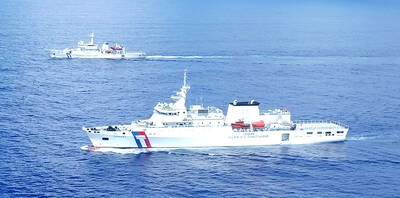
‘FRIENDSHIP FLEET’: A CGA official is scheduled to meet with the president of the Pacific nation, while one of the ships is to host a banquet and National Day event Two Coast Guard Administration (CGA) patrol vessels have docked at Malakal Harbor in Palau as part of an expedition exercise and diplomatic visit, during which a senior official is expected to meet with Palauan President Surangel Whipps Jr, the agency said yesterday. The two vessels, the 4,000-tonne-class Chiayi and the 1,000-tonne-class Penghu, set sail for Palau from Taiwan last week and arrived on Tuesday at Malakal Harbor, the CGA’s Fleet Branch said in a statement. The journey marks the second time the CGA has dispatched a “friendship fleet” to another country, after it sent its first-ever goodwill fleet, comprising the Hualien and
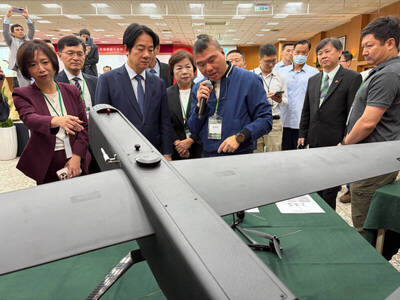
Two executives of drone supplier Jiin Ming Industry Co (錦明實業) have been detained and held incommunicado over the company's alleged use of prohibited China-made chips and camera lenses in drones supplied under recent military contracts, the Taoyuan District Prosecutors' Office said today. In a statement, prosecutors said they raided the offices of Jiin Ming — headquartered in Taoyuan — as well as those of its subsidiaries and its suppliers on Thursday last week. The raids followed a report that the company had breached its procurement contracts by putting the prohibited components into drones delivered to the military. During the raids, prosecutors summoned
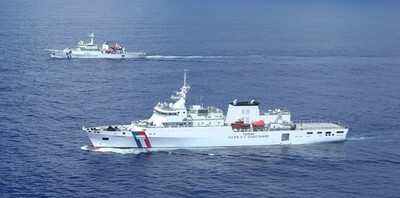
The Coast Guard Administration (CGA) today said that two of its patrol vessels have docked at Palau's Malakal Harbor as part of an expedition exercise and diplomatic visit, during which a senior official is expected to meet with the Palauan president. The two vessels, the 4,000-tonne-class Chiayi (嘉義) and the 1,000-tonne-class Penghu (澎湖), set sail for Palau from Taiwan last week and arrived at Malakal Harbor yesterday, the CGA's Fleet Branch said in a statement. The journey marked the second time the CGA has dispatched a "Friendship Fleet" to another country, after it sent its first-ever goodwill fleet, comprising the Hualien (花蓮)
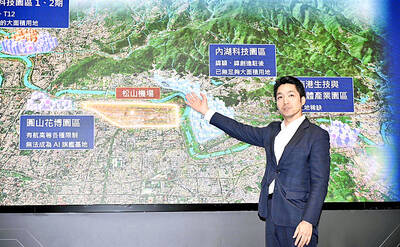
DETAILED PLAN NEEDED: Relocating the airport would affect not just travelers, but also undermine national defense and emergency medical services, a legislator said Taipei Mayor Chiang Wan-an (蔣萬安) yesterday proposed relocating Taipei International Airport (Songshan airport) and turning the site into an artificial intelligence (AI) park, drawing opposition from politicians across party lines. Chiang’s plan would turn the 300 hectares into an AI park featuring tech clusters, residential communities and green space. The industrial cluster would host 200 domestic enterprises, generate NT$12 trillion (US$376.47 billion) in output, and accommodate 65,000 jobs and 35,000 residents, he said. Cabinet spokeswoman Michelle Lee (李慧芝) said the Executive Yuan was surprised by the announcement, as the Taipei City Government did not discuss the proposal with the central government before making


 RSS
RSS