


Residents of Mailiao Township (麥寮), Yunlin County, are planning to rally at Formosa Plastics Group’s petrochemical complex tomorrow to reiterate their demand for an immediate halt to operations at the fire-stricken facility. Hsu Liu-pin (許留賓), a township representative, said yesterday that an estimated 300 residents would deliver their appeal to company officials.
Besides demanding a full suspension of operations, Hsu said the protesters would demand that Formosa Plastics Group put forward an evacuation plan so that locals could keep away from danger zones should similar accidents occur again.
Hsu was referring to the two blazes that broke out at the nation’s largest petrochemical complex last week, the sixth and seventh fires there in a year.
Following Monday’s protest by residents of Taisi (台西), Baojhong (褒忠), Dongshih (東勢) and Lunbei (崙背) — all townships surrounding the complex — Hsu said the new protest would be an “ultimatum” to the company.
“If they fail to give us the answer we want, we will launch a long-term battle against them,” he said.
Hsu said the protests would become better organized, larger and more intense until the operations of the complex become impossible.
For instance, Hsu said, local residents would not rule out occupying streets surrounding the complex to enforce massive road closures in the area.
Meanwhile, environmentalists urged the government yesterday to speed up the promotion of higher-value petrochemical production in Taiwan in the wake of the fires at the complex.
Blaming the fires on gas leaks from aging pipelines, the activists said the government should help the industry shift its focus away from a scale-oriented mode of production that tends to put a heavy burden on facilities and equipment.
“It [sectional shutdown] is only healing the head when there’s a headache and healing the foot when the foot aches. We think it [the Mailiao plant] needs a thorough inspection to prevent future problems,” Taiwan Environmental Protection Union Changhua Division deputy-director Tsai Chia-yang (蔡嘉陽) said.
Tsai said the government should take the opportunity to review the policy toward the industry and shut down or shrink the scale of inappropriate plants.
“Only low-value petrochemicals can be yielded under such a practice [of employing larger-scale plants],” said Chan Chang-chuan (詹長權), a professor of occupational medicine and industrial hygiene at National Taiwan University. “Taiwan cannot continue with this model because it is both uneconomical and harmful to the environment.”
Instead, Chan said, Taiwan should increase the added value of its petrochemical products at home, while working with global partners to pursue production on a massive scale.
In June, the Ministry of Economic Affairs established a goal of helping the local petrochemical industry increase its value-added rate to 20 percent by 2020.
Before that goal is met, some environmentalists said, the government should also consider the possibility of relocating part of the Mailiao operations to Greater Kaohsiung, where environmental conditions are considered more suitable for concentrated petrochemical production.
“The problems of land subsidence and water shortage are especially severe in central Taiwan,” Tsai said. “The government needs to revise its strategy for national spatial development so that resources can be allocated wisely.”

FUKUOKA SITUATION: Japanese media reported that the pathogen is expected to be identified by the summer, while the CDC downplayed the idea that it was hMPV A “mysterious cold-like illness” reported in Japan’s Fukuoka Prefecture does not seem to be a new disease, but Japanese authorities have been asked about the situation, the Centers for Disease Control (CDC) said yesterday. The Fukuoka Prefectural Medical Association on Wednesday told a news conference that a “mystery cold” that has become a hot topic on social media is “highly likely to be caused by some kind of viral infection,” Japan’s KBC News reported. “Many people are experiencing symptoms starting with a sore throat, followed by a runny nose, phlegm and a severe cough,” KBC News reported, citing association officials. Health authorities are

Nvidia Corp CEO Jensen Huang (黃仁勳) arrived in Taiwan yesterday ahead of upcoming AI and technology events, saying he plans to meet with clients and Taiwan Semiconductor Manufacturing Co Chairman C.C. Wei (魏哲家) during his visit. After landing at Taipei Songshan Airport, Huang posed for photos with fans and handed out Yakult drinks to reporters and supporters waiting at the scene, saying he has “a lot to do” during the trip. Asked about reports that Nvidia’s planned headquarters site in Taipei’s Beitou Shilin Technology Park could break ground on May 27, Huang said that if the company holds an event, he would

The Ministry of Finance this afternoon announced the winning numbers for the March-April uniform invoice lottery. The winning number for the NT$10 million (US$318,060) special prize is 19531471, and the winning number for the NT$2 million grand prize is 85941329. Three numbers were drawn for the NT$200,000 first prize: 07225810, 20231230 and 83518781. Those with receipts matching the last seven digits of any of the first-prize numbers will win the NT$40,000 second prize, while those matching the last six digits will win the NT$10,000 third prize. Those whose receipts match the last five digits of the first-prize numbers can claim the NT$4,000 fourth prize,
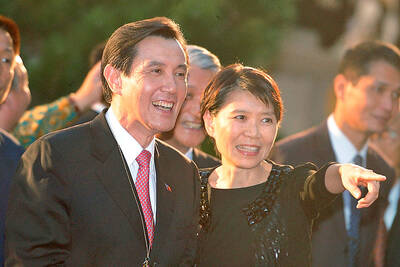
Former president Ma Ying-jeou (馬英九) yesterday expressed “shock and regret” over a statement issued by his wife without his consent, and rejected her assertion that his eldest sister, Ma Yi-nan (馬以南), would manage his medical care or act as his spokesperson amid an ongoing embezzlement probe into his foundation. Ma Ying-jeou in a statement said he was shocked by a statement by his wife, Chou Mei-ching (周美青), regarding his affairs. Ma Yi-nan “must not” be in charge of his healthcare and other personal affairs, nor can she be allowed to represent the Ma family, the former president said. He said he was also


 RSS
RSS