


Campaigning for office in 2008, President Ma Ying-jeou (馬英九) promised an economic windfall of US$2 billion a year by opening the gates to Chinese tourism. If the Tourism Bureau is to be believed, Ma has achieved precisely that as he heads into elections in January for a possible second term.
However, interviews with industry officials and Taiwanese tour operators, as well as an examination of China’s Taiwan tour packages, suggest that the figure has been overstated by at least US$700 million. Questions about the accuracy of the government’s claims could prove embarrassing to Ma as campaigning heats up.
Tourism has been a big part of Ma’s push to deepen links with China and his re-election campaign is expected to once again tout the benefits of hitching Taiwan’s economy to China’s lucrative markets.
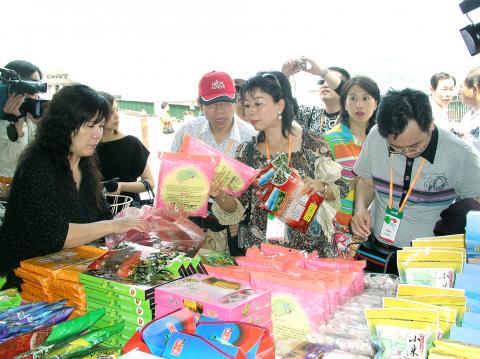
Photo: Chen Hsin-jen, Taipei Times
While trade between the sides and Taiwanese investment in China has flourished for the past two decades, Chinese visitors were mostly kept at arm’s length until Ma took office in 2008.
Ma reversed his predecessor’s more careful policy on China, initially sanctioning 300 Chinese arrivals a day. Until late last month, when the first individual visitors crossed the 160km wide Taiwan Strait, all tourists had to come on tour packages.
Alice Chen of the Tourism Bureau said the Chinese tourist influx has meant big money for Taiwan.
Last year, about 1.16 million Chinese tourists spent NT$59.1 billion (US$2 billion) in Taiwan, providing a substantial boost for an industry long in the doldrums, the Tourism Bureau says.
The bureau’s figures, Chen says, were collated on the basis of interviews at airports with just 1,896 of the 1 million-plus Chinese visitors, rather than relying on hard data from vendors of tourist services — hotels, restaurants, shopping venues and the like.
In response to a query, Ma spokesman Fan Chiang Tai-chi (范姜泰基) referred reporters back to the Tourism Bureau, whose deputy director-general Wayne Liu (劉喜臨) repeatedly refused interview requests.
Chen said she could not explain the discrepancies.
On the Taiwanese side, tour operators say they are taking the brunt of the China revenue shortfall, operating at a loss and churning tourists through shops that promise hefty commissions on sales to claw back some profit.
The government estimates that Chinese tourists spent an average of US$246 a day in Taiwan last year. That was made up of US$142 for shopping and US$104 for the services that are provided by tour package operators — hotels, meals, local transportation, venue admission and incidentals.
However, an examination of tour package prices shows they are much lower than the government’s estimate and tour operators say that, at best, they get half of the money Chinese tourists pay to Chinese tour agencies for these tours.
That amounts to at least a US$700 million hole in the government figure.
On top of that, it is likely that some of the money Chinese tourists spend on shopping is ending up in Hong Kong, where the owners of some of the major Taiwanese shopping outlets are based.
And at least until recently, a ruse involving special credit card readers that disguised the true location of purchases meant the government was cheated out of sales tax from Chinese tourists. Taiwanese authorities are now investigating this practice.
The typical tour of Taiwan lasts eight days and costs between 3,700 and 8,000 yuan (US$574 to US$1,240), depending on airfare from the Chinese point of embarkation.
Tours that leave from Fujian Province, China, which is directly across the Strait, provide a good benchmark for working out the tour package cost excluding airfares. Spread over eight days — and assuming US$100 for transportation across the Strait — the package averages out to US$60 per day.
Taiwanese tour operators say their Chinese counterparts now offer them as little US$20 per tourist per day, which is far below the US$50 to US$55 they say they are spending to procure hotel rooms, meals and other services for their Chinese customers.
This is forcing operators to provide substandard tours, said Fauzy Wu, an official at Taiwan International Tour Manager Development Association, who once supported closer tourist links with China.
These feature cut-rate hotels, greasy spoon meals, endless bus rides from one out-of-the-way hotel to the next, and non-stop visits to glitzy shopping venues that promise high commissions of as much as 50 percent to operators.
“Chinese tourists are getting up earlier than roosters, eating worse than pigs and are totally exhausted from spending most of their days on intercity buses,” Wu said.
Democratic Progressive Party (DPP) Chairperson Tsai Ing-wen (蔡英文) says that Ma and the Chinese Nationalist Party (KMT) have sold Taiwan short in their bid to draw Taiwan’s economy ever closer to China’s. The tourism problems could buttress those arguments.
They might also be problematic for China. Beijing is far more partial to Ma than the DPP, which it reviles for its theoretical stand in favor of Taiwanese independence.
The Taiwanese operators say their current business model has been foisted on them by tour -operators from Hong Kong.
These Hong Kong operators comprise only 13 of the 300 operators that Taiwan’s government sanctions to receive Chinese tourists in Taiwan, but rake in 50 percent of the profits.
Local operators say their Hong Kong counterparts have leveraged their familiarity with the Chinese tourist market and the lack of restrictions placed upon them by Taiwan’s government to dominate business.
“Hong Kong has the worst group tour business model,” said travel agency proprietor Hsu Chin-rui, who is also chairman of a cross-strait travel association. “We do not welcome their agents here.”
Hsu says the problems with Chinese tourism don’t end there.
At least half of the 164 Chinese tour agencies allowed to sign up customers to visit Taiwan have poor payment records and Taiwanese tour operators are owed about NT$5 billion.
The Tourism Bureau says it is powerless to fix the situation.
Taiwanese tour guide Jack Lee complained about the late payments and said they were having a knock-on effect on tour guides like himself, as Taiwanese agencies were failing to pay subcontractors on time.
“I myself am owed NT$300,000,” Lee said. “And there are many others like me.”
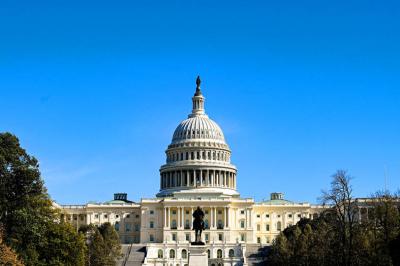
The US House of Representatives yesterday passed the PROTECT Taiwan Act, which stipulates that Washington would exclude China from participating in major global financial organizations if its actions directly threaten Taiwan’s security. The bill, proposed by Republican US Representative Frank Lucas, passed with 395 votes in favor and two against. It stipulates that if China’s actions pose any threat to Taiwan’s security, economic or social systems, the US would, “to the maximum extent practicable,” exclude China from international financial institutions, including the G20, the Bank for International Settlements and the Financial Stability Board. The bill makes it clear that China
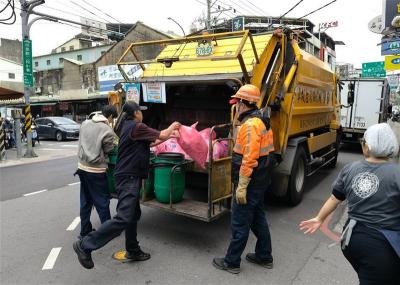
Garbage and recycling schedules are to vary from Saturday through Sunday next week over the Lunar New Year holiday period. The following collection information is from the governments of the six special municipalities. Taipei Regular service: Sunday to Monday next week. No service: Tuesday to Thursday next week. Extra service: Friday next week. Regular service resumes: Saturday next week. New Taipei City Extra service: Sunday. Adjusted collection time: Monday next week — garbage collection is to begin in the morning and end at 6pm. No service: Tuesday to Thursday next week. Regular service resumes: Friday next week. Note: Garbage can be dropped off at 70
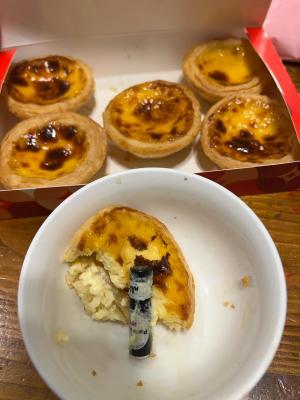
A KFC branch in Kaohsiung may be fined between NT$60,000 and NT$200 million (US$1,907 and US$6.37 million), after a customer yesterday found an entire AAA battery inside an egg tart, the Kaohsiung Department of Health said today. The customer was about to microwave a box of egg tarts they had bought at the fast-food restaurant’s Nanzih (楠梓) branch when they checked the bottom and saw a dark shadow inside one of them, they said in a Threads post. The customer filmed themself taking the egg tart apart to reveal an entire AAA battery inside, which apparently showed signs of damage. Surveillance footage showed
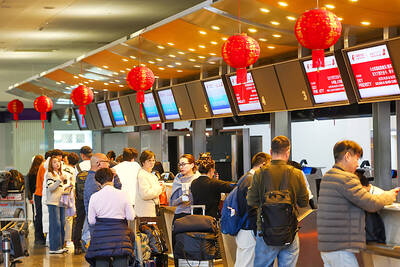
GROUP EFFORT: The number of inbound travelers rose 11 to 12 percent last month, with a significant increase in tourists from Europe and North America, an official said The government aims to attract 9.4 million visitors this year, the Tourism Administration said yesterday, citing last year’s success in diversifying tourist markets. Taiwan last year drew about 8.57 million international arrivals, 72.3 percent of pre-COVID-19 levels. By contrast, the nation had about 18.94 million outbound tourists last year, surpassing the pre-COVID-19 level of 17.1 million. The estimated tourism revenue deficit was about NT$700.9 billion (US$22.22 billion). Taoyuan International Airport Corp expects more than 160,000 passengers to pass through the nation’s largest airport daily during the Lunar New Year holiday, which begins on Saturday. As of Jan. 30, the nation’s average hotel occupancy rate


 RSS
RSS