


The Ministry of Transportation and Communications said yesterday it would determine who was responsible for allowing the illegal intrusion of a female passenger into the Taiwan Taoyuan International Airport’s restricted area after reviewing a report by Taoyuan International Airport Corp (TIA).
“The TIA has conducted a comprehensive inspection on the restricted area after the event and identified the locations that need to be reinforced,” said Chi Wen-jong (祁文中), director of the Department of Aviation and Navigation, adding the company also held a meeting yesterday with representatives from the Aviation Police, China Airlines and the Taiwan Taoyuan International Airport Service.
The security of the nation’s largest airport was tested on Thursday after a 48-year-old woman entered the airport’s restricted area through a crack between a cement wall and barbed wire and eventually boarded a China Airlines aircraft. She was not found until the cabin crew of the aircraft conducted a routine inspection before takeoff.
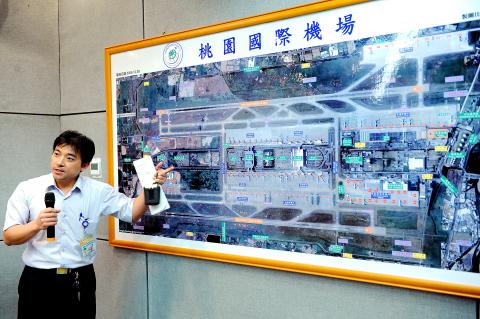
Photo: Chu Pei-hsiung, Taipei Times
TIA president Samuel Lin (林鵬良) said he was “shocked” to hear of the event and decided to do an on-site inspection with the Aviation Police yesterday morning, in which the team found several flaws in Taoyuan airport’s security.
They found the ground at the bottom of the barbed wire appeared to have subsided in two different places.
Lin said the officials suspected that the intruder might have sneaked into the restricted area through one of these two places. He said that the airport set up two layers of security on its north side, including a 2.5m high barbed wire fence as a barrier outside and a 3m high cement wall on the inside. There are also 0.5m high razor wire obstacles on top of these two barriers, he said.
He added that a small passage used by maintenance staff was located between the two barriers, which does not have a door or barrier to restrict access. While the jet bridge has an access control system preventing passengers coming through the terminal from going down to the airport ramp, Lin said that the bridge was not equipped with a similar system that could stop those going up from the ramp to the jet bridge.
Lin said the inspection team also found that the aircraft that the intruder boarded landed at 12:44am and the crew members finished cleaning the cabins and their other procedures at 2:23am.
“The crewmembers were supposed to tell the maintenance operation center to close the cabin door and remove the jet bridge after they were done, but they didn’t,” Lin said. “So the intruder was able to enter the cabin at 3:31am.”
Lin said that the intruder drove a ladder truck used by the ground crew, who left the key in the ignition, adding that this violated airport security regulations.
Many asked why the control tower failed to notice the truck since its radar can detect a moving object on the taxiway.
Air Navigation and Weather Service Deputy Director Chien Yuan-lin (錢元琳) said the motorized vehicles used by the ground crew are equipped with transponders if the vehicles are meant to operate on the taxiways.
“The ladder truck is not supposed to appear on the taxiway, so it does not have a transponder,” Chien said.
Chien said that rather than appearing as a straight line, the lack of transponder made the truck look like an isolated dot on the radar screen, which could easily be overlooked.
In light of the event, Chien said they would inform the TIA whenever they found any unusual signal on the radar screen.
According to Chien, the unauthorized passenger drove on the 1.8km taxiway from 3:25am to 3:29am.
Prior to her arrival, there were two cargo flights using the runway: One departed at 3:14am and the other landed at 3:18am.

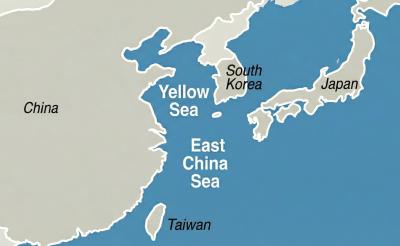
China has reserved offshore airspace in the Yellow Sea and East China Sea from March 27 to May 6, issuing alerts usually used to warn of military exercises, although no such exercises have been announced, the Wall Street Journal (WSJ) reported yesterday. Reserving such a large area for 40 days without explanation is an “unusual step,” as military exercises normally only last a few days, the paper said. These alerts, known as Notice to Air Missions (Notams), “are intended to inform pilots and aviation authorities of temporary airspace hazards or restrictions,” the article said. The airspace reserved in the alert is

South Korea is planning to revise its controversial electronic arrival card, a step Taiwanese officials said prompted them to hold off on planned retaliatory measures, a South Korean media report said yesterday. A Yonhap News Agency report said that the South Korean Ministry of Foreign Affairs is planning to remove the “previous departure place” and “next destination” fields from its e-arrival card system. The plan, reached after interagency consultations, is under review and aims to simplify entry procedures and align the electronic form with the paper version, a South Korean ministry official said. The fields — which appeared only on the electronic form

A bipartisan group of US senators has introduced a bill to enhance cooperation with Taiwan on drone development and to reduce reliance on supply chains linked to China. The proposed Blue Skies for Taiwan Act of 2026 was introduced by Republican US senators Ted Cruz and John Curtis, and Democratic US senators Jeff Merkley and Andy Kim. The legislation seeks to ease constraints on Taiwan-US cooperation in uncrewed aerial systems (UAS), including dependence on China-sourced components, limited access to capital and regulatory barriers under US export controls, a news release issued by Cruz on Wednesday said. The bill would establish a "Blue UAS
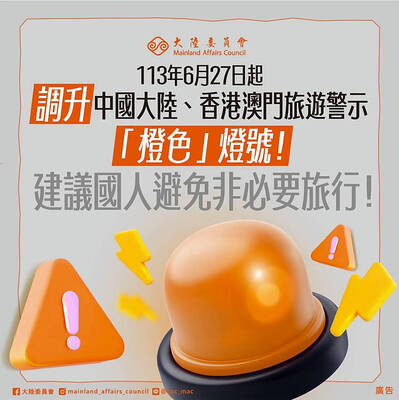
More than 6,000 Taiwanese students have participated in exchange programs in China over the past two years, despite the Mainland Affairs Council’s (MAC) “orange light” travel advisory, government records showed. The MAC’s publicly available registry showed that Taiwanese college and university students who went on exchange programs across the Strait numbered 3,592 and 2,966 people respectively. The National Immigration Agency data revealed that 2,296 and 2,551 Chinese students visited Taiwan for study in the same two years. A review of the Web sites of publicly-run universities and colleges showed that Taiwanese higher education institutions continued to recruit students for Chinese educational programs without


 RSS
RSS