


A 25-year-old medical school student who was working as an intern at a Greater Tainan hospital was found dead last week after being on shift for 36 straight hours without rest.
Lin Yen-ting (林彥廷), a student at Kaohsiung Medical University, had been interning at National Cheng Kung University Hospital since last June. He left his dormitory for work on the morning of April 25, then worked the nightshift that day and continued working until 8pm the following evening.
Back in his dormitory, he fell down in the bathroom and was rushed to the hospital on the morning of April 27, where he was later pronounced dead.
In the Taiwanese education system, medical students must complete a six-year undergraduate course at university and then spend a final seventh year as hospital interns before graduation.
Seventh-year students have to work the same hours as residents and physicians, meaning they have to work an average of 12 hours a day and cover night shifts every three days, for very little salary.
“My brother was so young and all of a sudden he died. What am I supposed to do with his death?” his sister Lin Yi-shan (林逸姍) said at a press conference on Wednesday organized by Chinese Nationalist Party (KMT) Legislator Cheng Ju-fen (鄭汝芬)
Cheng said the medical intern system was in desperate need of reform. Medical students have long been a “gray area,” where the Ministry of Education, the Department of Health and the Council of Labor Affairs have overlapping responsibilities, the lawmaker said.
“It takes a long time to train a good doctor and the loss of an intern means we have lost a potentially good physician,” Cheng said.
Medical students are not eligible for labor insurance, nor do they receive work subsidies when an incident like this happens, the legislator said.
Lin’s family will only receive NT$1 million (US$35,000) compensation from a student insurance policy.
Lai Chi-wan (賴其萬), an official at the education ministry, said that starting in the 2013 academic year, medical students would no longer be required to finish their internship before graduation. The internship will begin after graduation, when they will be better protected by law, Lai said.
Government agencies would work together to map out policies to prevent a similar incident, Lai said, adding: “We have to make something positive from such a tragedy.”

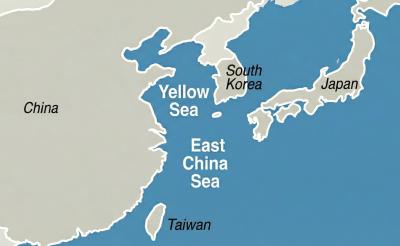
China has reserved offshore airspace in the Yellow Sea and East China Sea from March 27 to May 6, issuing alerts usually used to warn of military exercises, although no such exercises have been announced, the Wall Street Journal (WSJ) reported yesterday. Reserving such a large area for 40 days without explanation is an “unusual step,” as military exercises normally only last a few days, the paper said. These alerts, known as Notice to Air Missions (Notams), “are intended to inform pilots and aviation authorities of temporary airspace hazards or restrictions,” the article said. The airspace reserved in the alert is
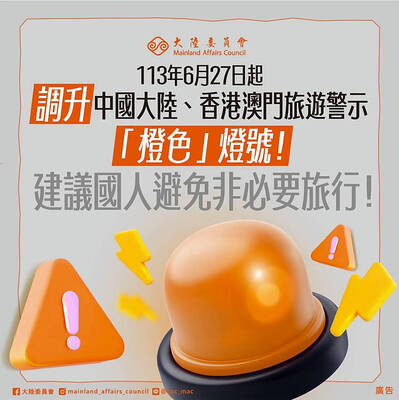
More than 6,000 Taiwanese students have participated in exchange programs in China over the past two years, despite the Mainland Affairs Council’s (MAC) “orange light” travel advisory, government records showed. The MAC’s publicly available registry showed that Taiwanese college and university students who went on exchange programs across the Strait numbered 3,592 and 2,966 people respectively. The National Immigration Agency data revealed that 2,296 and 2,551 Chinese students visited Taiwan for study in the same two years. A review of the Web sites of publicly-run universities and colleges showed that Taiwanese higher education institutions continued to recruit students for Chinese educational programs without

A bipartisan group of US senators has introduced a bill to enhance cooperation with Taiwan on drone development and to reduce reliance on supply chains linked to China. The proposed Blue Skies for Taiwan Act of 2026 was introduced by Republican US senators Ted Cruz and John Curtis, and Democratic US senators Jeff Merkley and Andy Kim. The legislation seeks to ease constraints on Taiwan-US cooperation in uncrewed aerial systems (UAS), including dependence on China-sourced components, limited access to capital and regulatory barriers under US export controls, a news release issued by Cruz on Wednesday said. The bill would establish a "Blue UAS
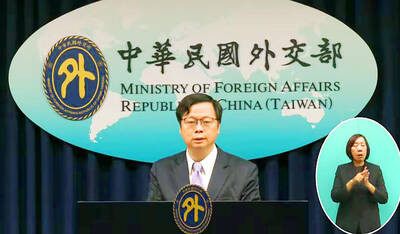
NAMING SPAT: The foreign ministry called on Denmark to propose an acceptable solution to the erroneous nationality used for Taiwanese on residence permits Taiwan has revoked some privileges for Danish diplomatic staff over a Danish permit that lists “Taiwan” as “China,” Eric Huang (黃鈞耀), head of the Ministry of Foreign Affairs’ Department of European Affairs, told a news conference in Taipei yesterday. Reporters asked Huang whether the Danish government had responded to the ministry’s request that it correct the nationality on Danish residence permits of Taiwanese, which has been listed as “China” since 2024. Taiwan’s representative office in Denmark continues to communicate with the Danish government, and the ministry has revoked some privileges previously granted to Danish representatives in Taiwan and would continue to review


 RSS
RSS