


Following President Ma Ying-jeou’s (馬英九) opposition to the construction of a petrochemical complex on wetlands along the coast of Changhua County on Friday, Minister of the Interior (MOI) Jiang Yi-huah (江宜樺) announced that the ministry would soon begin the process to turn the area into a nature reserve.
“I have asked the Construction and Planning Agency [CPA] to begin negotiating with the local government to turn the coastal wetlands in Changhua County into a nature reserve,” Jiang said in a press release yesterday. “If everything goes smoothly, we hope to hold the first expert meeting in two weeks to plan the wetlands park.”
The announcement came one day after Ma voiced his opposition to Kuokuang Petrochemical Technology Co’s plan to build a petrochemical complex in the wetlands because of strong opposition from local residents, environmental groups and university students from around the country.
Jiang said in the statement that he has asked the CPA to launch a detailed survey of the ecosystem in the Changhua County wetlands as it seeks to reach a consensus with the local government.
“Since 2007, the ministry has declared more than 82 sites across the country protected wetlands of different degrees, covering as many as 56.8 hectares ... because we recognize that wetlands are an important mechanism in preserving animal species, purifying water, economic production, stabilizing the coastline, as well as in tourism,” Jiang said.
Environmental and ecological groups recommended that the Changhua wetlands be placed on the list of protected wetlands in 2007 and 2008. However, when the CPA published the latest list of wetlands to be protected as natural reserves in January, the Changhua wetlands were not named.
The CPA said at the time that the Changhua wetlands were not listed because the county government was opposed to it, drawing criticism from environmentalists and ecologists who said the Changhua wetlands — the largest remaining coastal wetlands in the country — were “sacrificed” because of the Kuokuang project.
The Changhua wetlands are an important habitat for many endangered bird species and the endangered humpback dolphin, it is also an important production region for farm-raised oysters.
CPA Director-General Yeh Shih-wen (葉世文) yesterday said the agency would contact academics and ecological experts to see when it would be convenient for them to attend a meeting before setting a date.
Asked whether he anticipated the county government to again oppose the area being placed on the protected wetland list, he said: “I really cannot say at the moment since we have not talked to the local government yet.”

The military has spotted two Chinese warships operating in waters near Penghu County in the Taiwan Strait and sent its own naval and air forces to monitor the vessels, the Ministry of National Defense (MND) said. Beijing sends warships and warplanes into the waters and skies around Taiwan on an almost daily basis, drawing condemnation from Taipei. While the ministry offers daily updates on the locations of Chinese military aircraft, it only rarely gives details of where Chinese warships are operating, generally only when it detects aircraft carriers, as happened last week. A Chinese destroyer and a frigate entered waters to the southwest
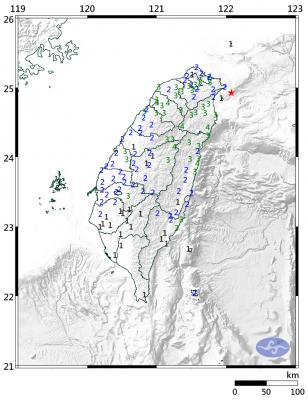
A magnitude 6.1 earthquake struck off the coast of Yilan County at 8:39pm tonight, the Central Weather Administration (CWA) said, with no immediate reports of damage or injuries. The epicenter was 38.7km east-northeast of Yilan County Hall at a focal depth of 98.3km, the CWA’s Seismological Center said. The quake’s maximum intensity, which gauges the actual physical effect of a seismic event, was a level 4 on Taiwan’s 7-tier intensity scale, the center said. That intensity level was recorded in Yilan County’s Nanao Township (南澳), Hsinchu County’s Guansi Township (關西), Nantou County’s Hehuanshan (合歡山) and Hualien County’s Yanliao (鹽寮). An intensity of 3 was

Japanese Prime Minister Sanae Takaichi’s comment last year on Tokyo’s potential reaction to a Taiwan-China conflict has forced Beijing to rewrite its invasion plans, a retired Japanese general said. Takaichi told the Diet on Nov. 7 last year that a Chinese naval blockade or military attack on Taiwan could constitute a “survival-threatening situation” for Japan, potentially allowing Tokyo to exercise its right to collective self-defense. Former Japan Ground Self-Defense Force general Kiyofumi Ogawa said in a recent speech that the remark has been interpreted as meaning Japan could intervene in the early stages of a Taiwan Strait conflict, undermining China’s previous assumptions

Taiwan Railways Corp (TRC) today announced that Shin Kong Mitsukoshi has been selected as the preferred bidder to operate the Taipei Railway Station shopping mall, replacing the current operator, Breeze Development Co Ltd. Among eight qualified firms that delivered presentations and were evaluated by a review committee, Shin Kong Mitsukoshi was ranked first, while Breeze was named the runner-up, the rail company said in a statement. Contract negotiations are to proceed in accordance with regulations, it said, adding that if negotiations with the top bidder fail, it could invite the second-ranked applicant to enter talks. Breeze in a statement today expressed doubts over


 RSS
RSS