


Canadian firm CAE has been awarded a contract to design and manufacture a flight simulator and tactical trainer for the P-3C “Orion” maritime patrol aircraft Taiwan has purchased from the US, the company announced in a March 23 press release.
Under the terms of the contract, CAE will design and manufacture a P-3C operational flight trainer (OFT) as well as a P-3C operational tactics trainer (OTT). The P-3C OFT will be a Level D equivalent flight simulator and used to train the pilots and co-pilots of Taiwan’s P-3C Orion maritime patrol aircraft, the press release said. The P-3C OTT will be used to train the sensor operators in the P-3C aircraft.
Both training devices are scheduled for delivery in 2014.
The deal is part of a series of contracts signed by CAE, a leading provider of simulation and modeling technologies and integrated training solutions for the aviation industry and defense community, with the US Navy valued at more than US$100 million.
Taiwan procured 12 P-3C aircraft from the US for US$1.9 billion in 2007 following a six-year delay stemming from political infighting and questions over the estimated cost of US$300 million per new plane. Instead, Taiwan opted for the purchase of 12 refurbished aircraft. US firm Lockheed Martin was awarded the contract to refurbish the P-3Cs, sold as Excess Defense Articles. The first aircraft is scheduled for delivery to Taiwanese training units in the US in June, Defense News said, with the other 11 to be delivered this year and next.
The P-3Cs, which will play an essential role in anti-submarine warfare, are to replace Taiwan’s aging Grumman S-2T Turbo Trackers acquired in the 1980s. According to Defense News, only a handful of the S-2Ts in the Taiwanese Navy’s lineup are still operational and none are mission capable.
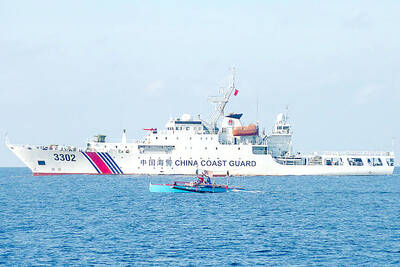
EXPANSIONIST: China deploys an average of 40 to 50 warships and coast guard vessels daily in the South China Sea, despite pledges not to militarize the region, an official said China is attempting to expand its influence across the First Island Chain and increase pressure on Japan by sending coast guard vessels into waters off of Taiwan under the pretext of maritime negotiations with Japan and the Philippines, a national security official said yesterday. China’s recent actions in the waters east of Taiwan and Japan and the Philippines’ exclusive economic zones (EEZ) are attempts to establish dominance in First Island Chain waters, said the official who declined to be named, adding that this is “expansion disguised as law enforcement.” Framing China’s actions solely as a cross-strait issue is a serious misjudgment that
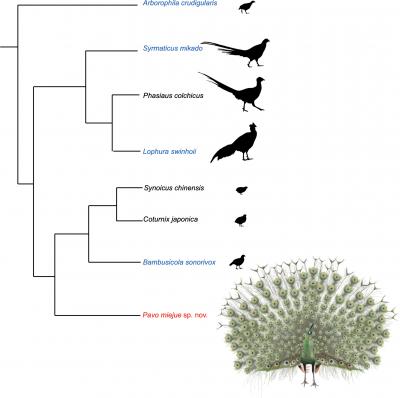
Through analyzing fossil evidence, a research team at National Taiwan University (NTU) discovered the largest endemic bird to have lived in Taiwan, naming it Pavo miejue, or extinct peafowl (滅絕孔雀). The Mikado pheasant, which is printed on the back of the NT$1,000 bank note, was previously believed to be the biggest endemic bird to Taiwan. The research team’s findings suggest that Pavo miejue lived during the Pleistocene epoch tens of thousands of years ago. It is the first endemic extinct bird species discovered and formally named in Taiwan. The study was coauthored by NTU Institute of Ecology and Evolutionary Biology professor Tsai Cheng-hsiu (蔡政修),
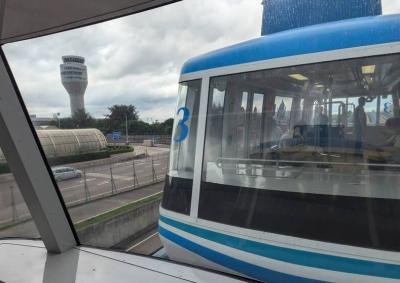
Taiwan Taoyuan International Airport is to suspend its automated Skytrain service connecting Terminal 1 and Terminal 2 starting on July 1 to facilitate connection works for the upcoming Terminal 3, the airport operator said today. Passengers and staff who need to travel between the two terminals after the suspension can instead use the Taoyuan MRT or the airport's 24-hour shuttle bus service, Taoyuan International Airport Corp said. The Taoyuan MRT Airport Line directly links the two terminals, while the shuttle buses are to operate around the clock, the company added. The Skytrain provides free transportation between the airport’s two terminals for travelers and
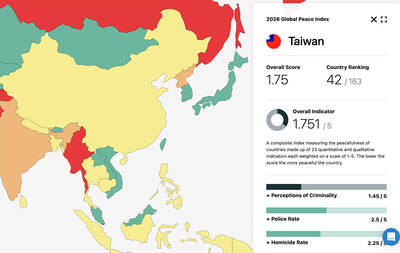
Taiwan ranked 42nd in terms of peacefulness among 163 countries, down five places from last year, according to this year’s Global Peace Index. With an overall score of 1.751, Taiwan dropped from 37th last year, the report published by the global Institute for Economics and Peace showed. The overall score measures a country’s level of peacefulness using 23 quantitative and qualitative indicators across three domains — ongoing domestic and international conflict, societal safety and security, and militarization. While Taiwan ranked 42nd worldwide, it was listed in ninth place among the 19 Asian-Pacific countries in the report, after New Zealand, Singapore, Japan, Malaysia,


 RSS
RSS