


The Chinese Nationalist Party (KMT) yesterday elected 32 Central Standing Committee (CSC) members, calling back several former members who had their election status revoked last year because of bribery claims.
Lee Chuan-chiao (李全教), one of those who lost his election status as a CSC member last year because of election bribery, received 1,079 votes and topped the election list.
He had denied the bribery accusations and filed a lawsuit against the KMT last year for annulling his election status, and won the lawsuit earlier this year.
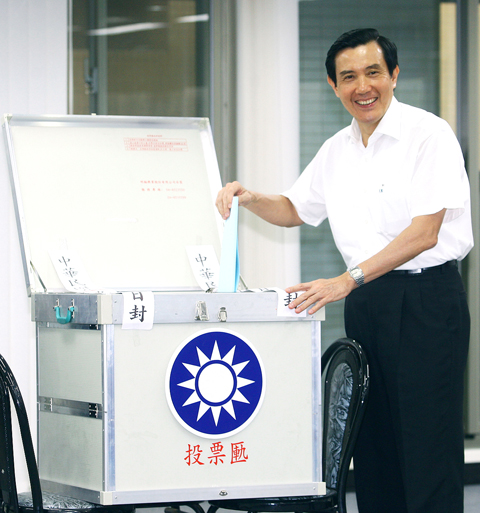
PHOTO: CNA
Lee will take over as a KMT legislator once the KMT revokes the party membership of former KMT legislator Hsu Shu-po (許舒博), who was found guilty earlier this month in a second trial of accepting bribes from the National Chinese Herbal Apothecary Association.
Yao Jiang-lin (姚江臨), who was one of 12 former CSC members whose election status were revoked by the KMT last year, received the third-highest number of votes with 1,040.
Two other former CSC members whose election status was revoked, Hsu Sen-rong (許顯榮) and Chen Wen-han (陳文漢), were also elected yesterday.
The majority of CSC members are KMT lawmakers, as a total of 13 KMT legislators, including Chiu Yi (邱毅), Chang Hsien-yao (張顯耀) and Hou Tsai-feng (侯彩鳳), won seats in the election yesterday.
KMT Legislator Wu Yu-sheng (吳育昇), a long-term aide to President Ma Ying-jeou (馬英九), failed to secure a seat in yesterday’s election.
KMT’s Kaohsiung mayoral candidate Huang Chao-hsun (黃昭順) and Sean Lien (連勝文), son of former KMT chairman Lien Chan (連戰), did not seek re-election this year.
In his capacity as KMT chairman, Ma yesterday cast a vote in the CSC election and said the vicious tradition of bribery in CSC elections had abated in this year’s election.
Seeking to eliminate the bribery tradition and improve the image of the party, the KMT tightened regulations on CSC election campaigns in May and banned all kinds of bribery, including hosting banquets and sending gifts. Candidates who violate the regulations face losing their party membership.
Director of the KMT’s Evaluation and Discipline Committee Juan Kang-meng (阮剛猛) said the committee found that no candidates were involved in bribing party delegates in this year’s election campaign.
The CSC is the highest decision-making body in the KMT, and its 32 members meet every Wednesday to approve major policies. However, the committee’s role was weakened after Ma was first elected party chairman in 2005 and began meeting with party officials to discuss major decisions in a separate weekly meeting.
All members will formally assume the positions next Wednesday.

More than half of the bamboo vipers captured in Tainan in the past few years were found in the city’s Sinhua District (新化), while other districts had smaller catches or none at all. Every year, Tainan captures about 6,000 snakes which have made their way into people’s homes. Of the six major venomous snakes in Taiwan, the cobra, the many-banded krait, the brown-spotted pit viper and the bamboo viper are the most frequently captured. The high concentration of bamboo vipers captured in Sinhua District is puzzling. Tainan Agriculture Bureau Forestry and Nature Conservation Division head Chu Chien-ming (朱健明) earlier this week said that the
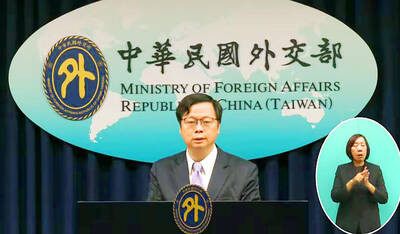
NAMING SPAT: The foreign ministry called on Denmark to propose an acceptable solution to the erroneous nationality used for Taiwanese on residence permits Taiwan has revoked some privileges for Danish diplomatic staff over a Danish permit that lists “Taiwan” as “China,” Eric Huang (黃鈞耀), head of the Ministry of Foreign Affairs’ Department of European Affairs, told a news conference in Taipei yesterday. Reporters asked Huang whether the Danish government had responded to the ministry’s request that it correct the nationality on Danish residence permits of Taiwanese, which has been listed as “China” since 2024. Taiwan’s representative office in Denmark continues to communicate with the Danish government, and the ministry has revoked some privileges previously granted to Danish representatives in Taiwan and would continue to review

The first bluefin tuna of the season, brought to shore in Pingtung County and weighing 190kg, was yesterday auctioned for NT$10,600 (US$333.5) per kilogram, setting a record high for the local market. The auction was held at the fish market in Donggang Fishing Harbor, where the Siaoliouciou Island-registered fishing vessel Fu Yu Ching No. 2 delivered the “Pingtung First Tuna” it had caught for bidding. Bidding was intense, and the tuna was ultimately jointly purchased by a local restaurant and a local company for NT$10,600 per kilogram — NT$300 ,more than last year — for a total of NT$2.014 million. The 67-year-old skipper

China has reserved offshore airspace over the Yellow Sea and East China Sea from March 27 to May 6, issuing alerts that are usually used to warn of military exercises, although no such exercises have been announced, the Wall Street Journal (WSJ) reported on Sunday. Reserving such a large area for 40 days without explanation is an “unusual step,” as military exercises normally only last a few days, the paper said. The alerts, known as notice to air missions (NOTAMs), “are intended to inform pilots and aviation authorities of temporary airspace hazards or restrictions,” the article said. The airspace reserved in the alert


 RSS
RSS